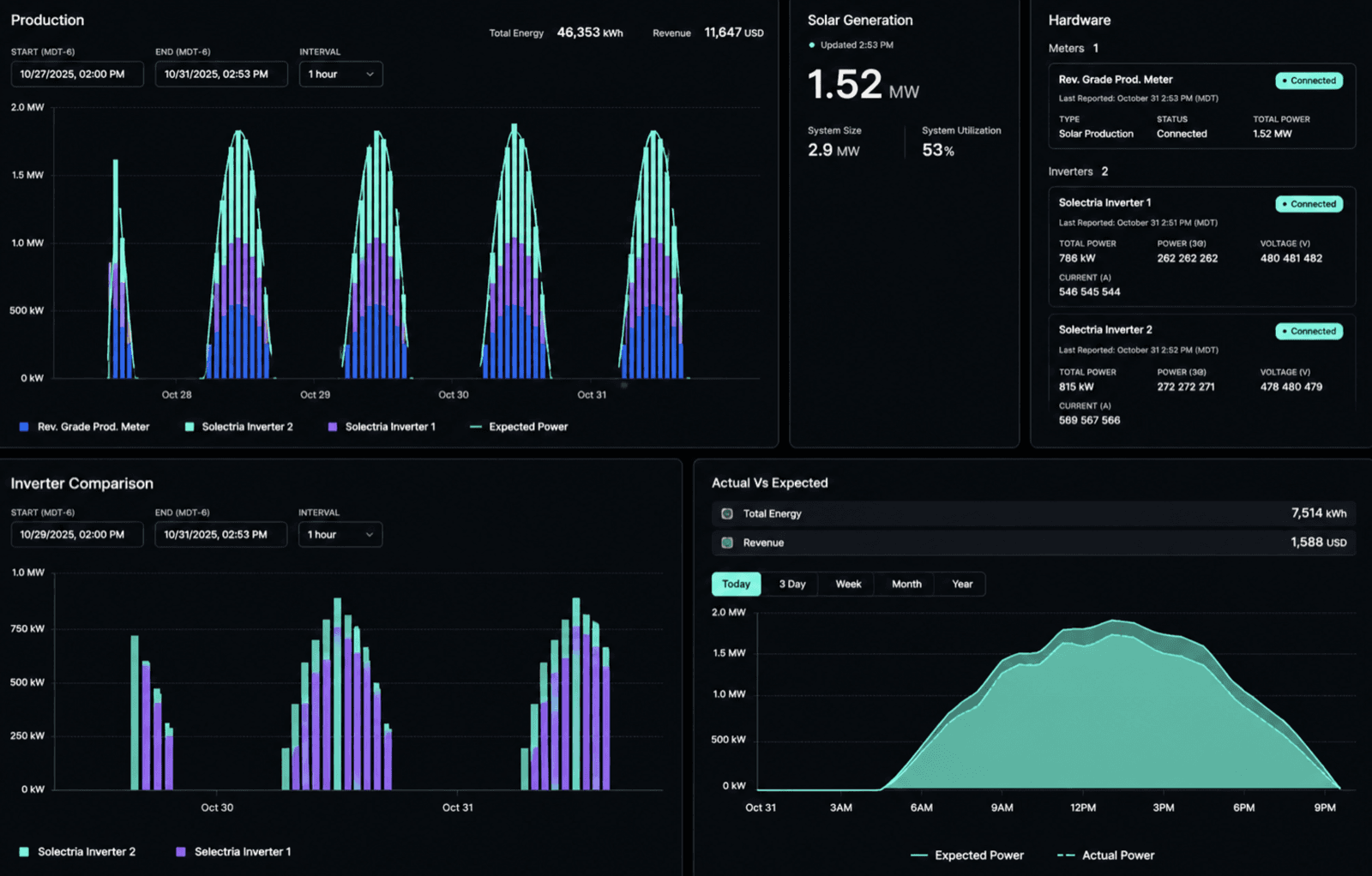
A solar energy management system (solar EMS) is the software platform that monitors, analyzes, and optimizes solar power generation. Basic inverter monitoring can tell you whether panels are producing; a solar EMS tells you whether they are producing what they should, why they are not, and what the site should do about it, from individual string data up to portfolio wide analytics.
This guide explains what a solar EMS does, how performance verification works, and what separates a real platform from the free portal that came with the inverters.
What does a solar EMS do?
Real time monitoring
A solar EMS collects high resolution data, WATTMORE's Intellect EnFORM samples at 30 second granularity, from every component on site: inverters, combiners, meters, weather stations, trackers, and transformers. Operators see production, irradiance, temperature, and equipment status in real time, across every manufacturer, in one place.
Performance verification
Production numbers alone cannot tell you whether a plant is healthy: 1 MW output might be excellent on an overcast morning and alarming at solar noon. Performance verification compares actual production against expected production computed from measured irradiance. The industry standard for this discipline is IEC 61724, which defines monitoring practice and the performance ratio metric that normalizes output for the weather the site actually received (IEC 61724). A solar EMS automates the comparison continuously and flags deviations while they are still cheap to fix.
Fault detection and alerting
String outages, stuck trackers, failed fans, communication losses, and drifting sensors each cost energy quietly. The EMS detects anomalies against expected behavior, raises tiered alarms, and gives operations the evidence to dispatch the right fix, a discipline covered in our solar monitoring best practices guide.
Load management and grid compliance
Behind the meter, the EMS manages the interaction between solar production, site load, and the grid: optimizing self consumption, honoring export limits, and meeting interconnection requirements such as power factor, voltage support, and curtailment response.
Battery coordination
In solar plus storage systems the solar EMS works with the battery EMS to shift midday surplus into evening load, manage demand peaks, and keep the combined system inside its interconnection limits. Our 303 Battery field report shows the pattern running unattended: solar captured through the day, discharged into the evening, with zero export to the grid.
Why the losses are worth finding
The financial case for a solar EMS is the energy that leaks away when nobody is measuring. Soiling, dust, pollen, and ash on modules, commonly costs several percent of annual energy and varies widely by region and season; NREL's soiling research documents both the scale and the variability (NREL soiling research). Equipment problems add more: a single failed string on a commercial roof can go unnoticed for months behind a green status light, and degradation above the expected rate compounds year over year. None of these announce themselves. They are found by comparing measured output to expected output, which is precisely the job of the EMS.
The arithmetic is simple: on a plant earning six figures a year, a few percent of silent loss pays for serious monitoring many times over, and the loss found in month one instead of month twelve is worth eleven months of energy.
Solar EMS versus inverter monitoring
Most inverter manufacturers include a monitoring portal. The limitations show up at portfolio scale:
- Single vendor view: portals show their own equipment; a mixed fleet needs as many portals as brands
- Coarse data: five to fifteen minute intervals hide transients that 30 second data reveals
- No independent measurement: without site irradiance the portal cannot compute performance ratio, so underperformance hides inside weather
- No integration: weather stations, meters, trackers, and batteries live outside the portal's world
A dedicated solar energy management system integrates every equipment type, protocol, and manufacturer into one platform with analytics on top. That vendor agnostic breadth is also what makes a fleet dispatchable later: the same platform that monitors a thousand sites can aggregate them into a virtual power plant.
What to look for in a solar EMS
- Vendor agnostic device support across Modbus, DNP3, MQTT, and REST
- 30 second data with store and forward logging so outages never leave gaps
- Measured irradiance, sensors specified per ISO 9060, feeding automated performance ratio per IEC 61724
- Tiered alarming tuned to avoid alert fatigue
- Portfolio benchmarking, automated reporting, and open data export
- A path to control: export limiting, grid compliance, and battery coordination when the site needs them
WATTMORE's Intellect EnFORM is built to this checklist and runs across mixed fleets today. Contact us to see it on your portfolio.