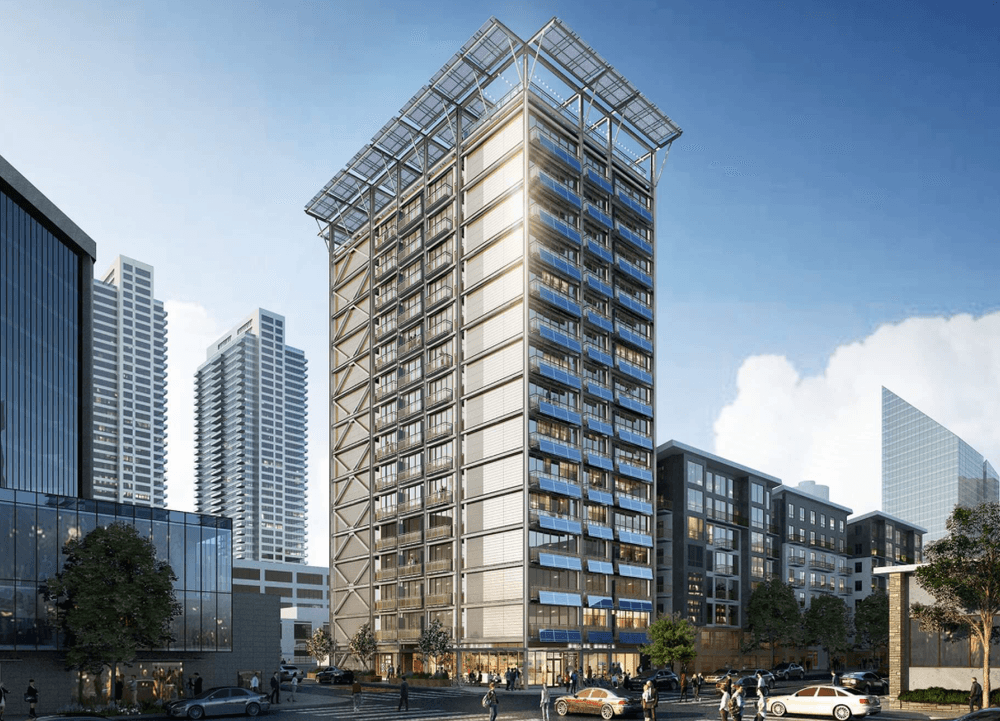
For seventeen months, a battery storage system at a Seattle apartment community ran itself. At 303 Battery, a residential tower in Belltown wrapped in solar, WATTMORE’s Intellect Operate ran a disciplined daily rhythm: capturing on-site solar through the day and discharging into the building’s evening load, all without operator intervention.
Over that period the battery delivered 41.0 MWh back to the building across 311 clean daily cycles, held a firm 20% reserve floor every night, and ensured zero energy was exported to the grid. Round-trip efficiency held at 76% across all active days, and 80% on nominal cycling days.
The asset

303 Battery, a residential apartment tower in Seattle’s Belltown neighborhood with rooftop and façade PV.
303 Battery is wrapped in solar and crowned by a rooftop PV canopy. On site, a battery energy storage system pairs with that solar to reshape how the building draws power, shifting clean daytime energy into the evening and trimming peak demand on the grid. The storage system is built on a Delta 125 kW power conversion system and three Blue Planet LXHV battery cabinets, all orchestrated by Intellect Operate.
- Power conversion system: Delta 125 kW PCS
- Battery: Blue Planet LXHV
- Configuration: 3 cabinets × 32 modules
- Module energy: 2 kWh × 96
- Total storage capacity: 192 kWh (125 kW)
How Intellect Operate runs the site
A roughly five-second control loop balances three battery strings, drives state-of-charge toward a daily schedule, and coordinates one PCS with the building’s PV inverters, vendor-agnostic, autonomous, no operator in the loop.
Daytime · solar window: load-level to schedule
Through the day the EMS drives the battery toward a rising state-of-charge target, ~80% by 3 PM, 100% by 6 PM, soaking up solar to level the net load. It never charges from the grid.
Daytime · safeguard: prevent export
The EMS curtails the Ap Systems micro PV inverters to hold net grid load above 20 kW; a fast safety loop charges the battery if net load nears zero, so power never flows backward. Preventing reverse power flow is a hard requirement at this site.
Evening · overnight: shift to evening
From its evening peak the battery discharges through the night, back toward ~20% by morning, leveling the building load. It won’t discharge while solar is still producing.
Mid-month · upkeep: recalibrate
On the 15th of each month the EMS charges the pack to 100% and holds for five minutes to re-anchor state-of-charge.
Results at a glance
Over 17 months, Intellect Operate turned 303 Battery into a dependable, self-running daily asset, capturing solar, shifting it into the evening, and protecting the grid connection without any operator involvement.
- Energy discharged: 41.0 MWh to the building load (~203 full cycles)
- Solar on-site: 128 MWh with zero net export
- Daily cycles: 311 clean cycling days
- Round-trip efficiency: 80% on nominal days (76% across all active days)
- Evening peak: −17%, roughly 21 kW shaved
Zero export, by design
Preventing reverse power flow is this project’s core requirement. On the sunniest days, on-site solar climbs toward the building’s own demand, on 5 June 2025 the site came within 3.6 kW of exporting. Intellect Operate holds the line with a two-layer safeguard.
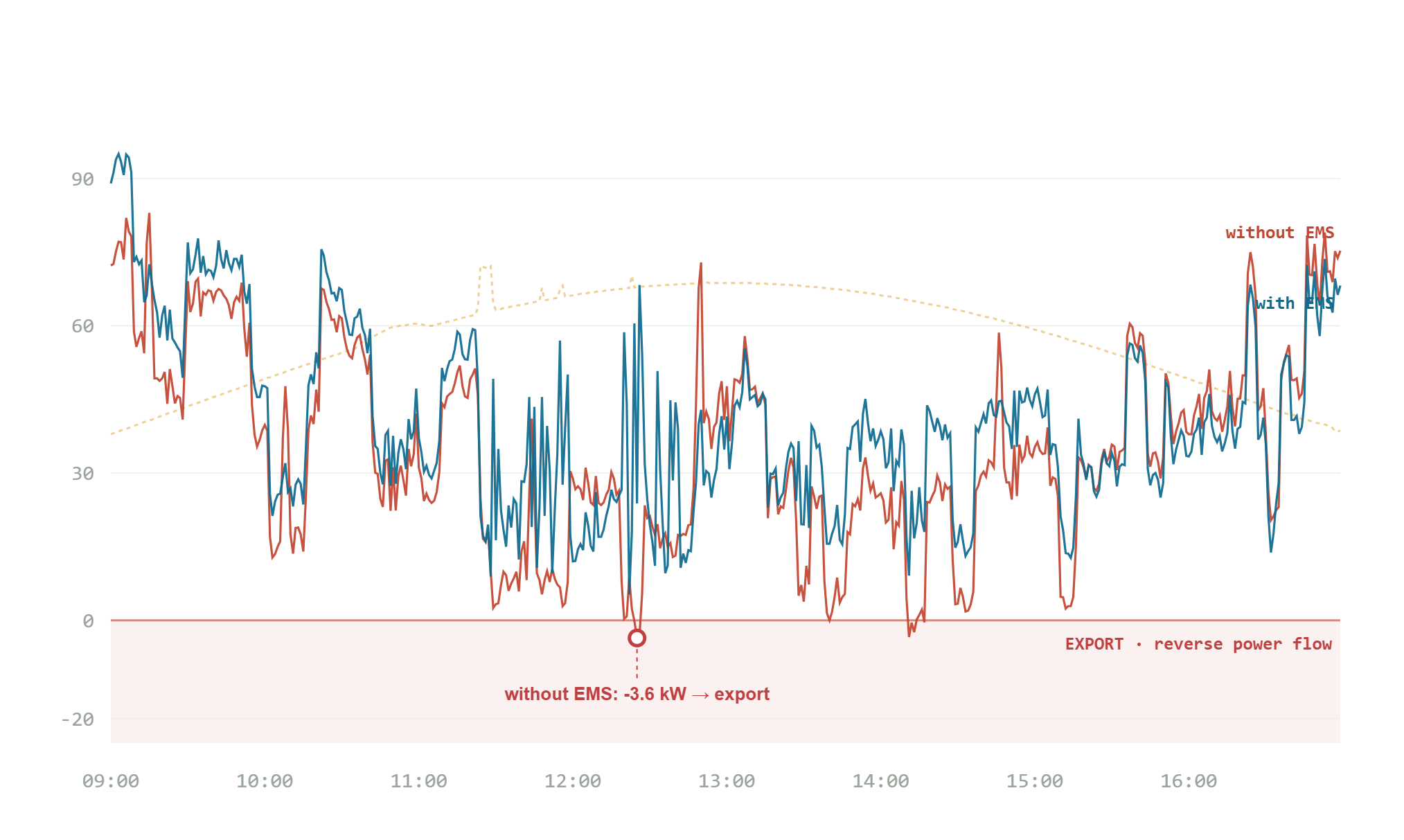
A high-solar day, 5 Jun 2025. With PV de-curtailed to its true potential the building’s net load would dip to −3.6 kW at midday; Intellect Operate absorbs and curtails to hold the meter positive.
- Layer 1 · absorb: the EMS charges the batteries on a daily schedule, soaking up solar so it lifts the net load rather than exporting.
- Layer 2 · curtail: it curtails the PV inverters to keep net grid load above 20 kW; a fast loop tops up the battery if it nears zero.
The result: 0 kWh exported across 482 days.
Anatomy of a day
Averaged across all nominal days, the battery sits near its 20% floor at dawn, charges through the midday solar window to ~84%, then discharges into the evening and overnight load.
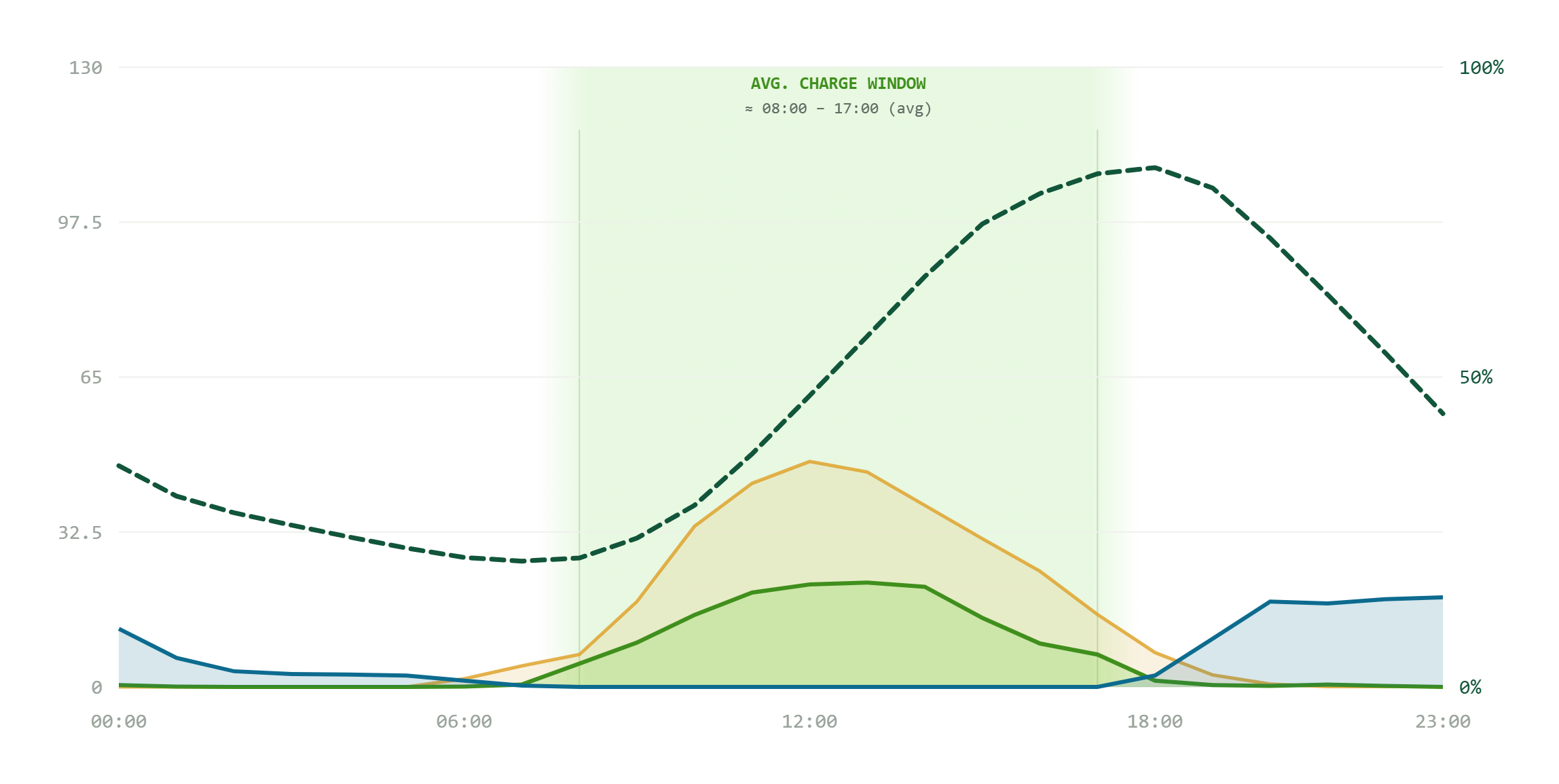
The average 24-hour profile, battery power (left axis) and state of charge (right axis), averaged across nominal days.
- Charge window: 08:00 to 17:00, just after sunrise to before sunset
- SOC swing: 20→84%, with a firm reserve floor held nightly
- Evening discharge: 118 kWh average energy into the peak
Performance through the seasons
Performance tracks the sun. In summer, abundant solar lets the battery charge to ~89% daily; through winter, shorter, dimmer days cap the ceiling near 60 to 70%. The system stores what’s available and still holds its 20% floor every night.
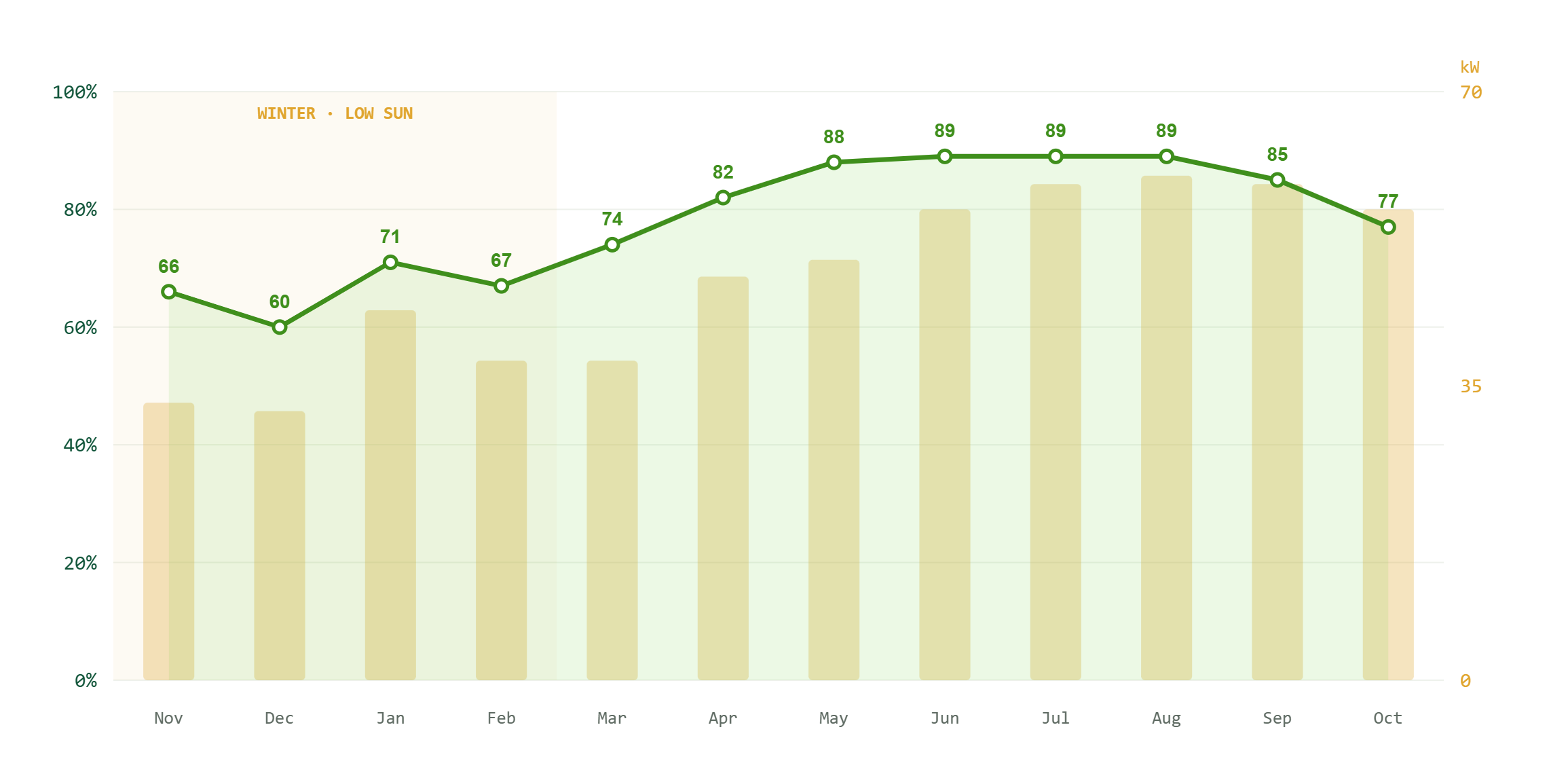
Monthly charge ceiling vs. available solar, Nov 2024 to Oct 2025. Each point is that month’s average daily peak SOC; bars show average midday solar power available.
Clean energy, kept on-site
Solar output swings from winter lows to summer peaks, but because building demand consistently exceeds PV, every kilowatt-hour was consumed on site, displacing grid energy and avoiding an estimated ~37 tonnes of CO₂.
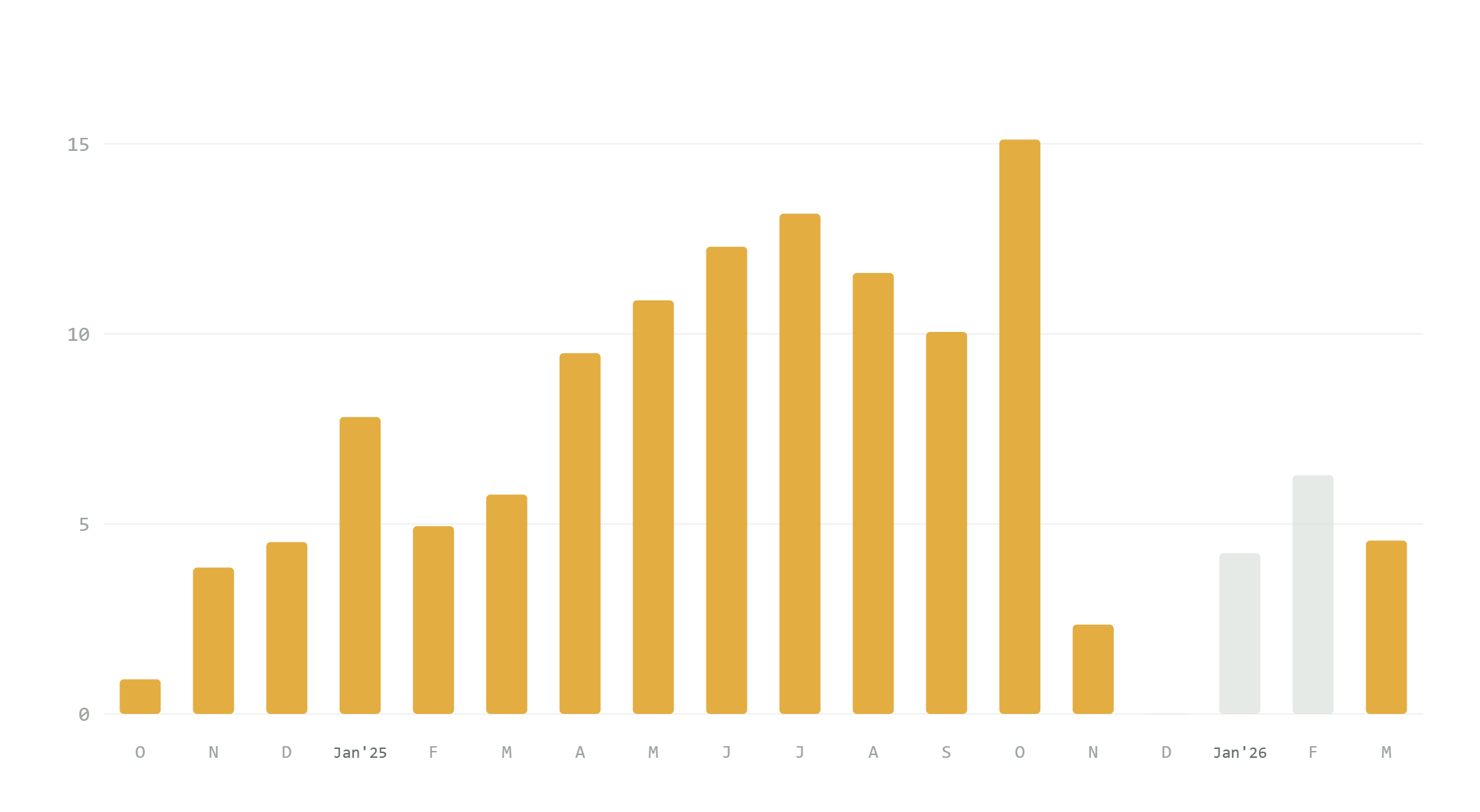
Solar energy harvested per month, all consumed on-site. Faded bars indicate reduced-operation months.
- Solar delivered: 128 MWh over the full period
- Self-consumed: 100%, every kWh used on site
- Of building load: 60% self-supplied by on-site solar
Peak shaving and load shifting
As solar peaks, Intellect Operate pulls midday grid draw down from ~111 kW to ~74 kW, a 37 kW cut. Stored energy then re-emerges in the evening, flattening the daily grid profile and trimming the costly evening peak.
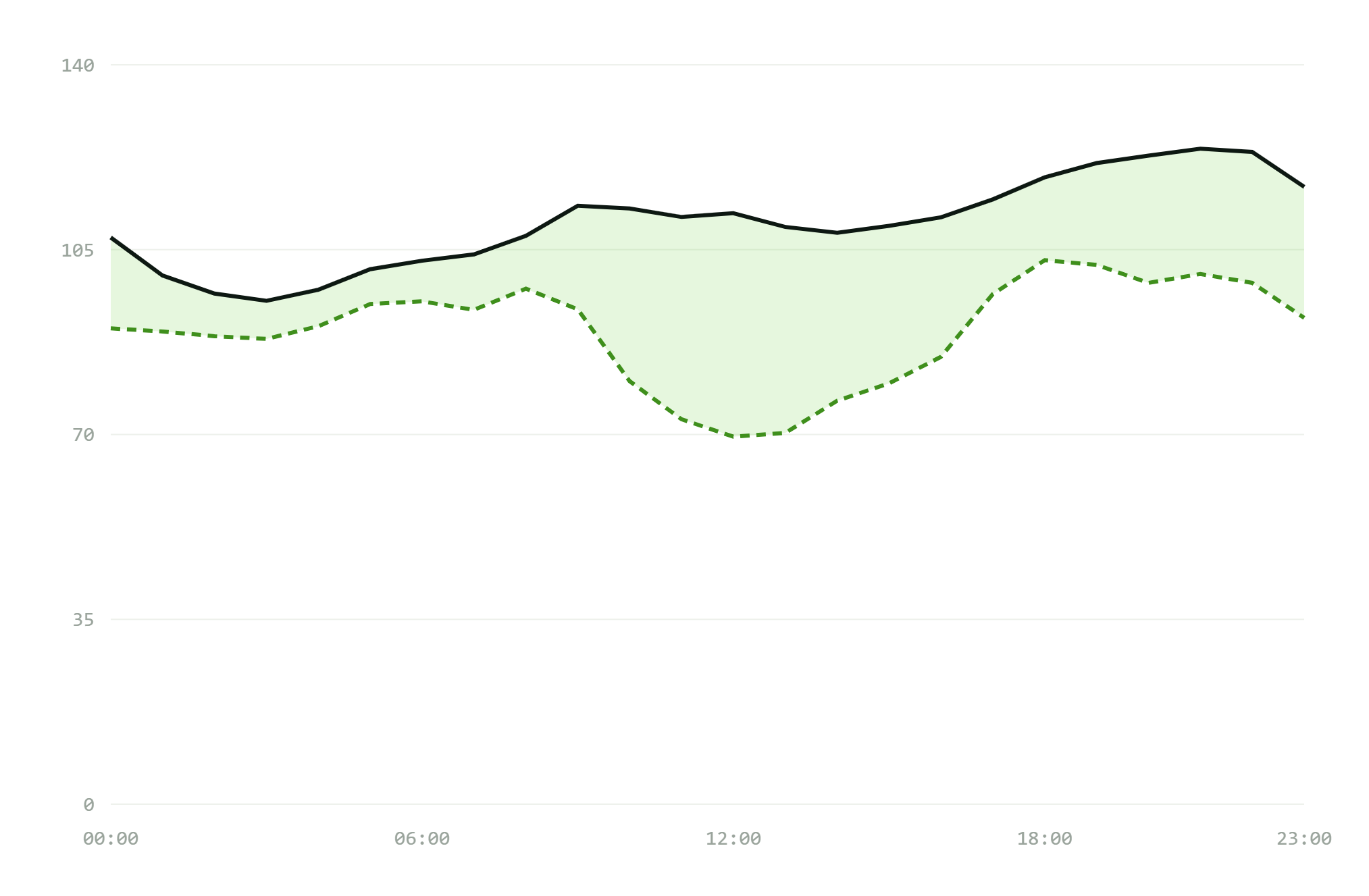
Building load vs. grid draw on an average day. The shaded gap is demand met by solar and battery instead of the grid.
- Midday grid demand: 33% lower
- Evening peak: −17%, ~21 kW trimmed
- Shifted daily: 118 kWh from midday into the evening
Reliable, continuous operation
For almost a year, from 22 October 2024 to 17 October 2025, a run of 357 days, Intellect Operate cycled the battery every single day without interruption: autonomously, with no operator in the loop and no reserve-floor breaches. Across the full 17 months it ran on 83% of days; a maintenance period over winter 2025/26 accounts for the rest, after which the EMS resumed normal cycling on its own.
- Availability: 83% across 17 months
- Cycles delivered: 311 with zero floor breaches
- Recovery: automatic, with no manual restart
In summary
- Intellect Operate cycled the battery on 311 clean days over 17 months, a predictable daily pattern with no reserve-floor breaches.
- It moved 41 MWh into the evening at 76 to 80% efficiency and shaved 17% off the grid peak.
- All 128 MWh of solar stayed on-site, zero export, enforced automatically.
- The same platform scales across sites and asset types, one report, with many projects to follow.
Intellect Operate is WATTMORE’s platform for energy management, power-plant control, and dispatch for solar and storage, vendor-agnostic, edge-to-cloud, and autonomous. Contact WATTMORE to discuss storage operations for your site.