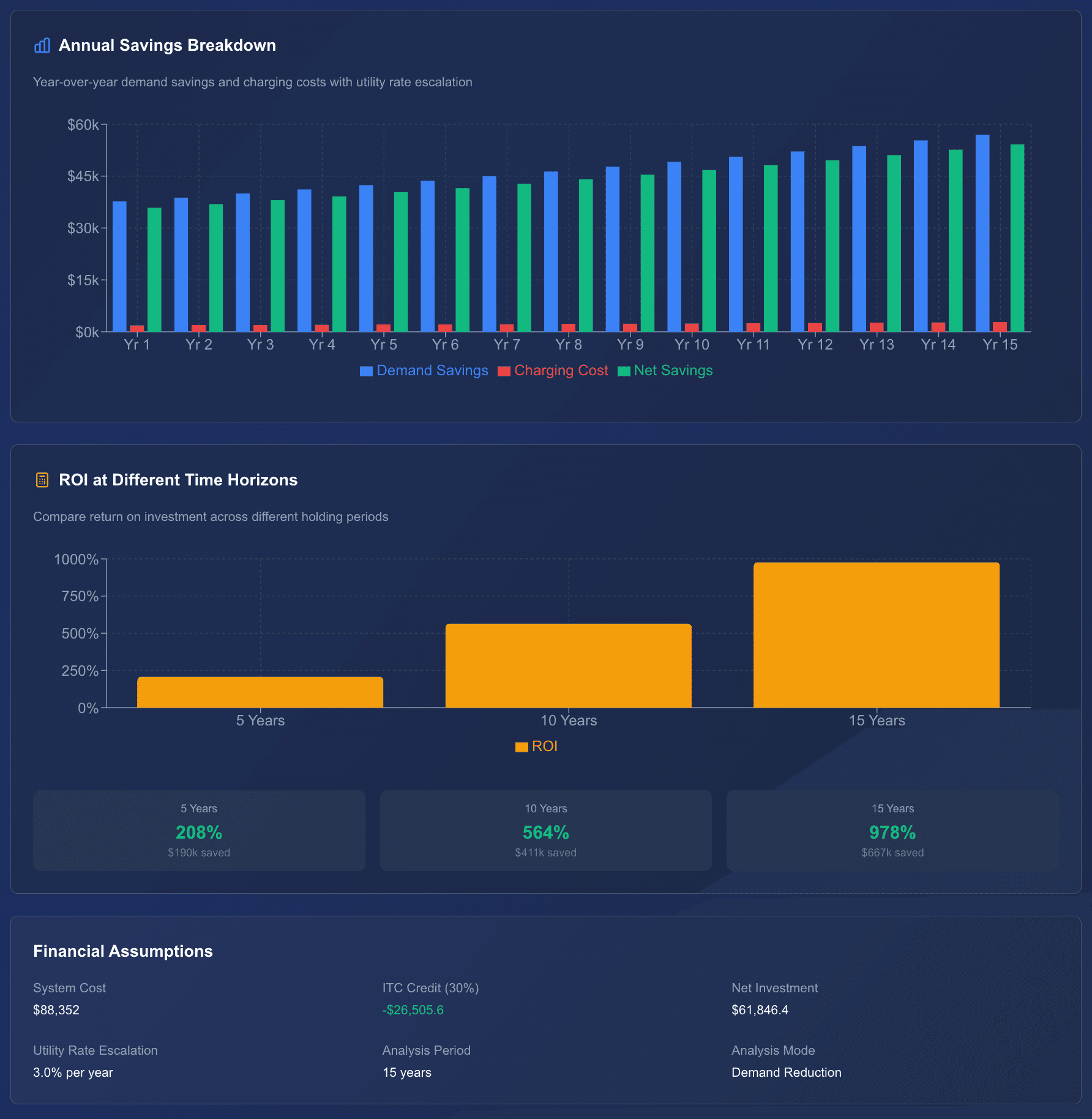
Ask three vendors what a battery energy storage system costs and you will get three numbers, all of them incomplete. Not because anyone is lying, but because the number they quote is the price of the equipment, and the price of the equipment is a small part of the cost of owning it for twenty years.
A storage asset is not a purchase. It is a twenty year operating commitment with a tax profile, a fuel bill, a maintenance schedule, a mid life capital event, and a performance curve that bends downward every year whether anyone is watching it or not. The projects that disappoint their owners are almost never the ones that failed. They are the ones that performed exactly as the equipment allowed, measured against a model that never accounted for what ownership actually costs.
The price of the system is not the cost of the system
The industry benchmarks make the gap obvious. Lazard's 2025 levelized cost of storage analysis puts a 100 MW, four hour standalone system between $115 and $254 per MWh delivered, and a 1 MW, two hour commercial and industrial system between $319 and $506 per MWh. That is a spread of nearly $200 per MWh on the same nameplate hardware. Equipment price is not what separates the low end from the high end. Charging cost, efficiency, degradation, maintenance, capital events, and financing are.
Most early stage storage models are a spreadsheet with three inputs: installed cost, annual savings, and a payback period. That model holds up for about ninety days, right until the first invoice for charging energy arrives, or the first summer when cell temperatures run higher than anyone planned for, or year eleven when usable capacity has quietly drifted below what the demand charge strategy requires.
WATTMORE builds ownership around two products that were designed to answer each other. WATTMORE Intellect PLAN is the planning tool: it models the full life of the asset before anyone signs anything. WATTMORE Intellect Operate is our EMS: it runs the system in the field under the assumptions PLAN committed to, and it measures what actually happens. One sets the target. The other hits it, and proves it.
When WATTMORE models a project in Intellect PLAN, the objective is not to produce an attractive payback. It is to produce a number the owner can still stand behind in year fifteen. Every line that will ever hit the operating budget has to be in the model from the beginning.
What a true ownership model has to include
Intellect PLAN runs an hourly (8760) simulation of the site and rolls the results into a full proforma. Dispatch and cost are modeled together, because they are not independent; how you operate the asset determines what it costs to own. The lines that matter:
- Charging cost. Every kilowatt hour that goes into the battery is bought at a real tariff rate, in the hour it is actually consumed, including the demand impact of charging itself. A battery that shaves one peak by creating another has not saved anything.
- Round trip efficiency. The energy that comes out is less than the energy that went in. That delta is a recurring purchase of energy you never get to sell or offset, priced at the tariff, escalating every year with the rate.
- Auxiliary and parasitic load. Thermal management, controls, and balance of plant draw power around the clock, including in hours when the battery is doing nothing. Station auxiliary load commonly runs between 1.5 and 4 percent of throughput depending on climate and duty cycle, and on a hot site it is a line item, not a rounding error.
- Thermal derate and thermal degradation. Cells that live hot lose capacity faster and deliver less power at the moment they are worth the most, which in most tariffs is the hottest hour of the hottest afternoon. Temperature is both a performance input and a degradation input.
- Calendar and cycle degradation. The battery ages with time and it ages with use, and the two do not add up in a simple way. Capacity fade is modeled year by year against the actual dispatch profile rather than assumed as a flat percentage from a datasheet.
- Cell augmentation or pack refresh. Most systems need capacity added back somewhere past year eight to ten to keep meeting the obligation they were sized for. That is a capital event with a date and a dollar figure, and it belongs in the proforma on day one.
- PCS maintenance and PCS replacement. Power conversion is typically 15 to 25 percent of BESS hardware cost, and bidirectional converters are conventionally modeled on a fifteen year life. Filters, fans, contactors, and firmware carry service intervals long before that.
- Fixed and variable O&M. NREL models fixed O&M for utility scale storage at 2.5 percent of capital cost per year. Commercial systems commonly carry service agreements in the range of $15 to $25 per kW per year, and PNNL escalates fixed O&M at 2 percent per year in real terms across the analysis period.
- Insurance and property tax. PNNL's levelized cost workbook carries insurance at 0.4 percent of capital per year and an industrial personal property tax rate averaging 0.84 percent. Neither shows up on a vendor quote; both show up every year for twenty years.
- Taxes and incentives. The 48E investment tax credit, MACRS depreciation with the basis reduced by half the credit, and the new foreign entity of concern sourcing thresholds all move the after tax return more than most equipment decisions do.
- Warranty coverage, escalation, and decommissioning. Utility rates escalate. Service agreements expire. Warranty terms are written against throughput, temperature, and cycle limits that an aggressive dispatch strategy can quietly violate. And at the end, somebody pays to take the system out.
Round trip efficiency is a recurring purchase, not a spec
Round trip efficiency deserves its own section because of how often it is treated as a number on a datasheet instead of an annual expense. Walk the full chain on a modern lithium iron phosphate system: roughly 99.5 percent each way through the transformer, about 98.5 percent each way through the PCS, a couple of points for station auxiliary load, and around 96 percent for the DC battery round trip. Multiply it out and a healthy system lands near 90 percent from AC in to AC out, with most of the industry sitting somewhere between 85 and 94 percent.
That missing 10 percent is energy you buy at the tariff and never deliver back. Over twenty years, against escalating rates, it is real money, and it compounds against every other assumption in the model.
It is also not a constant. Efficiency moves with state of charge, with C rate, with temperature, and with how the system is being asked to operate. As cells age and internal resistance rises, round trip efficiency drifts down a point or two from beginning of life to end of life, in parallel with capacity fade. A strategy that runs the battery hard at high C rate in hot conditions buys a worse round trip efficiency than the same hardware operated inside a better envelope. The model has to reflect that, and so does the controller.
Degradation is a decision, not a datasheet number
This is where modeling and operations stop being separate disciplines. Annual degradation is not something that happens to a battery. It is something the operating strategy does to a battery. Depth of discharge, cycle count, average state of charge at rest, C rate, and cell temperature are all knobs, and every one of them is set by the controller, every day, for twenty years.
The numbers are not small. Grid scale lithium iron phosphate systems commonly give up 20 to 30 percent of their capacity across the first decade, and manufacturer performance warranties are typically written to a floor of 70 to 80 percent state of health at the end of a ten year term. Modo Energy's metered analysis of the Great Britain fleet found roughly 4 percent degradation per 365 cycles in real operation, which means the difference between a system cycling once a day and one cycling twice a day is not a rounding error over a twenty year life; it is an augmentation schedule.
Two identical systems on two identical sites can be five to ten percent apart in usable capacity by year ten purely because of how they were operated. One of them makes its augmentation date on schedule. The other needs capital three years early, and the owner finds out from a performance report instead of from a plan.
The mid life capital events nobody budgets for
Augmentation is not an edge case; it is the standard way the industry keeps a system meeting its obligation. PNNL's levelized cost methodology models it explicitly: a lithium ion storage block is operated at roughly 80 percent depth of discharge at the start of the project, drops to 60 percent once the first augmentation occurs, and gets augmented again each time available energy falls back to 60 percent of rated energy. Those augmentation, replacement, and major overhaul costs sit in the revenue requirement alongside O&M and charging cost, because that is where they land in real life.
The same is true on the power side. A fifteen year converter life against a twenty year project life means one replacement inside the ownership period, and power conversion is a meaningful share of the hardware bill. An owner who models a twenty year proforma with zero capital after year zero is not modeling a storage project; they are modeling a hope.
The tax side moved, and it moved again
Storage kept its investment tax credit when wind and solar generation credits were cut back. Under 48E, standalone storage remains eligible for projects that begin construction through 2033, at a 30 percent base credit for projects under 1 MW or projects that meet prevailing wage and apprenticeship requirements, with domestic content and energy community adders on top.
What changed is sourcing. The foreign entity of concern rules now require a project to clear a material assistance cost ratio: a minimum share of project cost from non prohibited sources, starting at 55 percent for storage projects beginning construction in 2026, rising to 60 percent in 2027 and 75 percent by 2030. Miss the threshold and the credit is not reduced, it is gone. A 30 percent swing in net capital cost is not a procurement detail; it is the difference between a project that pencils and one that does not, and it belongs in the model at the same time as the equipment selection.
Intellect Operate: the model is only true if the system is operated that way
A financial model is a set of promises about how an asset will behave. Every one of those promises has to be kept by a controller, in the field, in real time, thousands of times a year, with nobody watching.
This is the part of storage ownership that gets the least attention and does the most damage. An excellent model paired with an indifferent EMS produces a project that misses its numbers and nobody can explain why. WATTMORE Intellect Operate exists to close that gap. It runs the site under the same assumptions Intellect PLAN was built on:
- Cycle and throughput budgeting. Dispatch honors the annual cycle count the model assumed, so degradation tracks the projection instead of outrunning it and pulling the augmentation date forward.
- State of charge and depth of discharge limits. Operating windows are enforced in the control loop, not left to an operator's discretion, so the battery ages the way it was modeled to age.
- Thermal aware dispatch. Power and cycling are managed against cell temperature so the system does not buy avoidable capacity fade, or avoidable auxiliary load, during the exact hours it is worth the most.
- Charging that respects the tariff. The EMS knows the rate structure and refuses to create a new peak while solving an old one, which is the single most common way a demand charge project underdelivers.
- Warranty envelope enforcement. Throughput, temperature, and cycle limits that keep coverage intact are enforced by the controller, not tracked in a spreadsheet after the fact and argued about later.
- Measurement against the model. Actual performance is reported against the modeled case continuously, so a drift in year three is a conversation in year three, not a surprise in year eleven.
Warranty claims are won with data, not opinions
Here is the situation almost every storage owner eventually finds themselves in. Capacity is fading faster than the warranty curve says it should. The owner believes there is a claim. The manufacturer asks how the system was operated, and points at the conditions in the contract: temperature range, maximum C rate, annual cycle limit, depth of discharge, total throughput. Whoever can answer that question with records wins the conversation.
Intellect Operate is built to be that record. It logs at high resolution, from one second to fifteen minute intervals, and it keeps the full operating history of the asset: cell and module temperatures, state of charge, depth of discharge on every cycle, C rate, cumulative throughput, equivalent full cycles, and measured capacity and round trip efficiency over time. When degradation accelerates, the owner can show exactly what the system was doing when it happened, and demonstrate that every operating parameter stayed inside the warranty envelope.
That is the difference between a claim and an argument. An owner with a spreadsheet and a monitoring portal that keeps thirty days of history is negotiating from memory. An owner running Intellect Operate is negotiating from the manufacturer's own conditions, measured continuously since commissioning, on the system in question. And because the EMS enforces the envelope as well as records it, the most common reason claims get denied, operation outside the warranted conditions, is off the table before it starts.
Maintenance that is tracked, not remembered
The maintenance side of ownership fails quietly. PCS filters and fans have service intervals. Firmware has revisions. HVAC has a schedule. Communications faults come and go. None of it is dramatic, and all of it is expensive when it is skipped, because deferred maintenance shows up later as auxiliary load, thermal derate, and degradation that nobody planned for.
Operate carries a built in ticketing system so maintenance is an auditable record instead of an institutional memory. Alarms and anomalies raise tickets, work gets assigned and closed against the asset, and the history stays attached to the site. That record does three things for the owner: it keeps the equipment on its intervals, it substantiates the maintenance obligations most warranties require, and it turns the O&M line in the model from an estimate into a measured number. Owners and their teams can also submit and track work directly through WATTMORE ticketing and support.
Real data lowers the cost of ownership
Every assumption in this post is a number somebody has to guess at the start of a project. Real data collection is how you stop guessing, and every guess you retire takes cost out of ownership:
- Measured round trip efficiency and auxiliary load replace a datasheet number, so the charging line in the proforma is the actual charging bill.
- Measured capacity fade against actual cycles tells you whether the augmentation is a year eight event or a year twelve event, which is capital you either need or do not.
- Thermal history explains which hours are actually costing you capacity, so dispatch can be tuned before the damage compounds.
- Fault and maintenance history predicts PCS service and replacement instead of reacting to it.
- Anomaly detection catches a string, a fan, or a sensor drifting long before it becomes an outage during a peak event.
All of it flows back into Intellect PLAN. The assumptions we model the next project with are the assumptions the last one produced.
The same algorithms, from proposal to year twenty
Intellect PLAN and Intellect Operate share optimization logic. The dispatch strategy that produces the savings number in the proposal is the dispatch strategy that runs on the edge hardware at the site. That is deliberate, and it is unusual. Most of this industry models a project in one tool, buys hardware from a second, controls it with a third, and monitors it in a fourth, then wonders why the delivered result and the modeled result never quite reconcile.
When the model and the controller are the same system, the proforma stops being a sales artifact and becomes an operating specification. Every assumption in it is a setting the controller enforces, and every deviation from it is something the controller can see and report.
Plan it, operate it, monitor it, under one umbrella
This is the case for keeping the whole life of the asset with one partner. Plan the system in WATTMORE Intellect PLAN, with true ownership costs modeled from the first assumption. Operate it with WATTMORE Intellect Operate, which enforces those assumptions in the control loop instead of hoping somebody honors them. Monitor it in the same platform, with the operating history, the warranty evidence, and the maintenance record all attached to the asset rather than scattered across a vendor portal, a spreadsheet, and somebody's inbox.
Every handoff you remove is a place where the number stops being true. When planning, control, monitoring, and support live under one umbrella, there is no gap between what was promised and what is measured, and no argument about who owns the difference. There is one model, one controller, one record, and one company accountable for all of it.
We know the costs because we pay them every day
WATTMORE has operated commercial battery systems since the company was founded. Our team spends its days inside real sites, reading real degradation curves, paying real charging bills, scheduling real PCS service, and planning real augmentations. The assumptions in Intellect PLAN are not borrowed from a vendor datasheet or an industry survey. They come from fleet data that Intellect Operate collects, on systems we are responsible for, under service agreements we have to meet.
That is the argument for modeling total cost of ownership honestly, even when a lighter model would produce a prettier payback. An owner who understands the real number can plan for it, budget the augmentation, schedule the PCS work, defend a warranty claim, and hold the asset to a standard. An owner who was sold the pretty number finds out the difference over twenty years, one invoice at a time.
Explore WATTMORE Intellect PLAN to see how we model the full life of a storage asset, see WATTMORE Intellect Operate for the EMS that runs and monitors it under those assumptions, or contact us to plan, operate, and monitor your asset under one umbrella.
Sources
- Lazard, Levelized Cost of Energy+ and Levelized Cost of Storage, 2025
- NREL, Cost Projections for Utility Scale Battery Storage: 2025 Update
- PNNL, Energy Storage Cost and Performance Assessment and LCOS Workbook Documentation
- Modo Energy, Degradation: the impact on battery energy storage in Great Britain, 2025