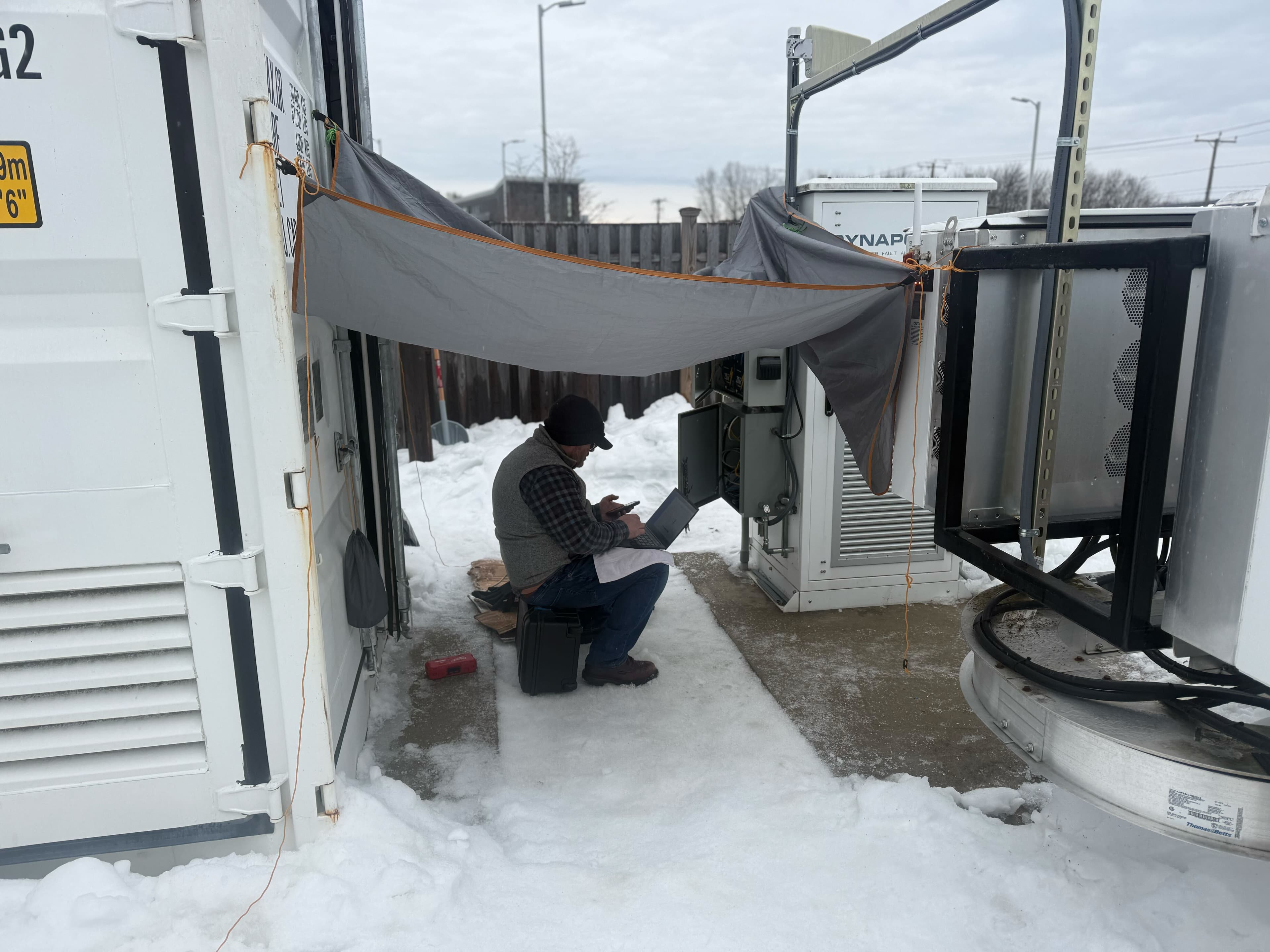
Across the country, there are solar and storage energy management systems sitting idle for one reason only: the controls have failed. The panels are fine. The batteries are fine. The inverters are fine. But the Energy Management System (EMS) or Data Acquisition System (DAS) that is supposed to run the site has stopped working, gone unsupported, or was never reliable to begin with, and the asset goes dark while everything underneath it depreciates.
WATTMORE's removal-and-replace (R&R) work exists for exactly this problem. We do not sell batteries, and we do not install solar panels. We replace the legacy controls layer on existing PV and battery energy storage assets so the equipment already in the ground can go back to work.
Why R&R is not just a controller swap
Swapping a controller sounds simple on paper. In the field, it rarely is. A real removal-and-replace project has to account for:
Unknown conditions: Legacy wiring, undocumented changes, and instrumentation that may or may not still work
Equipment inactivity: Batteries and inverters that have sat idle for months or years often need OEM-supported recovery before they can operate normally again
Multi-vendor integration: A single DC-coupled site can involve a PV inverter, a DC-to-DC converter, a battery OEM, metering, and a communications stack, each with its own protocol and quirks
Incomplete instrumentation: Missing CTs, missing insulation-monitoring equipment, and other gaps that only surface once someone is inside the enclosure
Treating R&R as a like-for-like hardware swap is how projects stall. WATTMORE treats it as a discovery-driven engineering problem first, and a field installation second.
The WATTMORE R&R method
Every removal-and-replace project follows the same disciplined sequence:
Discovery and existing-condition verification: Photograph the enclosure, wiring, conduit entries, one-lines, and device lists; identify every battery, PCS, DC converter, PV inverter, meter, CT, and communications interface on site.
Site-specific retrofit design: Decide whether a full enclosure replacement, a backplate swap, distributed controllers, or a communications-only fix fits the actual field constraints, rather than forcing a standard panel where it doesn't belong.
Preassembly and testing: Build, wire, label, and test the replacement hardware in advance, with contingency materials on hand for the conditions most likely to appear on site.
Controlled removal and installation: Document and label every legacy connection, isolate the incumbent controls, and install the replacement while preserving as much reusable infrastructure as possible.
Communications and data validation: Bring every device online, from batteries and PCS equipment to meters, CTs, and insulation monitors, and validate scaling, direction, status, alarms, and limits.
Functional commissioning: Work through startup and shutdown sequencing, fault clearing, charge and discharge testing, and OEM-supported commissioning, with contingency time built in for what discovery couldn't catch.
Reviving a DC-coupled battery in Massachusetts
One recent R&R project involved an approximately 1 MWh DC-coupled PV and battery system built on a Solectria PVS-500 sled with a Dynapower DPS-500 DC-to-DC converter and an Eos Energy battery. The solar side was commissioned, but the battery had sat inactive for roughly two years because the legacy EMS needed to be replaced.
WATTMORE collected detailed photographs and documentation before mobilizing, then designed and built a complete replacement EMS enclosure off site. During the removal-and-replace, the site was found to be missing CTs on the main output and the required DC insulation-monitoring equipment, gaps that would have gone unnoticed without hands-on discovery. WATTMORE specified the missing instrumentation and communications requirements and coordinated directly with Solectria, Dynapower, and Eos Energy to bring the asset toward recommissioning.
Solving a radio problem in California
A four-unit Sungrow containerized battery system in Arcadia, California had been offline for about two years, hampered by a legacy EMS that relied on an unreliable radio link to reach a battery unit on the far side of the site. Rather than replace the radio link with another radio link, WATTMORE redesigned the architecture entirely: two independent EMS controllers, one for each physical area, coordinating as a single site system with local controls instead of a fragile wireless connection.
The team reviewed eight to ten conduit entries in each existing enclosure before choosing the least intrusive path: retaining the weatherproof enclosures and conduit penetrations and replacing only the internal controls backplates, preassembled and pre-wired ahead of time to minimize field labor. When the batteries showed low module voltage after two years of inactivity, WATTMORE coordinated OEM-supported recovery with Sungrow before bringing the system back to normal operation.
Beyond controls: solving problems standard retrofits can't
Not every stranded asset needs a straightforward EMS swap. In Delta, Utah, a planned utility interconnection for a roughly 2 MW solar plant became uneconomic, leaving the asset stranded for two years before WATTMORE was brought in to find a different path forward. The team developed and commissioned an islanded operating architecture combining a battery, a grid-forming PCS, fourteen existing PV inverters, dynamic load, and weather data, tuning virtual impedance, droop, voltage, and frequency response, and diagnosing everything from phase imbalance to BMS lockups along the way.
That project, along with the DC-coupled EMS and DAS work above, points to the same underlying capability: when an existing system doesn't fit a standard template, WATTMORE can redesign the operating architecture, integrate across vendors, and keep iterating until the asset works.
In summary
Removal-and-replace is a discovery-driven engineering process, not a simple controller swap.
Legacy wiring, missing instrumentation, and equipment inactivity are the norm on real R&R projects, not the exception.
WATTMORE has hands-on experience replacing EMS and DAS platforms on DC-coupled PV + BESS assets, standalone solar DAS systems, and non-standard microgrid architectures, across battery, PCS, and inverter OEMs.
The goal is always the same: a documented, supportable controls platform and a credible path back to reliable operation, without losing the value of the PV, battery, and power-conversion equipment already on site.
Without WATTMORE, these sites would still be stranded. Now, they are functional and owens were able to bypass costly substation upgrades, due to WATTMORE’s engineers iterating until a practical solution was achieved.
If you have a solar or storage EMS asset sitting idle because of failed or unsupported controls, reach out to WATTMORE to talk through a removal-and-replace plan.