FEOC compliance has quickly become one of the most important procurement requirements in the American solar and energy storage industry. If you are developing, financing, or operating a solar or battery storage project, the FEOC status of every component in your system, including the control and monitoring layer, now has direct consequences for tax credit eligibility, cybersecurity posture, and long-term project risk. A second requirement, Build America, Buy America (BABA), sits alongside it and governs federally funded infrastructure work. WATTMORE equipment is both FEOC compliant and BABA compliant. This article explains what a FEOC is, what BABA requires, where both sets of rules came from, what compliance versus non-compliance means in practice, and why it matters specifically for EMS platforms, SCADA systems, power plant controllers, and data acquisition equipment.
What Is a FEOC?
FEOC stands for Foreign Entity of Concern. In broad terms, a FEOC is a company that is owned by, controlled by, or subject to the jurisdiction or direction of a covered foreign government. The covered nations are China, Russia, Iran, and North Korea. The designation is not limited to companies headquartered in those countries: subsidiaries, joint ventures, and companies with significant covered-nation ownership or influence can also qualify as FEOCs.
Where Did FEOC Rules Come From?
The primary sources are worth having at hand. Section 40207(a)(5) of the Infrastructure Investment and Jobs Act carries the statutory definition, and the Department of Energy's final interpretive rule, published in the Federal Register in May 2024, defines the operative terms: government of a foreign country, foreign entity, subject to the jurisdiction, and owned by, controlled by, or subject to the direction of (the Department of Energy's FEOC interpretive rule). The covered nations are China, Russia, Iran, and North Korea. On the domestic preference side, the Build America Buy America provisions live in Title IX of the same 2021 law, administered through the Made in America Office for projects receiving federal financial assistance.
The FEOC concept entered federal law through the Infrastructure Investment and Jobs Act of 2021, which used it to restrict who could receive federal battery supply chain funding. The Inflation Reduction Act of 2022 then applied FEOC restrictions to clean vehicle tax credits: electric vehicles with battery components or critical minerals sourced from a FEOC lost eligibility.
The turning point for solar and storage came with the budget reconciliation law passed in July 2025, which extended FEOC restrictions to the clean electricity investment and production tax credits that most solar and battery storage projects depend on. Under these rules, projects that receive material assistance from prohibited foreign entities can lose access to federal tax credits, and the restrictions phase in for projects beginning construction after 2025. The exact thresholds and documentation requirements are detailed and evolving, so developers should work with tax counsel, but the direction is unmistakable: the American clean energy market is moving away from covered-nation supply chains.
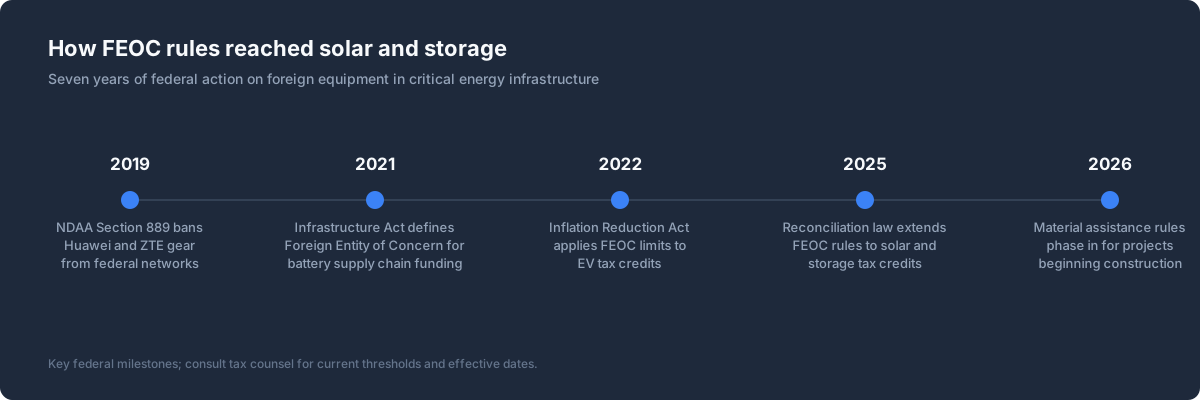
Seven years of federal policy, one direction: foreign entities of concern are being engineered out of American energy infrastructure.
FEOC rules did not appear out of nowhere. They follow a decade of escalating federal action on foreign equipment in critical infrastructure, including Section 889 of the 2019 National Defense Authorization Act, which banned Huawei and ZTE gear from federal networks, and repeated federal advisories about remotely accessible foreign-made inverters and control devices on the power grid.
FEOC Compliant vs. Non-Compliant: What It Means in Practice
A FEOC-compliant project sources its equipment, components, and material assistance from suppliers that are not foreign entities of concern, and can document it. A non-compliant project cannot. The practical differences are significant:
Tax credits: Non-compliant projects risk losing investment and production tax credits that often represent 30% or more of project economics. Compliant projects preserve them.
Financing: Lenders and tax equity investors now screen for FEOC exposure during diligence. Non-compliant equipment can stall or kill a deal.
Cybersecurity: Non-compliant control equipment means firmware, cloud services, and remote access pathways that may be subject to a covered foreign government. Compliant equipment keeps the control chain accountable to U.S. law.
Longevity: Regulations are tightening, not loosening. Equipment that is non-compliant today is a candidate for forced replacement tomorrow.
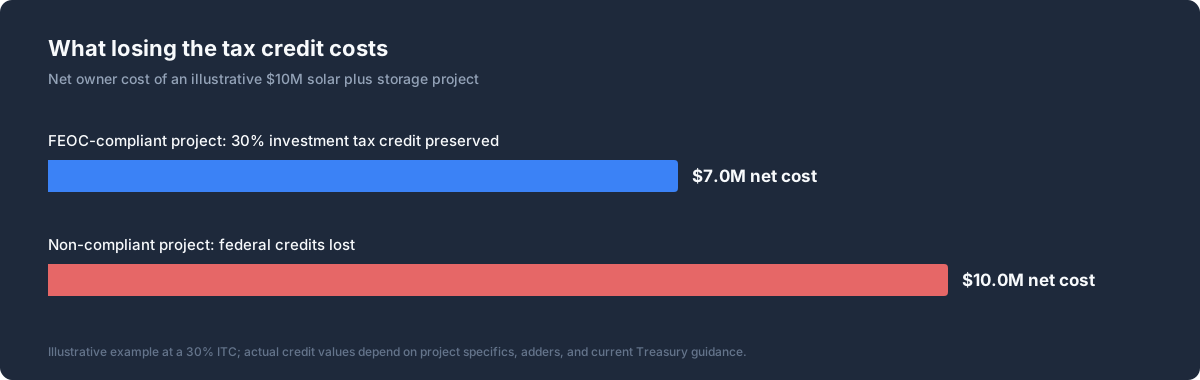
On an illustrative $10M project, FEOC non-compliance can erase the entire 30% federal investment tax credit. Choosing FEOC-compliant equipment like the WATTMORE EMS and WATTMORE DAS platforms protects that value.
The Supply Chain Reality
Why is FEOC compliance suddenly so hard? Because the global solar supply chain runs through China. Industry analyst rankings consistently show that vendors headquartered in FEOC covered nations ship the large majority of the world's PV inverters, and covered-nation firms hold similar positions in battery cells, power conversion equipment, and monitoring hardware. When federal officials have examined foreign-made grid equipment, the findings have not been reassuring: in 2025, U.S. investigators and multiple media outlets reported undocumented communication hardware discovered inside some foreign-made inverters and battery equipment, exactly the kind of hidden pathway FEOC rules are designed to eliminate.
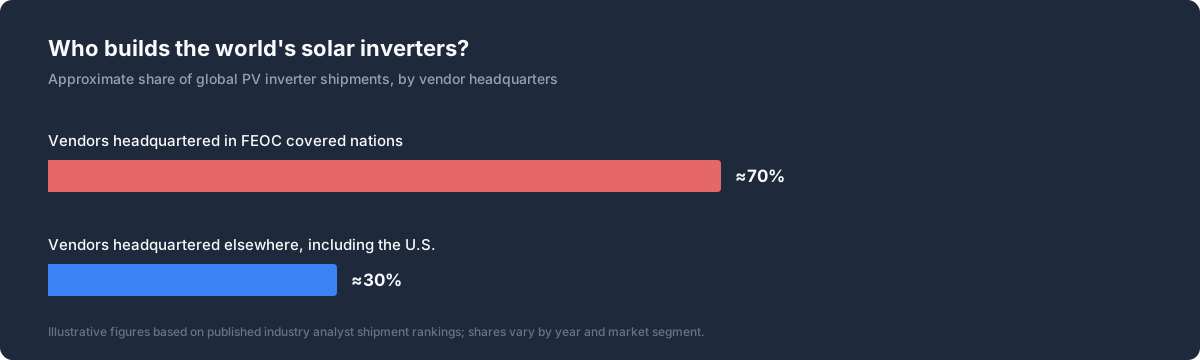
Most of the world's solar inverters ship from vendors headquartered in FEOC covered nations, which makes the origin of your control and monitoring layer a decision, not a default.
You cannot always control where every module or cell was made. You can absolutely control who builds your EMS, your SCADA, your power plant controller, and your DAS. That is the layer where American-made alternatives like the WATTMORE EMS, the WATTMORE PPC, and the WATTMORE Intellect EnFORM solar and storage monitoring platform exist today, are proven in the field, and carry none of the covered-nation baggage.
Why FEOC Matters Most at the Control Layer
Modules and racking are passive. Your EMS, SCADA system, power plant controller, and DAS are not: they are networked computers with privileged access to your generating assets. This is exactly where FEOC exposure is most dangerous.
EMS and SCADA
The energy management system holds credentials to every inverter and battery on site, makes autonomous dispatch decisions, and maintains persistent cloud connectivity. A storage EMS or SCADA platform built by a FEOC means foreign-developed code running with administrative control over grid-connected power equipment, often with vendor remote access built in. No firewall configuration fully mitigates a compromised vendor. The WATTMORE EMS, Intellect Operate, takes the opposite approach: every line of dispatch and SCADA code is written by WATTMORE's U.S. engineering team, and every remote access pathway is one you can audit.
Power Plant Controllers
The power plant controller enforces grid compliance in real time: voltage regulation, frequency response, ramp rate control, and curtailment. It is the device your utility trusts at the point of interconnection. A PPC from a foreign entity of concern places that trust relationship in the hands of a company answerable to a covered foreign government. The WATTMORE PPC, Intellect PPC, keeps that trust domestic: FEOC-compliant hardware, U.S.-developed control code, and control documentation your interconnection engineers can actually review.
DAS and Monitoring Equipment
Data acquisition systems see everything: production data, meter data, weather data, and network topology. DAS hardware with covered-nation firmware creates both a data exfiltration risk and a foothold inside your operational network. Monitoring equipment is often the least scrutinized and longest-lived gear on site, which makes its provenance matter even more. The WATTMORE Intellect EnFORM solar and storage monitoring platform and its DAS panel line are designed, assembled, and supported by WATTMORE with a FEOC-compliant bill of materials, so the equipment watching your fleet answers only to you.
The Benefits of FEOC Compliance
BenefitWhat It MeansImpact on Your ProjectTax credit eligibilityEquipment sourcing preserves ITC and PTC qualification under the 2025 FEOC rulesProtects 30%+ of project economicsStronger cybersecurityNo firmware, cloud services, or remote access subject to a covered foreign governmentReduced attack surface on grid-connected control systemsSupply chain transparencyDocumented component origin from vendors accountable to U.S. lawFaster diligence, cleaner audits, easier compliance reportingFinancing and insurabilityPasses lender, tax equity, and insurer FEOC screeningFewer deal delays, better terms, broader capital accessHigher quality and supportDomestic engineering teams, direct accountability, no offshore black-box firmwareFaster issue resolution and longer equipment lifeRegulatory future-proofingAligned with the direction of federal and state policy on grid securityNo forced rip-and-replace as restrictions tighten
BABA: The Other Half of the Domestic Sourcing Equation
WATTMORE control and monitoring equipment is BABA compliant as well as FEOC compliant.
BABA stands for Build America, Buy America. It is a domestic preference law enacted as part of the Infrastructure Investment and Jobs Act of 2021, and it applies to infrastructure projects that receive federal financial assistance: grants, loans, loan guarantees, and cooperative agreements. Where FEOC rules ask who made your equipment and whether they answer to a covered foreign government, BABA asks where it was made. They are separate requirements with separate tests, and a project can be subject to one, the other, or both.
What BABA Actually Requires
The Build America, Buy America Act directs that federally funded infrastructure projects use domestically produced materials across three categories:
Iron and steel: All manufacturing processes, from melting through coating, must occur in the United States.
Manufactured products: The product must be manufactured in the United States, and the cost of its U.S.-origin components must exceed 55% of the total cost of all components. EMS, SCADA, PPC, and DAS equipment falls in this category.
Construction materials: All manufacturing processes must occur in the United States.
The Office of Management and Budget administers the standard through its Made in America Office, and each federal agency applies it to the programs it funds. Waivers exist for non-availability, unreasonable cost, and public interest, but a waiver is a process, not a shortcut: it means paperwork, agency review, and schedule risk on a project that is usually already on a clock.
Why BABA Matters
BABA determines whether federal dollars can pay for your equipment at all. That reach is wider than many developers expect. Solar and storage work funded through federal grant and loan programs, rural energy programs, tribal and municipal energy projects, school and public facility upgrades, federal facility installations, and disaster resilience funding is routinely subject to BABA requirements. If a single manufactured product on the project fails the test, the funding agency can disallow the cost or require replacement.
It is also worth separating BABA from the domestic content bonus credit under the Inflation Reduction Act. They are different programs with different thresholds and different administrators, and meeting one does not automatically satisfy the other. Confusing the two is a common and expensive mistake. Your funding agreement and your tax counsel will tell you which apply to a given project; the practical takeaway is that specifying equipment that already satisfies both removes the question entirely.
The strategic argument is the same one behind FEOC. Domestic manufacturing of grid control equipment means a supply chain that survives tariffs, export controls, and geopolitical disruption, an engineering team in your time zone, and hardware whose origin you can document without a research project.
Where WATTMORE Stands
WATTMORE control and monitoring equipment is BABA compliant. Our EMS, PPC, SCADA, and DAS products are manufactured and assembled in the United States, and we maintain the domestic content documentation our customers need to satisfy a funding agency without filing for a waiver. Combined with our FEOC-compliant status, that means a WATTMORE control layer clears both the who and the where on federally funded work.
That combination is genuinely uncommon. Much of the control and monitoring equipment on the market today can satisfy one requirement or neither, and vendors scrambling to reconfigure supply chains are quoting timelines measured in quarters. WATTMORE built domestically from the start, so there is nothing to retrofit and nothing to wait for.
WATTMORE: FEOC and BABA Compliant EMS, PPC, SCADA, and DAS for All Your Needs
WATTMORE designs and builds its entire control and monitoring stack in the United States, free of covered-nation hardware dependencies and foreign-controlled firmware. While much of the industry is scrambling to untangle FEOC exposure from its supply chains and to requalify products for BABA, WATTMORE customers are already there. You can standardize your entire control layer on WATTMORE FEOC-compliant and BABA-compliant equipment today, without compromise and without waiting:
WATTMORE EMS: Intellect Operate is a FEOC-compliant storage EMS with SCADA-grade monitoring, real-time economic dispatch, and edge-plus-cloud architecture, developed entirely by WATTMORE's U.S. engineering team.
WATTMORE PPC: Intellect PPC is a FEOC-compliant power plant controller built into the same platform, delivering grid compliance you can document and defend.
WATTMORE Monitoring and DAS: The WATTMORE Intellect EnFORM solar and storage monitoring platform provides FEOC-compliant DAS panels and monitoring for portfolios of any size, with vendor-agnostic protocol support and enterprise-grade security.
The benefits compound when the stack comes from one accountable vendor. A WATTMORE EMS talking to a WATTMORE PPC through WATTMORE monitoring hardware means one domestic supply chain to document for your tax equity partner and your funding agency, one security posture for your lender's diligence, and one U.S.-based engineering team on the phone when you need support. No black-box firmware, no offshore escalation queue, no questions your compliance counsel cannot answer.
FEOC and BABA compliance is not just a tax checkbox or a grant condition; it is a statement about who controls your assets, who sees your data, where your equipment was built, and who answers when something goes wrong. With WATTMORE, the answer to all four is a company accountable to you and to U.S. law.
Evaluating FEOC or BABA exposure on a new project or an existing fleet? Contact WATTMORE to review your control and monitoring stack and see how WATTMORE FEOC-compliant and BABA-compliant EMS, PPC, SCADA, and DAS solutions fit your needs.