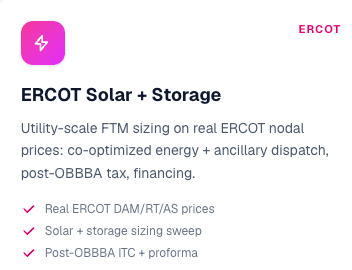
Intellect PLAN, WATTMORE's financial planning and system sizing platform at wattmoreplan.com, now includes a full front of the meter (FTM) solar and storage sizing tool for ERCOT. Developers and asset owners planning utility scale projects in Texas can now size the solar array, the battery, and the point of interconnection together against real ERCOT market economics, and get NPV, IRR, and payback for the combined plant in one workflow. It is the ninth purpose built application type in PLAN, and the second dedicated to front of the meter revenue alongside the New York VDER Value Stack tool.
ERCOT is a different kind of market
Most storage sizing tools were built for behind the meter economics: demand charges, tariffs, and state incentive programs. ERCOT plays by different rules. It is an energy only market; there is no capacity payment waiting at the end of the year. A front of the meter project in Texas earns its return from two places: selling energy when prices are high, and selling ancillary services that keep the grid stable.
Both of those revenue streams are volatile by design. ERCOT settles energy at thousands of individual settlement points, prices swing from single digits to the multi thousand dollar per MWh range during scarcity events, and a large share of a storage project's annual energy revenue can be earned in a handful of extreme days. That volatility is exactly what makes storage valuable in Texas, and exactly what makes it hard to size a project with a spreadsheet and an average price assumption.
What the ERCOT FTM tool models
The new application type brings PLAN's hourly (8760) simulation engine to merchant project economics:
- Real ERCOT nodal prices. Solar generation and battery dispatch are valued against real ERCOT day ahead market, real time market, and ancillary services price data rather than a flat assumption, so the model captures the spread between charging in low priced hours and discharging into evening and scarcity peaks.
- Co-optimized energy and ancillary dispatch. Energy arbitrage and ancillary services participation compete for the same battery capacity, so the model co-optimizes dispatch across both instead of stacking them naively; the recommended size reflects how the plant would actually be operated.
- Solar plus storage sizing sweep. The tool sweeps combinations of solar array size and battery size at a shared point of interconnection, capturing clipped energy recapture and the interaction between solar output and dispatch strategy.
- Post OBBBA tax and financing. The financial model reflects the investment tax credit under the post OBBBA rules, financing structure, and year by year revenue projections, rolling up into a full proforma with NPV, IRR, and payback for the whole plant.
Sizing the plant, not just the battery
Front of the meter sizing has more degrees of freedom than a behind the meter project. Solar capacity, battery power, battery duration, and the interconnection limit all interact. A larger array behind a fixed POI limit produces more clipped energy for the battery to capture; a longer duration battery earns more in extended scarcity events but costs more per cycle in normal conditions. PLAN evaluates these combinations against the market data and recommends the configuration that delivers the best risk adjusted return, instead of forcing you to guess a ratio and check it after the fact.
Because everything runs on the same hourly engine, you can compare cases side by side: standalone storage against solar plus storage, a two hour battery against a four hour battery, or a conservative price forecast against an aggressive one. The financial outputs stay consistent across every case, so the comparison is apples to apples.
Nine application types, one workflow
ERCOT FTM Solar and Storage Sizing joins the eight application types PLAN already supports: Demand Charge Reduction, Energy Arbitrage, Size My PV System, Solar Self-Consumption, Front of Meter Revenue for New York's VDER Value Stack, Illinois Energy Storage for the CRGA programs, Connecticut Storage Sizing, and Massachusetts Storage Sizing. Each one is a purpose built simulation matched to the economics of its market, and all of them run inside the same upload, configure, optimize, and export workflow.
Texas is the largest and fastest moving storage market in the country, and projects there live or die on the quality of their revenue modeling. With the ERCOT FTM tool, that modeling happens where the sizing decision is made.
Explore Intellect PLAN to see all nine application types, or contact WATTMORE to model a front of the meter solar and storage project in ERCOT with real market economics built in.