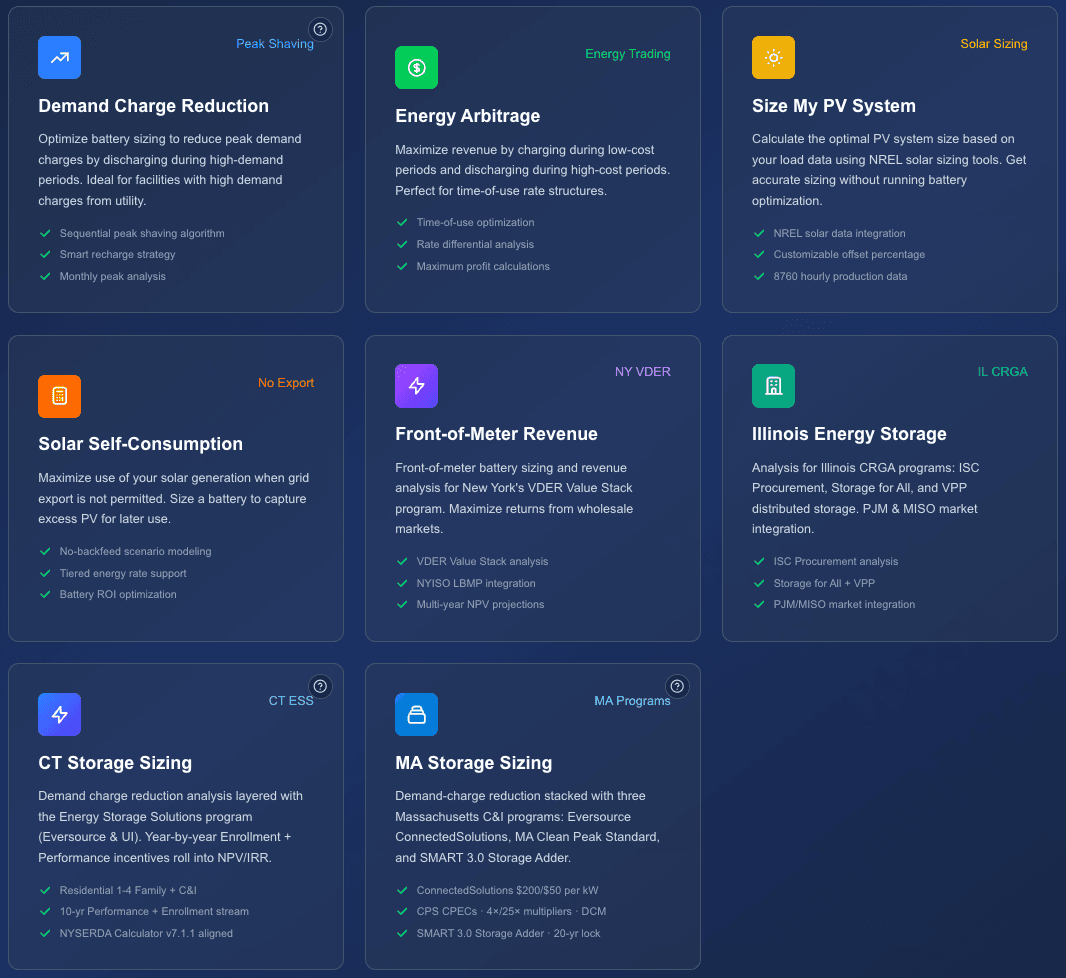
Intellect PLAN now ships with two new application types built specifically for the Northeast: Connecticut Storage Sizing and Massachusetts Storage Sizing. With these additions, PLAN covers eight purpose-built simulation types, each pairing a battery-sizing optimization engine with the incentive structures that actually drive project economics in a given market. For developers and asset owners working in Connecticut and Massachusetts, that means modeling real program revenue, not generic demand-charge assumptions, directly into NPV and IRR.
Why state incentive programs belong in the sizing model
In the Northeast, battery storage economics are dominated by stacked state programs. A system sized only against demand-charge reduction will almost always be mis-sized for these markets, because the largest revenue streams come from utility performance incentives and state clean-energy programs that pay on capacity, dispatch, and certificates. The optimal battery for a Massachusetts C&I site looks very different from one optimized for demand charges alone.
Modeling those programs by hand in a spreadsheet is slow and error-prone. The incentive schedules change year to year, payments depend on dispatch behavior, and the value only materializes when the battery is sized correctly to capture it. Intellect PLAN builds these programs directly into the optimization so the recommended system size reflects the full, stacked value from day one.
Connecticut: Energy Storage Solutions (ESS)
Connecticut's Energy Storage Solutions program, administered by Eversource and United Illuminating, is one of the most structured storage incentives in the country. It layers an upfront enrollment incentive with ongoing performance payments tied to how the battery actually performs during grid events, and it spans both residential and commercial customers.
The new CT Storage Sizing tool in Intellect PLAN models demand-charge reduction layered with the ESS program, then rolls the incentive streams into the project's NPV and IRR:
- Residential 1-4 family and C&I sizing in a single workflow, reflecting the program's different customer classes.
- Year-by-year enrollment and performance incentive streams, so the multi-year payment structure is captured in the cash-flow model rather than approximated as a lump sum.
- CT ESS incentive schedule alignment, so the modeled payments track the program's published rates.
The result is a recommended battery size and a financial model that reflect how a Connecticut project actually earns its return, with demand-charge savings and ESS incentives evaluated together instead of in isolation.
Massachusetts: ConnectedSolutions, Clean Peak Standard, and SMART 3.0
Massachusetts offers some of the richest storage revenue in the country, but capturing it means stacking three distinct programs on top of demand-charge management. The new MA Storage Sizing tool models all three together:
- Eversource ConnectedSolutions, a performance-based dispatch program that pays on capacity delivered during summer and winter events (modeled at the program's $200 and $50 per kW levels).
- Massachusetts Clean Peak Standard (CPS), which generates Clean Peak Energy Certificates (CPECs) with seasonal and resiliency multipliers, including the 4× and 25× multipliers that dramatically change storage value, alongside demand-charge management (DCM).
- SMART 3.0 Storage Adder, the storage incentive for solar-paired systems, with its 20-year lock that makes long-horizon modeling essential.
Because these programs reward different behavior, sizing for one in isolation leaves money on the table. PLAN's MA Storage Sizing tool stacks ConnectedSolutions, Clean Peak Standard, and the SMART 3.0 Storage Adder on top of demand-charge reduction and sizes the system to maximize the combined value over the full incentive horizon.
Sizing for stacked value, not single programs
Both new tools use the same core approach that powers the rest of Intellect PLAN: hourly (8760) load and generation modeling, a purpose-built optimization algorithm, and a financial model that produces NPV, IRR, and payback. What changes is the revenue logic. Instead of optimizing against a single value stream, the CT and MA tools evaluate how a given battery size performs across every applicable program at once, then recommend the size that delivers the best risk-adjusted return.
That matters because stacked programs often pull in different directions. A battery sized purely for ConnectedSolutions dispatch may be too large to be cost-effective for demand-charge reduction alone, while a battery sized only for demand charges may be too small to fully capture Clean Peak multipliers. Modeling them together is the only way to find the sweet spot.
Eight application types, one workflow
Connecticut and Massachusetts join the six application types PLAN already supports: Demand Charge Reduction, Energy Arbitrage, Size My PV System, Solar Self-Consumption, Front-of-Meter Revenue for New York's VDER Value Stack, and Illinois Energy Storage for the CRGA programs. Each is a purpose-built simulation that matches the economics of its market, and all of them run inside the same upload-configure-optimize-export workflow.
As more states roll out structured storage incentives, this market-specific approach lets PLAN model real project economics instead of forcing every project into a generic template.
Explore Intellect PLAN to see all eight application types, or contact WATTMORE to model a Connecticut or Massachusetts storage project with the full incentive stack built in.