When the load is a data center, a hospital campus, a defense installation, or a fab, there is no such thing as a small control failure. Every megawatt behind your meter is either an asset you operate with confidence or a liability you discover at the worst possible moment.
WATTMORE exists to make it the first one. We are the mission critical operations solution for facilities that cannot blink: one company delivering certified hardware and certified software as a single, tested, deployed system. Not a dashboard bolted onto somebody else's black box. Not four vendors pointing at each other at two in the morning. The whole operating layer, from the pyranometer on the roof to the boardroom report, engineered and supported by the people who wrote it.
This is the complete picture: what we deliver, how each piece works, and why the certifications and the end to end architecture are the entire point when your load is not allowed to go down.
One vendor. Certified hardware and software. End to end.
The urgency behind all of this is measurable. Lawrence Berkeley National Laboratory's 2024 national assessment, released through the Department of Energy, found data center electricity use tripled from 58 TWh in 2014 to 176 TWh in 2023, and projects between 325 and 580 TWh by 2028, as much as 12 percent of all United States electricity (Lawrence Berkeley National Laboratory). Grid interconnection has not kept pace; queues stretch years (Lawrence Berkeley National Laboratory). The facilities that keep growing through that squeeze are the ones that can generate, store, and control their own power, which makes the operating layer described below infrastructure, not software.
Most energy platforms are one of two things: a software company that needs somebody else's box, or a hardware company that needs somebody else's software. Both leave you holding the integration risk.
WATTMORE builds both halves, in Denver, as one product. Intellect Edge is our ruggedized controller hardware, assembled and tested here. WATTCORE OS is our patented operating software, backed by five issued US patents. Because we build both, the platform can promise what glued together stacks cannot: no vendor boundary between the box and the code, one latency budget from meter to setpoint, and one company accountable for the entire result.
End to end is not a slogan here. It is the actual product line, and it covers the full lifecycle of the asset:
| Stage | Product | What it does for you |
|---|---|---|
| Before capital | Intellect PLAN | Sizes and stress tests the design against real weather years, so the system you buy is the system you needed |
| The hardware | Intellect Edge | Ruggedized, fanless, UPS backed redundant controllers, Denver built |
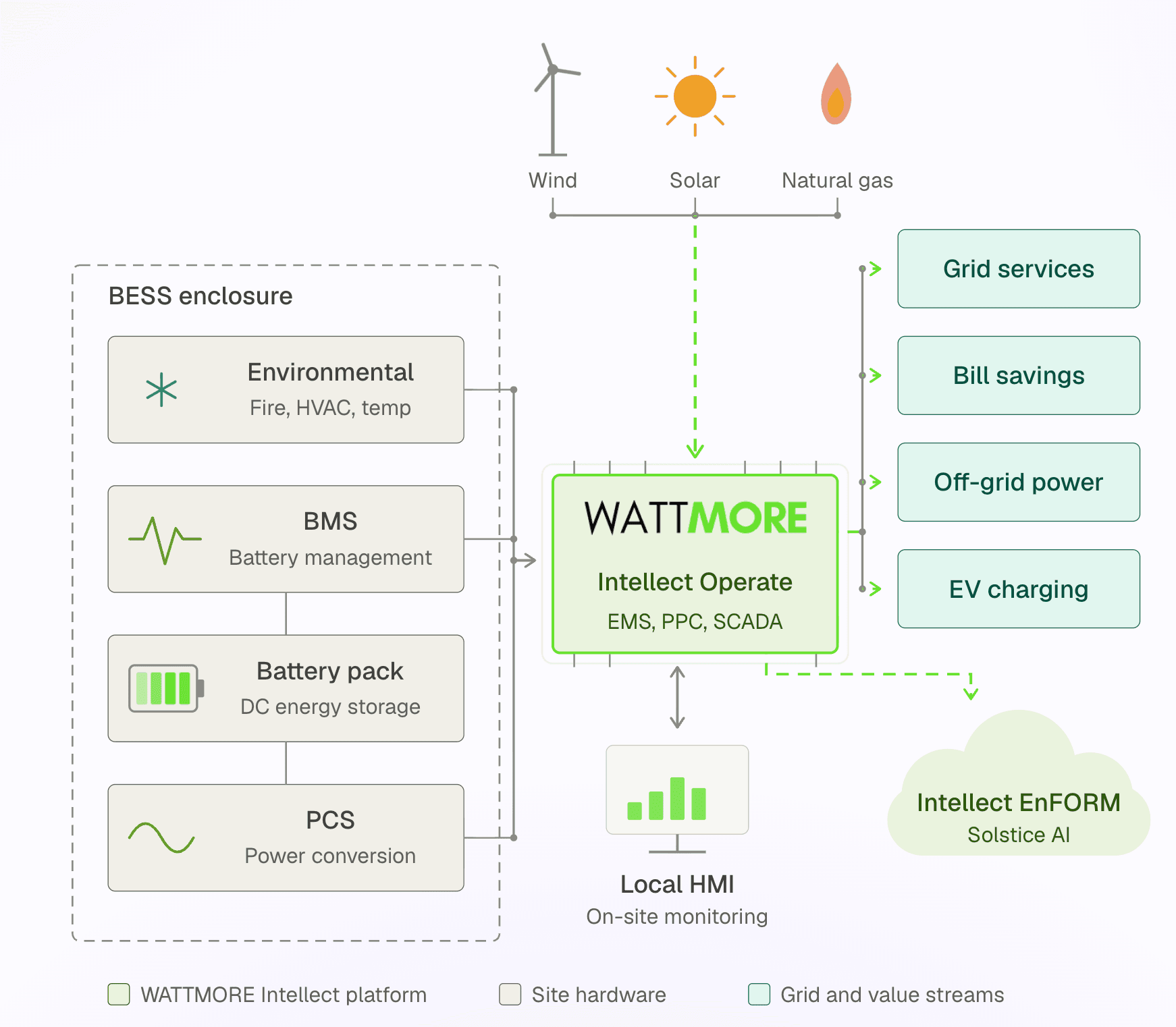
| The control | Intellect Operate | EMS, PPC, and SCADA in one certified edge stack |
| The record | Intellect EnFORM | Full suite cloud DAS, command and control, reporting, and alerting |
| The intelligence | Solstice AI | A team of asset manager analysts watching every site, around the clock |
PLAN sizes it. Edge runs it. Operate controls it. EnFORM watches it. Solstice makes sense of it. One platform, one login, one data model, one number to call.
Certified, not asserted
In mission critical work, "we follow best practices" is not an answer. Your lender, your insurer, your interconnecting utility, and your security team all want documentation, and they want it from a third party. Here is what we hand them.
Grid and interconnection
- IEEE 1547-2018. The distributed energy interconnection baseline: ride through, voltage regulation, and frequency response. Intellect Operate runs the full grid function library under it.
- IEEE 2030.7. Microgrid controller requirements, the standard that matters the moment your site has to island.
- IEEE 2800. The same discipline applied to large inverter based plants on the transmission system.
- UL 1741. The certification your inverters carry to prove those behaviors, which our PPC is built to exercise correctly.
- NERC ride through and reliability requirements for inverter based resources, on a NERC CIP aware architecture.
Hardware safety and product security
- UL 61010-2-201. Hardware safety certification covering the Intellect Operate and EnFORM control panels. Any software change that affects hardware behavior, control signals, timing, or limits is reviewed against those requirements before it ships.
- IEC 62443-4-1. Certified secure development lifecycle. Not a policy PDF: a documented SDLC with mandatory security review before any production release, and network facing code built to IEC 62443 zone and conduit principles.
- UL 2900-2-2. Cybersecurity for industrial control systems, an active certification target we are engineering against today.
- ISO 27001 and SOC 2 Type II certified cloud infrastructure, with SHA-256 integrity hashing from edge to cloud.
Performance, procurement, and program compliance
- IEC 61724. The standard our performance ratio, availability, and yield calculations follow, so the numbers survive diligence.
- Build America Buy America. Intellect Edge runs roughly 63 percent US domestic content, comfortably above the 55 percent BABA threshold, with a certificate of origin available.
- FEOC compliant ownership and supply chain, increasingly a gating requirement rather than a preference.
- SGIP monitoring, control, data retention, and reporting requirements for California funded projects.
- OEM certified. Validated on the manufacturers' own hardware, in the manufacturers' own facilities, with certification records available for diligence and financing.
That last one deserves emphasis, because it is the difference between a product and a pilot. Our integrations are not "we read the Modbus map and it seemed to work." They were tested and certified by the equipment makers themselves, on their benches. When a lender asks whether the control system is bankable, that file is the answer.
Where mission critical projects actually go wrong
We get called into sites that are already built, and the pattern almost never varies. The batteries work. The inverters work. The switchgear works. Every individual component performs to spec.
What failed is the layer above the hardware. Solar production lives in the inverter vendor's portal. Battery state lives in a second system. Protection relay data lives in a third package inside the switchgear. The power plant controller is a sealed appliance nobody can see into, so when the plant curtails, no one on site can say why. Four vendors, four data models, four support contracts, four places for a real problem to hide in the seams.
For a commercial rooftop that is an annoyance. For a facility that cannot go down it is a genuine operational risk, because the questions you must answer during an event are immediate: what is the plant doing right now, why is it doing it, what constraint is binding, and how long can we hold this state. A stack assembled from point products cannot answer those in one place, at one moment, with one version of the truth.
That is the problem end to end solves. Not elegance. Answers, during an event.
Four systems, four verbs, one platform
Every serious power plant runs four systems. The fastest way to understand them is by the verb each one owns.
| System | Verb | What it owns | Timescale |
|---|---|---|---|
| EMS | Decides | What the plant should do, and when | Seconds to hours |
| PPC | Enforces | Grid rules at the point of interconnection | Milliseconds |
| SCADA | Shows | Live visibility, alarms, supervised control | Real time |
| DAS | Records | Every reading, for performance and proof | Forever |
Most portfolios buy those as four products from four vendors. We deliver all four as one: Intellect Operate runs the EMS, PPC, and SCADA at the edge inside your fence, and Intellect EnFORM is the full suite DAS and command layer in the cloud above it.
EMS control: the system that decides
The Energy Management System decides how, when, and where energy is stored or dispatched. Everything else executes, shows, or records. The EMS is the only layer making economic and operational choices, and at a mission critical site those choices pull against each other: hold critical load without interruption, cut demand charges, respect the battery warranty, stay inside the interconnection agreement, and earn something back where markets allow.
A static schedule cannot balance that. It captures an estimated 40 to 60 percent of the value actually available on your site. Intellect Operate runs a genuine optimizer instead: a mixed integer linear program that re-solves the entire plant every 15 minutes across seven energy flows, minimizing energy plus demand charges under efficiency, tariff, export, and state of charge constraints. It captures an estimated 85 to 95 percent of available value.
The loop underneath runs continuously: observe plant and grid state, forecast 48 hours ahead, optimize, dispatch setpoints, verify by readback, repeat. And the hierarchy is enforced in code rather than in a runbook: the BMS guards, the PCS moves power, the EMS decides. If the optimizer wants 500 kW and the battery management system publishes a 450 kW limit because the cells are warm, the plant gets 450. Always.
What that buys you
- Peak shaving. Demand charges bill your worst 15 minutes of the month. Facility pulls 600 kW, battery supplies 400 kW, the meter sees 200 kW. On one commercial site that single shaved peak is worth roughly 9,000 dollars a month. At campus scale the arithmetic gets considerably more compelling.
- Step load absorption. AI training clusters swing hard and fast. A utility service does not love it and a generator cannot follow it instantly. Storage under fast control absorbs the transient so nothing upstream ever sees it.
- Islanding and black start. Grid fails, disconnect cleanly and hold critical load. No grid at all, energize a dead plant from the battery, every morning if that is what the site requires.
- Revenue stacking where allowed. Arbitrage, ancillary services, and capacity are three paychecks for one asset. The mix moves: in Texas, ancillary services were roughly 85 percent of battery revenue in 2023, and a year later arbitrage was the majority. Static strategies leak money every time the market turns.
- Warranty protection. Cycling is capped in the optimizer, around two cycles per day, so revenue chasing never quietly consumes the asset you financed.
Edge autonomy, because the cloud is not a safety system
Dispatch, protection, and safety logic run entirely at the edge on redundant controllers inside your network. The cloud is supervisory and never in the safety loop. If the WAN drops, the site keeps running itself and the historian backfills on reconnect with a recovery point objective of zero.
Any control architecture that needs an internet connection to keep a plant stable has an outage already scheduled in it. Ours does not.
PPC control: the system that enforces
The Power Plant Controller is the referee at your point of interconnection. It turns a high level target, a megawatt setpoint, a voltage schedule, a power factor, into per inverter commands while enforcing the grid code. Nothing reaches the grid that breaks the rules.
It is not optional. Your interconnection agreement spells out required behaviors and the PPC is what proves you meet them: no PPC, no interconnection. The split with the EMS is deliberate. The EMS optimizes on a horizon of seconds to hours, thinking about money. The PPC enforces on a horizon of milliseconds, thinking about physics. Separate processes, so the PPC can override the EMS the instant the grid demands it.
The seven stage pipeline
Every command passes through a fixed pipeline, in order, on every cycle:
- EMS setpoint. The base plant command.
- Frequency watt droop. Frequency sags, the plant injects more; frequency rises, it backs off, proportionally. Five percent slope is standard, with a roughly 36 millihertz deadband per IEEE 2800 so the plant does not chase normal grid noise. Droop bypasses the ramp limiter, because grid support must be immediate.
- Curtailment. A hard ceiling on active power on grid operator command.
- State of charge limiting. Smooth derating toward zero approaching the soft and hard limits. Derate, never disconnect.
- Ramp rate limiting. Clamps rate of change so the plant never surges the grid. Asymmetric by design, since ramp down can be faster for safety.
- Voltage and reactive power. Constant power factor, voltage regulation, or a volt VAR curve, whichever your interconnection agreement specifies.
- Fleet allocation. One plant number becomes per unit commands: equal, proportional by rating, or priority order, with faulted units dropped and their share reassigned automatically.
Deterministic speed you can put in a spec
Sense the point of interconnection at 20 Hz, so no transient hides in a 50 millisecond window. Run the pipeline at 10 Hz, every 100 milliseconds. Actuate at 4 Hz, matched to what inverters can actually follow. End to end that is roughly 100 milliseconds from sense to setpoint, with fast frequency response verified under 200 milliseconds on a grid simulator.
The PPC never touches a device directly. It reads and writes a shared state bus, so it can restart without dropping control of your plant.
Ride through, do not trip
When the grid shakes, the required behavior is counterintuitive: stay connected. Voltage sag or swell means ride through and support the recovery. Over frequency means shed active power proportionally within seconds. Under frequency means release curtailment and give the grid everything it asks for. An unintentional island must be detected and disconnected, never energized beyond two seconds.
If thousands of inverter based plants trip on one fault, a local wobble becomes a cascading blackout. Grid codes require ride through, and a certified PPC is what delivers it.
SCADA and operator dashboards: the system that shows
SCADA collects from every device, shows it, raises alarms, and allows manual or rule based control. What it deliberately does not do is choose the optimal action. That is the EMS, and keeping the boundary clean is what makes both trustworthy.
Five layers: field RTUs and PLCs that collect and execute, buffering through outages with store and forward so a network blip never becomes a hole in your record; a real time database and alarm engine running as a hot standby pair that fails over in seconds; a historian; a redundant network; and operator screens, on site and remote.
One data model, any vendor
Underneath the screens is what makes a mixed fleet manageable: every vendor's registers map onto more than 200 canonical points with names like battery.soc, pcs.ac_power, and meter.frequency. New hardware is a profile, not a project. That is what vendor agnostic actually means, and it is why we can integrate what you already own instead of demanding you replace it.
On top sits a fault library of 132 conditions built from real registers, drawn from SunSpec, IEC 62619 and 61850, and the OEM maps of every integration we have certified: cell over and under voltage, thermal runaway precursors, DC arc faults, anti islanding, insulation and ground faults, communications loss by device class, emergency stop, fire and gas detection, breaker and relay trips.
Every condition carries a severity, which is what turns a wall of blinking flags into a triaged list: warning (approaching limits, system continues, possibly derated), alarm (at limits, derate or prepare to shut down), and fault (exceeded or failed, must stop).
Dashboards that answer the operational question
A dashboard can show a great deal and still never tell you what mode the plant is in, what rule is active, or what constraint is binding. Pretty is not transparent. Our screens put the binding constraint on the glass as one line of plain text, for example "PV limited to 20 percent, BESS alarm interlock active, alarm 4412," so the operator on shift and the engineer on the phone are reading the same answer.
The live single line carries real values on every element, and the picture is identical in your control room and remotely in EnFORM, with no VPN and no inbound path to the plant. Commands carry a seatbelt: role gated access, explicit confirmation on sensitive operations, readback verification, and an immutable audit log of who did what and when.
From alarm to work order, in minutes
An inverter drops offline mid afternoon. Within the poll cycle the fault posts to the state bus and the alarm engine raises it with device, site, and timestamp attached. Routing sends it by severity: a text to the on call engineer, an email to the site list. The operator acknowledges, checks the single line, opens a work order with the fault code prefilled in the built in CMMS. When the breaker is reclosed, recovery is verified in the same data that raised the alarm.
Minutes, end to end, in one system. On a daily summary portal that same event is discovered tomorrow.
The DAS: the system that records, and proves
Intellect EnFORM is your plant's long memory and its accountant. SCADA watches what is happening now, optimized for latency. The DAS remembers what happened and how well, optimized for fidelity and retention. Both draw from one acquisition, so there is never a second version of the truth to reconcile during an incident.
Our design rule is deliberately absolute: if it carries current or holds a register, it is monitored, historized, and alarmed. No device too small, no signal skipped. That is the difference between a DAS that settles a warranty claim and a portal that missed the string that quietly died.
Solar and storage DAS
On the generation side we measure inverters down to the string and per MPPT, because a view that stops at the inverter misses the one string dragging an array. On the storage side, state of charge, state of health, voltage, and temperature per battery block, plus cycle counts tracked against your warranty terms.
Resolution is 30 seconds by default, one second on critical points, with a 180 day full resolution buffer at the edge and lifetime retention in the cloud. Store and forward means outages cost you nothing. Many portals settle for 5 to 15 minute averages and miss short events entirely, and a step load event on a data center campus is precisely the kind of thing that vanishes inside a 15 minute average.
Metering
Revenue grade, ANSI class metering, with generation, consumption, and grid exchange kept as separate registers, because the difference between them is the money. Facility demand at 30 second resolution, since the utility bills your worst 15 minutes, and feeder and panel level CTs that tell you which circuits drive the peak. You cannot shave a peak you cannot see coming, and you cannot size the next battery without knowing which loads created the last one.
Metering is also where quiet revenue leaks surface. A cumulative register that has drifted from the measured power integral is a compliance and audit exposure for renewable credit reporting even when revenue itself is calculated correctly. That discrepancy goes unnoticed for a year unless something is watching both numbers.
Recloser control and monitoring
On distribution connected and campus scale sites, the recloser is where your plant meets the utility, and it is the device most likely to be doing something interesting during an event. EnFORM integrates protection relays and reclosers, SEL among them, for both monitoring and supervised control.
Monitoring covers relay state, breaker position, per phase voltage and current, frequency, shot counts, ready status, and a timestamped event log of every trip, reclose, and lockout. Historic per phase trending turns "the site tripped last Tuesday" into a waveform your engineers can actually reason about.
Control is supervised, deliberately. Trip and close are available from the same pane of glass, but every command requires explicit confirmation, passes role based access control, and is written to the audit log with the readback proving it took effect. Remote switching on a mission critical feeder is exactly the capability that should be available and should never be casual.
Transformer monitoring
The transformer is the least glamorous and most expensive thing on your site to lose: a six figure asset with a replacement lead time measured in months, sometimes beyond a year in the current market. For a mission critical facility that lead time is not a procurement problem, it is an availability problem.
So we monitor loading as a percentage of nameplate continuously, plus oil and winding temperatures. The physics that makes it worth doing: sustained overheating roughly halves insulation life for every 10 degrees Celsius above rating. Chronic overload is invisible day to day and fatal over years. Heat is not a fault, it is a mortgage on the asset, and the trend line is your warning.
A temperature channel costs almost nothing. It is the cheapest insurance on the entire site, and most monitoring portals never wire it in.
Weather station integration
Output alone is meaningless. Is the plant underperforming, or is it simply cloudy? Without irradiance you cannot tell a passing cloud from a failed tracker, a soiled array, or a tripped string.
We integrate NOAA grade on site instrumentation: global, plane of array, and direct normal irradiance from pyranometers, module and ambient temperature, wind speed and direction, humidity, barometric pressure, and rainfall. Where an on site station is not warranted, satellite irradiance fills the gap and forecasts run ahead of the plant.
Every channel answers a dollar question:
- Irradiance: is production correct for this sky, or is money leaking?
- Module temperature: normal thermal derate, roughly a third of a percent per degree Celsius, or a real fault?
- Rainfall: free wash, or time to schedule cleaning? Soiling is a quiet 2 to 5 percent tax.
- Wind: did the trackers stow before the storm? That is a warranty argument won in advance.
- Ambient temperature: context for battery HVAC duty and state of health numbers.
The KPIs, and why this data is contractual
It all rolls into three numbers every owner watches: performance ratio (actual against theoretical, weather adjusted), availability (percent of time the plant could produce when it should have), and energy yield (kilowatt hours delivered against the financial model). Standardized under IEC 61724 and historized at engineering resolution, so they hold up in diligence and, if it comes to it, in court.
These numbers settle performance guarantees, warranty claims, and investor reporting. They are contractual. Which is why a miscalibrated pyranometer is not a nuisance: it silently rewrites the performance ratio, and every settlement downstream inherits the error. Verified calibration and one standardized, trusted DAS across the portfolio is the only way that stays honest.
Microgrids: we have you covered
The most demanding thing you can ask an energy platform to do is run a facility with no utility to lean on. We do that today.
WATTMORE operates off grid solar plus storage data center microgrids in daily operation, serving 99 percent of energy from sunshine, with plants that black start themselves every morning. One deployment is a 20 megawatt campus running on 82.5 megawatts of PV and 245 megawatt hours of storage, grid forming, with no utility connection to fall back on.
In that environment the EMS is not an accessory. It is the utility. It sets frequency and voltage rather than following them. It sequences the black start. It decides, minute by minute, whether stored energy serves load or holds in reserve against tomorrow's forecast. There is no grid to absorb a mistake.
That is the honest test of an architecture. Edge autonomy, redundant controllers, an independent watchdog, deterministic control loops, and fail safe supervision are not features you appreciate until the thing they protect has no backstop. A platform that can run a data center campus off grid runs one behind a utility meter without breathing hard.
Built to fail safe
Mission critical means the interesting question is not what happens when everything works.
- Redundancy throughout. A lockstep EMS pair with bumpless takeover, redundant switches and firewalls in active standby, dual WAN paths, UPS backed power on every element. Any single failure is a ticket, not an outage.
- Independent watchdog. Heartbeat every two seconds; three consecutive misses drive assets to a safe state through the watchdog's own emergency stop path, bypassing the controller entirely.
- Stale data rules by device class. BMS communications lost means stop. Converter lost means ramp down. Meter lost means hold last safe value. The system never acts on data it cannot trust.
- Verified writes. Every setpoint confirmed by readback before it is trusted. No blind commands.
- Golden snapshot tests. A vendor firmware update that quietly moves or rescales a register is caught on our test bench, before it reaches your plant.
- Five layers of defense in depth, from service supervision down to hardwired protection outside software entirely. Device level protection always wins.
Behind all of it: continuous integration, SBOM audited releases, hardware in the loop test benches, and a formal FMEA maintained across every release, with failure modes analyzed and mitigated and none left above moderate.
Operating modes are explicit and logged: Run, Standby, Maintenance, Emergency Stop, Off. Standby recommends without writing anything, which is how a new control strategy earns your trust before it takes the wheel. Access is role based across Operator, Engineer, Administrator, and Auditor, enforced at the API, service, and database layers.
Security your CISO will actually accept
There is no inbound path from the internet. The edge initiates every connection outward over mutually authenticated TLS 1.3. Controllers run TPM 2.0 secure boot with AES-256 encryption at rest. Administrative access goes through a bastion with MFA and session recording. Updates are signed with automatic rollback. The OT network is segmented into zones and conduits per IEC 62443, the same standard our development lifecycle is certified against.
For federal, defense, and utility adjacent facilities, the procurement file matters as much as the architecture: BABA domestic content documentation, FEOC compliance, certificates of origin, and deployments already built to Marine Corps and federal control system cybersecurity standards.
The hardware we ship
Our control stack arrives in ruggedized, fanless panels built for the pad, not the rack.
- Operate EMS and PPC panel: a 24 by 24 by 12 inch NEMA 4X powder coated enclosure holding redundant edge controllers, UPS backup, a managed switch, the revenue grade metering interface, and surge protection.
- EnFORM DAS panel: its 16 by 16 by 6 inch NEMA 4X sibling, with a fanless gateway, precision metering, DIN rail power, and cellular, fiber, or customer LAN backhaul.
Both are gasketed and sealed against windblown dust, rain, hose down water, and ice, and mount on a wall, a pole, or the pad fence, outdoors, in any climate. No server room, no HVAC, no moving parts to fail, and a UPS that rides through the flickers. Controllers come from OnLogic in Vermont, UPS batteries from East Penn in Pennsylvania, assembled and tested in Denver.
Solstice AI: the analyst that never sleeps
Instrumentation produces data. Somebody still has to read it, and at portfolio scale and 30 second resolution that somebody cannot realistically be a person.
Solstice AI is a team of specialist analysts watching every site around the clock: solar, storage, grid compliance, metering, and communications reliability. It is not anomaly detection on a data stream. It knows the hardware, including register maps and fault dictionaries, because we integrated and certified that hardware. It knows the topology, so it distinguishes a device failure from a comms failure from a power failure. It knows the control narrative, so it knows what your plant was supposed to be doing.
Every diagnosis follows the same structure: observation, analysis, hypothesis, recommended action, with links to the underlying evidence. When three devices drop offline in the same minute, Solstice does not open three tickets. It reasons that coincident independent failures are improbable, hypothesizes an upstream AC event, and recommends verifying the breaker before anyone dispatches a technician to a healthy inverter.
It also catches the class of problem alarms never see, because nothing is broken: an array running four percent under weather adjusted expectation on clear days for nine days straight, isolated to two strings, priced at the weekly revenue leak. Solstice recommends; qualified humans and deterministic edge logic execute. The AI is never in the safety loop.
What you actually get
Everything included, nothing optional, on every deployment:
- EMS, PPC, and SCADA in one certified edge stack on patented WATTCORE OS
- Full grid services library: frequency watt droop, volt VAR support, power factor dispatch, ramp rate limiting, active power curtailment, SOC window limiting
- Full suite cloud DAS: solar to the string, storage per block, generator, digital twin, recloser control, transformer, weather, cameras, documents, asset management, alert routing, and automated reporting
- Deterministic edge control, redundancy, watchdog, and fail safe supervision
- Full role based access control, MFA everywhere, immutable audit log
- Control apps and scripting with a safety envelope check and digital twin testing before anything touches hardware, plus scheduling with one click rollback
- Open protocols and vendor agnostic integration: Modbus TCP and RTU, DNP3 as master and outstation, OPC UA, IEC 61850 and 104, SunSpec, REST, MQTT
- Utility and AGC dispatch, scheduled and special event modes
- Cybersecurity by design, FEOC and BABA compliant, off grid and microgrid proven
- Solstice AI across the fleet, with an optional 24/7 Denver monitoring backstop
No engineering services tax to understand your own plant. Your control narrative is a readable, versioned document, and every binding constraint appears on screen as one line of plain text.
Why WATTMORE
Five issued US patents. More than a gigawatt of collective deployment experience across five ISO markets. Over 100 million data points collected. Certified on the OEMs' own hardware, in their own facilities. Off grid data center microgrids running today at 99 percent solar with daily black start. Hardware and software built together in Denver, at 63 percent domestic content.
And when something goes wrong, the phone is answered in Denver by the engineers who wrote the code. The people who commission your site are the people on call for it afterward, with direct lines. Not a ticket queue, not an offshore tier one, not a chatbot.
We will also prove every claim above before you commit: a live demo on operating sites, on our dime; design certification test documentation with our engineers on the line; OEM certification records; audit ready compliance packages; an off grid microgrid walkthrough; and reference customers who will take your call.
Where to start
You do not have to start with a full replacement, and you should not have to. Four pathways, one standard:
- New construction. The full certified stack from day one, with the control narrative written during design rather than reverse engineered afterward.
- Monitoring overlay. EnFORM DAS over your existing gear, no control changes at all, Solstice on watch. Fastest path to value, zero control risk.
- Supervisory takeover. Operate commands the incumbent controllers you already own. We do this today over Schneider and Tesla equipment.
- Replacement and rescue. Full EMS and PPC replacement where the incumbent failed, or where the vendor vanished and left your plant orphaned.
Then the partnership runs a repeatable playbook: portfolio audit and standardization roadmap, one reference architecture per site archetype, control narratives written with your engineers, phased onboarding that delivers value in weeks with no control risk, and Solstice across the fleet with quarterly performance reviews.
The bottom line
Data centers and critical infrastructure are being asked to become power operators on a timeline nobody planned for. The hardware to do it already exists and is widely available. What is scarce is the operating layer above it: certified intelligence and control that makes solar, storage, generation, and the grid behave as one dependable machine, and certified instrumentation that proves it did.
That layer is the entire reason WATTMORE exists, and we deliver it end to end: the panel on the wall, the software inside it, the cloud above it, the AI watching it, and the engineers in Denver standing behind all of it.
If you are planning generation for a data center, a campus, or any facility where the load is not allowed to blink, talk to us before the single line is final. The control layer is dramatically cheaper to design in than to retrofit.
Explore Intellect Operate, see Intellect EnFORM, or book a live demo on an operating site.