Solar panels and batteries are going up everywhere;on homes, businesses, and industrial sites at record pace. But here is the uncomfortable truth: most of those batteries are dumb. They sit on the wall, follow a simple schedule, and capture a fraction of the value they could deliver. A battery without intelligent, coordinated control is just an expensive box that waits.
The technology that changes that;that turns thousands of individual batteries into a single, coordinated, revenue generating resource;is the virtual power plant. And it is quickly becoming one of the most valuable things you can do with distributed solar and storage.
What is a virtual power plant?
A virtual power plant, or VPP, is a fleet of distributed energy assets;batteries, solar, and flexible loads spread across many sites;that are aggregated and controlled as if they were one power plant. Instead of each battery acting alone, intelligent software sees every asset, coordinates them together, and dispatches them on command to deliver energy exactly when and where the grid, the market, or the customer needs it.
Nothing physical has to move. What changes is the intelligence layer on top: one platform that can monitor, coordinate, and dispatch an entire fleet in real time. Individually, a home battery is a rounding error. Together, a thousand of them behave like a power plant;one that can be pointed at whatever creates the most value.
Why virtual power plants matter
The numbers behind that claim are public. The U.S. Department of Energy's Pathways to Commercial Liftoff analysis found that deploying 80 to 160 GW of virtual power plants by 2030, roughly enough to serve 10 to 20 percent of national peak load, could reduce overall grid costs by about
Why virtual power plants matter
0 billion per year (Department of Energy), and its 2025 update measured the market already at tens of gigawatts and growing (Department of Energy 2025 update). Wood Mackenzie tracked United States VPP capacity at 37.5 GW in 2025, up 13.7 percent in a year. RMI projects that VPPs could cut United States peak demand by 60 GW by 2030, which is capacity utilities would otherwise buy as peaker plants and wires.Regulation opened the door. FERC Order 2222 requires the regional wholesale market operators to accept aggregations of distributed energy resources into their capacity, energy, and ancillary service markets, with a minimum aggregation size no larger than 100 kW (FERC Order 2222). A fleet of small batteries now has a legal route to the same markets a gas peaker sells into, provided the software can deliver the fleet as one resource.
A VPP transforms distributed solar and storage from a cost line into a revenue engine, and it does it with assets that are already in the ground.
- New revenue streams. Grid services, demand response, energy arbitrage, capacity, and peak demand reduction;value a standalone battery simply cannot reach on its own.
- More from what you already own. Every site starts earning its keep instead of sitting idle between rare outages.
- Grid resilience and flexibility. Aggregated, dispatchable capacity that supports the grid during peak events and helps integrate more clean energy;without building a new power plant.
- A stronger customer offer. For developers and installers, VPP participation turns a solar plus storage sale into an ongoing, revenue sharing relationship.
As the grid absorbs more solar and storage, VPPs are becoming essential infrastructure;for utilities looking for flexible capacity, and for the developers and asset owners who want to monetize the systems they deploy.
Why it is hard;and where most solutions fall short
Coordinating a fleet of distributed assets is genuinely difficult, and most tools only solve part of the problem:
- Vendor lock-in. Many platforms only talk to one manufacturer's hardware, so a mixed fleet is a non-starter.
- No visibility. You cannot dispatch what you cannot see;and most owners have no single view of their fleet's health, production, and revenue.
- Point solutions. Hardware only or software only products leave a gap that someone has to bridge by hand.
- No path to scale. What works for ten sites falls over at a thousand.
The result is stranded value;batteries that could be earning, sitting still.
How WATTMORE solves it: Intellect EnFORM
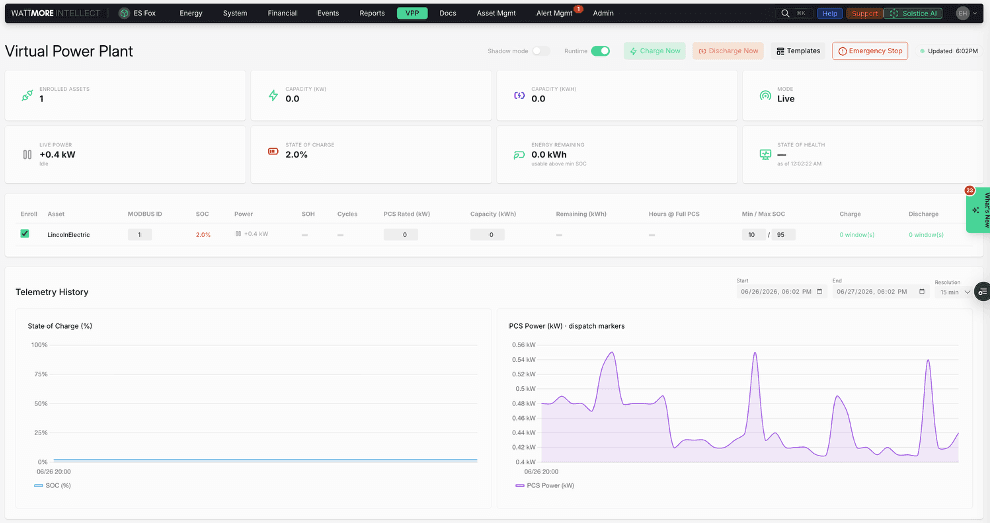
Intellect EnFORM is one unified, vendor agnostic platform that turns any fleet of solar and storage into a coordinated, dispatchable virtual power plant;from the edge device on the wall to the dispatch engine in the cloud. It closes the gap most solutions leave open, on one stack:
- See every asset. Portfolio-wide monitoring of energy, revenue, performance, and health across every site;one pane of glass for the whole fleet.
- Control every asset. Real-time and scheduled dispatch, with Time of Use control that keeps each site optimized even between events.
- Dispatch the whole fleet. Enroll assets into a single controllable resource and issue coordinated charge and discharge commands on demand.
- Works with any hardware. Truly vendor agnostic;any inverter, battery, or meter. No lock-in, no limits.
- Scales effortlessly. From a single pilot to thousands of sites on the same platform, without re-engineering.
- AI powered. Solstice AI turns fleet data into plain-language insight and optimization.
- Your brand, optionally. White-label the entire experience so your customers see a platform that is unmistakably yours.
The result is exactly what a virtual power plant is supposed to be: a monitoring and control layer on every asset, and a dispatch engine over the top that turns a scattered collection of batteries into a single, revenue capable power plant.
Turn your fleet into a power plant
The batteries are already going in the ground. The only question is whether they sit idle or go to work. WATTMORE was built to make them work;vendor agnostic, edge to cloud, one site or one thousand.
Explore Intellect EnFORM or talk to WATTMORE about standing up a virtual power plant on your fleet.