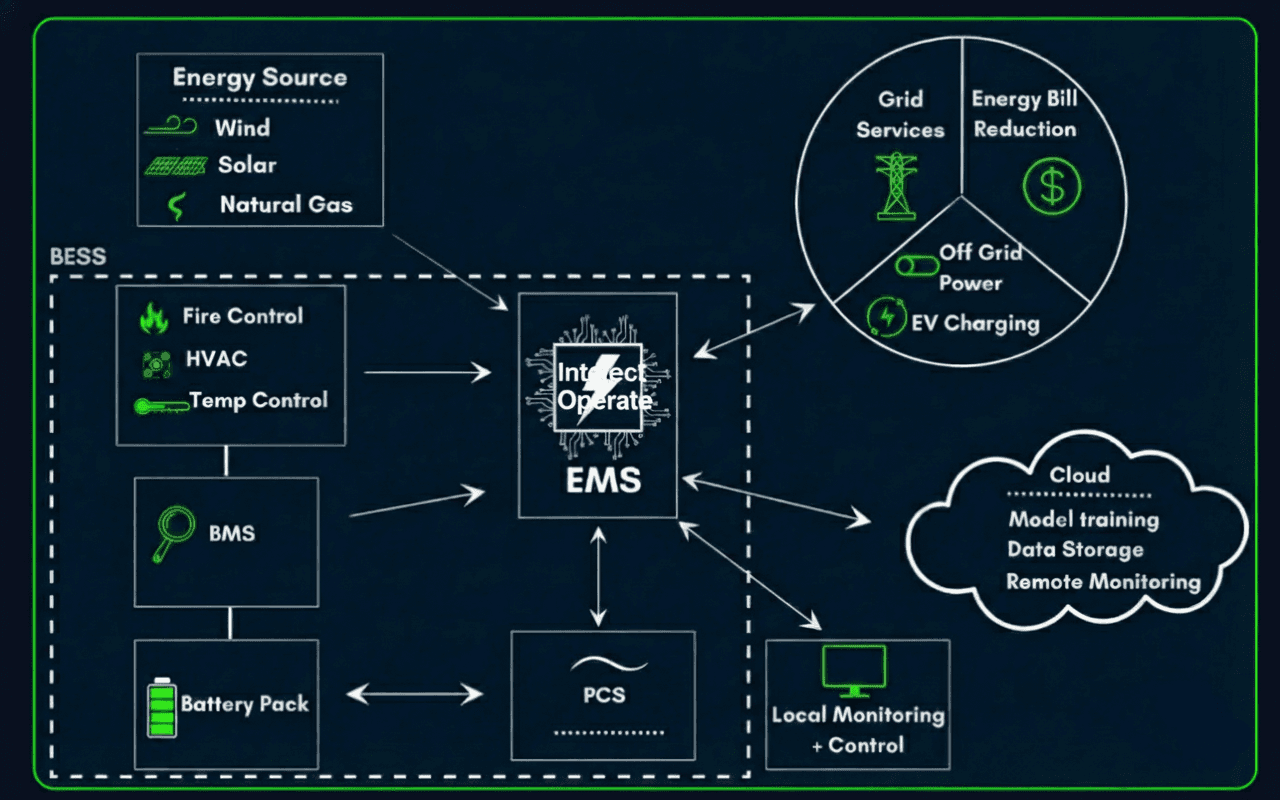
A battery energy management system (battery EMS) is the software platform that controls and optimizes the operation of a battery energy storage system. Whether you call it a storage EMS, an energy storage EMS, or a BESS EMS, it is the intelligence layer that decides when the battery charges, when it discharges, and how it takes part in energy markets and utility programs. The battery, the inverters, and the switchgear are the muscle; the EMS is the brain.
This guide covers what a battery energy management system does, how it works, how it differs from a BMS and from SCADA, what a good one looks like, and why it is the largest single driver of revenue on a storage project.
Why the EMS decides how much money a battery makes
Battery storage has become mainstream on the United States grid. According to the U.S. Energy Information Administration, United States utility scale battery capacity averaged 70 percent annual growth for three years and reached 43.6 GW by the end of 2025 (EIA). Almost none of that capacity earns money by sitting still. A battery is paid for doing the right thing at the right moment: absorbing cheap or surplus energy, releasing it when prices or demand peak, holding reserve for the grid operator, or responding to a frequency deviation within seconds.
Which of those things the battery does, and when, is entirely a software decision. Two identical batteries at identical sites can earn very different returns depending on how well their EMS forecasts, optimizes, and executes. That is why the EMS is best understood as an economic asset rather than an IT line item.
How a battery energy management system works
A battery EMS sits between the physical equipment and the project's economic objectives. It continuously ingests data from several sources:
- Battery management system (BMS): state of charge, cell voltages and temperatures, allowed charge and discharge limits, state of health, alarms
- Inverters and power conversion systems (PCS): active and reactive power, grid frequency and voltage, operating status
- Meters: site load, solar production, grid import and export at the point of interconnection
- External signals: wholesale energy prices, ancillary service awards, utility dispatch commands, tariff schedules, weather forecasts
From that data the EMS runs an optimization every few seconds. The objective is usually a mix of maximizing revenue or savings, staying inside warranty and safety constraints, and honoring any contractual obligations to a utility or grid operator. The result is a set of power setpoints sent to the inverters, and a schedule for the hours ahead that is revised as forecasts change.
In practice the loop looks like this: forecast load, solar, and prices; solve for the best charge and discharge plan; command the inverters for the next interval; measure what actually happened; repeat. The forecasting step matters because most of the value in storage depends on anticipating a peak or a price spike before it arrives, not reacting after the meter has already recorded it.
Core functions of a battery EMS
Real time dispatch
The primary function of any battery EMS is deciding how much the battery charges or discharges right now. That means solving an optimization that balances revenue, degradation, grid compliance, and battery health, then translating the answer into inverter setpoints while respecting the limits the BMS publishes.
Revenue optimization and value stacking
A battery EMS maximizes project economics by stacking value streams: demand charge reduction, time of use arbitrage, solar self consumption, frequency regulation, spinning reserve, capacity, and demand response. These streams compete for the same kilowatt hours, so the EMS has to jointly optimize rather than run them one at a time. Our guide to revenue stacking for battery storage goes deeper on how that tradeoff works.
The mix is changing. In ERCOT, Modo Energy measured the arbitrage share of battery revenue tripling from 25 percent to 76 percent in the twelve months to mid 2025, storing energy when prices are low and selling when they are high. Arbitrage rewards accurate forecasting and disciplined optimization far more than the fast, simple response that regulation markets rewarded a few years ago.
Grid services and market participation
Batteries that participate in wholesale markets or utility programs must respond to operator signals quickly and accurately. The EMS handles automatic generation control (AGC) setpoints, frequency response, voltage support, and demand response events, and it logs performance for settlement. Where an interconnection agreement requires plant level functions such as frequency droop, volt var control, or ramp rate limiting, those run in a power plant controller, which is either integrated into the EMS or coordinated with it.
Monitoring, alarming, and reporting
Beyond control, the EMS tracks every component, detects anomalies, raises alarms, and keeps the historical record that investors, utilities, incentive programs, and grid operators require. In most modern deployments the EMS includes the supervisory monitoring that a separate SCADA system used to provide.
Warranty and health management
Battery warranties specify limits on depth of discharge, charge and discharge rates, temperature, and annual energy throughput. A well designed EMS enforces those limits automatically and can trade a little revenue today for a longer useful life, which is worth far more over a fifteen year project.
Battery EMS versus SCADA versus BMS
These three systems are often confused, and the confusion is expensive. They serve different purposes:
- BMS (battery management system): hardware level protection built into the battery. It monitors cells and modules, balances them, prevents thermal runaway, and disconnects on a fault. Every battery has one regardless of what EMS is used.
- SCADA (supervisory control and data acquisition): supervision and record keeping. SCADA collects data, shows it to operators, raises alarms, and passes along manual or rule based commands. It does not decide what the battery should do to make money.
- Battery EMS: economic optimization and automated control. The EMS makes the dispatch decisions and turns a battery from a passive asset into an active one.
For a fuller comparison, read storage EMS versus SCADA and energy management system versus power plant controller.
What a good battery EMS looks like
When evaluating an EMS, the features that separate a strong platform from a basic controller are:
- Edge plus cloud architecture: the dispatch loop runs on site so the battery keeps working through a network outage; the cloud adds forecasting, fleet analytics, and reporting.
- Vendor agnostic integration: native Modbus RTU and TCP, DNP3, MQTT, and REST, with a real list of inverter and battery models already integrated.
- Forecast driven optimization: load, solar, and price forecasts feeding a solver, not a fixed schedule.
- Integrated grid compliance: a power plant controller with frequency droop, voltage control, and ramp limiting for sites that need it.
- Degradation aware dispatch: warranty limits enforced in software and cycling costs included in the optimization.
- Proof in the field: operating data from real sites, not just simulations.
Our guide to choosing the best energy management system for battery storage expands each of these into a vendor checklist.
Why the battery energy management system matters
The gap between a well optimized EMS and a basic control scheme is not a rounding error. On the sites WATTMORE operates, the EMS is the difference between a battery that shaves a demand peak and one that misses it, between capturing an evening price spike and sleeping through it. At E.S. Fox in Ontario, a 150 kW battery cut a 206 kW peak to 156 kW on the meter in a single event; at 303 Battery in Seattle, the EMS ran the system for seventeen months with no operator intervention, delivering 41 MWh back to the building with zero grid export. Neither result comes from the hardware alone.
For project developers, asset owners, and investors, the battery energy management system is not a software layer bolted on at the end. It is a core driver of project economics and should be chosen with the same rigor as the battery itself.
WATTMORE's Intellect Operate is a battery energy management system designed for exactly that job. See how it works, or request a demo.