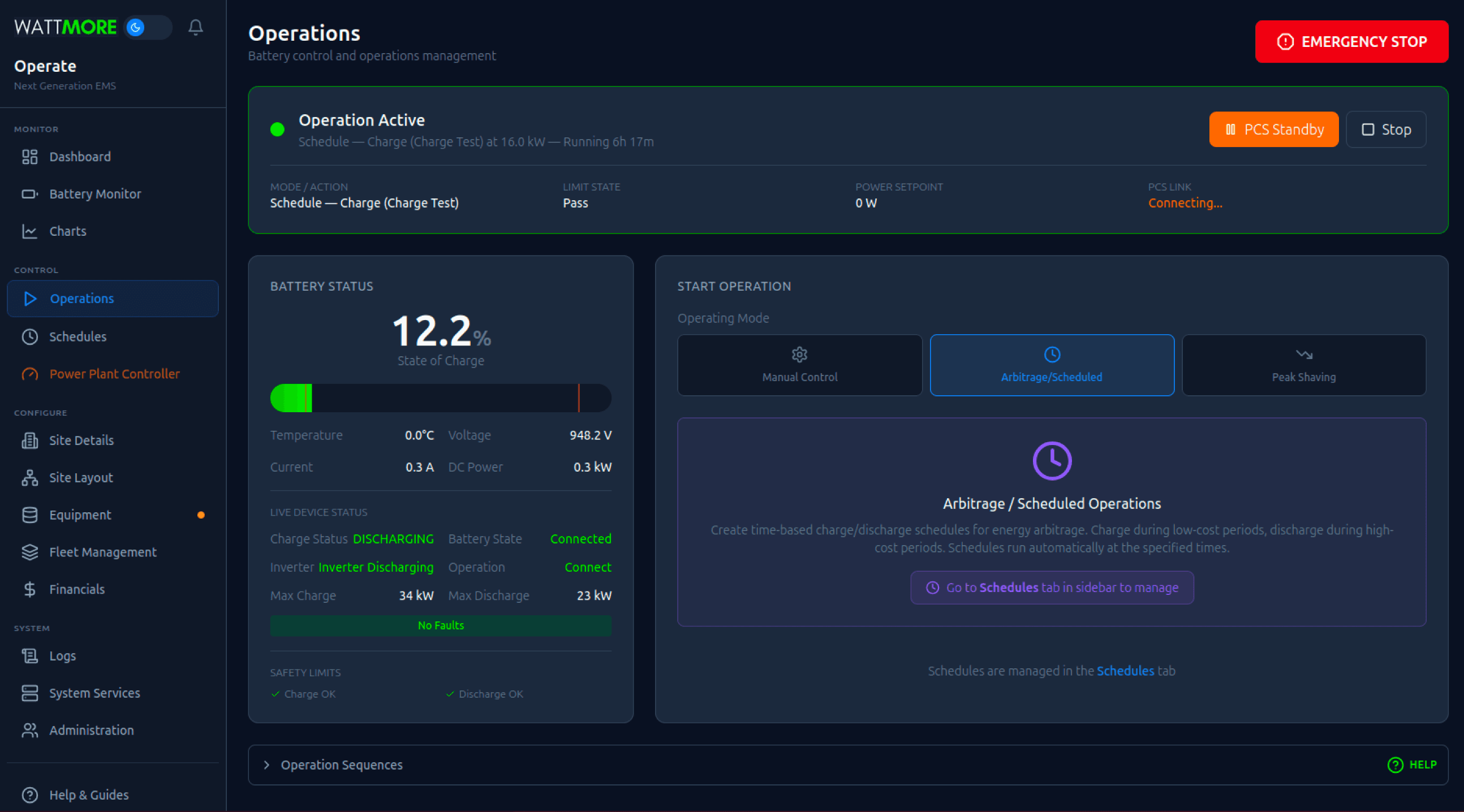
If you are developing, financing, or operating a battery energy storage system, you have almost certainly encountered two terms that cause persistent confusion: energy management system and power plant controller. Both are essential to a functioning BESS facility, but they serve fundamentally different purposes. Understanding the difference between an energy management system and a power plant controller is critical for making good procurement decisions and avoiding integration headaches that delay projects and reduce revenue.
What Is an Energy Management System?
An energy management system, or EMS, is the economic optimization layer of a battery energy storage system. The energy management system decides what the battery should do and when it should do it to maximize financial returns. It ingests market prices, weather forecasts, load data, contractual obligations, and battery state of health information, then computes optimal charge and discharge schedules across multiple revenue streams.
A well-designed energy management system handles a wide range of optimization objectives simultaneously. These include energy arbitrage, where the system buys low-cost energy and sells it at higher prices. They include demand charge management, frequency regulation, capacity market participation, and ancillary services. The energy management system balances all of these against battery degradation costs and warranty constraints to maximize net present value over the project lifetime.
The energy management system typically operates on timescales ranging from minutes to hours. It may re-optimize every five minutes based on updated price forecasts, or it may compute a day-ahead schedule that it refines in real time. The key characteristic is that the energy management system is concerned with economic outcomes: revenue, cost, margin, and long-term asset value.
WATTMORE's energy management system, Intellect Operate, exemplifies this approach with real-time dispatch optimization, multi-market revenue stacking, and hardware-agnostic integration across battery and inverter manufacturers.
What Is a Power Plant Controller?
A power plant controller, or PPC, is the real-time grid compliance layer of a BESS facility. The power plant controller ensures that the facility meets all electrical requirements at the point of interconnection, regardless of what the energy management system has requested. It operates on timescales of milliseconds to seconds, executing fast control loops for voltage regulation, frequency response, ramp rate limiting, and fault ride-through.
The power plant controller is the device that the utility or ISO communicates with directly. It receives curtailment commands, voltage setpoints, and AGC dispatch signals from the grid operator and translates those into coordinated actions across all inverters and power conversion equipment at the facility. The power plant controller is the single point of grid interface for the entire plant.
Unlike the energy management system, the power plant controller is not concerned with economics. It does not know or care what electricity prices are. Its sole objective is maintaining grid compliance and executing grid operator commands with the speed and accuracy required by the interconnection agreement, grid codes, and standards such as IEEE 2800.
WATTMORE's power plant controller, Intellect PPC, provides deterministic real-time control as an integrated add-on to Intellect Operate.
The Control Hierarchy: How EMS and PPC Work Together
The division of labor is reflected in how the standards bodies write about each layer. The DOE and Sandia energy storage handbook describes energy storage management systems as the layer that monitors and optimally controls storage systems and interoperates fleets with markets, utilities, and customers (DOE and Sandia energy storage handbook), which is the EMS role. The plant response functions belong to the compliance layer: NERC's inverter based resource guidance expects primary frequency response on approximately a 5 percent droop and defines the volt var behavior a plant controller must deliver (NERC), its battery storage guideline extends those characteristics into the charging region for four quadrant BESS operation (NERC battery storage guideline), and IEEE 2800 codifies the performance requirements for transmission connected inverter based resources as a whole (IEEE 2800).
In a properly architected BESS facility, the energy management system and power plant controller operate in a clear hierarchy. The energy management system sits above the power plant controller in the control stack. Here is how they interact:
- The energy management system computes an optimal dispatch target - Based on market conditions, forecasts, and battery constraints, the EMS determines that the facility should discharge at 50 MW for the next interval.
- The energy management system sends the setpoint to the power plant controller - The EMS communicates the 50 MW discharge target to the PPC.
- The power plant controller validates and executes the command - The PPC checks whether 50 MW is achievable given current grid conditions, ramp rate limits, voltage constraints, and any active curtailment orders from the grid operator. If the full 50 MW is permissible, the PPC distributes the setpoint across individual inverters. If grid conditions require a lower output, the PPC curtails accordingly.
- The power plant controller maintains real-time compliance - While executing the dispatch target, the PPC continuously adjusts reactive power for voltage regulation, enforces frequency droop response, and manages fault ride-through if a grid disturbance occurs.
The critical principle here is that the power plant controller always has authority to override the energy management system when grid compliance requires it. If the grid operator issues a curtailment to 30 MW, the power plant controller reduces output to 30 MW regardless of what the energy management system wants. Grid compliance is non-negotiable.
Why Both Are Necessary
Some developers ask whether they can use just an energy management system or just a power plant controller. The answer is no. You need both, and here is why:
Without an Energy Management System
A power plant controller alone can keep your facility grid-compliant, but it cannot optimize revenue. Without an energy management system, you have no intelligent dispatch logic. The battery would only respond to manual commands or grid operator signals. You would miss arbitrage opportunities, fail to stack revenue streams, and likely violate battery warranty terms due to unmanaged cycling patterns. A BESS project without an energy management system is a compliant asset that loses money.
Without a Power Plant Controller
An energy management system alone cannot satisfy interconnection requirements. Without a power plant controller, you have no real-time voltage regulation, no frequency droop response, no ramp rate enforcement, and no fault ride-through coordination. The utility will not grant you permission to operate. A BESS project without a power plant controller is an optimized asset that cannot connect to the grid.
The Integration Challenge with Separate Vendors
Here is where the industry runs into trouble. Most BESS projects today procure the energy management system from one vendor and the power plant controller from a different vendor. This creates an integration boundary that introduces several problems:
Communication Latency
When the energy management system and power plant controller are separate systems, they communicate over network protocols such as Modbus TCP or DNP3. Every setpoint change crosses a protocol translation layer, adding latency. In normal operation this is manageable, but during fast grid events, even small communication delays can cause the energy management system and power plant controller to fall out of sync.
Conflicting Assumptions
The energy management system may compute a dispatch schedule assuming the full rated capacity is available. But the power plant controller may be curtailing output due to a grid constraint the energy management system does not know about. Without tight integration, the energy management system cannot account for power plant controller constraints in its optimization, leading to suboptimal dispatch and lost revenue.
Finger-Pointing During Issues
When a grid compliance event occurs, the energy management system vendor and power plant controller vendor each point to the other as the cause. Was the problem a bad setpoint from the energy management system, or a control loop issue in the power plant controller? With separate vendors, diagnosing root cause requires correlating logs from two different systems with different timestamps and data formats. This wastes engineering time and delays resolution.
Double Commissioning Effort
Separate systems mean separate commissioning procedures. The power plant controller must be commissioned and tested against utility requirements, and then the energy management system must be commissioned and tested for correct interaction with the power plant controller. Any issue at the integration boundary requires both vendors on site, coordinating schedules and troubleshooting together.
Why WATTMORE Combines the Energy Management System and Power Plant Controller
WATTMORE recognized early that the separation between energy management system and power plant controller creates unnecessary risk and cost for BESS projects. That is why Intellect Operate and Intellect PPC are built as a single integrated platform.
In the WATTMORE architecture, the energy management system and power plant controller share the same compute environment, the same data layer, and the same engineering team. The energy management system has native visibility into power plant controller constraints, so it optimizes dispatch with full awareness of grid compliance requirements. The power plant controller receives setpoints internally with sub-millisecond latency, not over an external network protocol.
This integrated approach delivers measurable benefits:
- Higher revenue capture - The energy management system never requests setpoints that the power plant controller will override, eliminating unnecessary curtailment from integration mismatches.
- Faster commissioning - One system to commission, one vendor on site, one set of logs to review. Projects reach commercial operation faster.
- Lower operational risk - No integration boundary means no protocol translation failures, no conflicting assumptions, and no vendor finger-pointing.
- Single accountability - WATTMORE is responsible for both economic optimization and grid compliance. There is never ambiguity about who owns a problem.
Making the Right Architecture Decision
If you are evaluating energy management system and power plant controller options for a BESS project, consider these factors:
- Integration risk - How will the energy management system and power plant controller communicate? What happens when that communication link fails?
- Commissioning timeline - Can both systems be commissioned together, or do they require separate, sequential commissioning procedures?
- Accountability - When a grid compliance event occurs at 2 AM, who do you call? One vendor or two?
- Optimization awareness - Does the energy management system understand power plant controller constraints natively, or does it optimize in a vacuum and hope the power plant controller can execute?
The energy management system and the power plant controller are both essential. The question is not whether you need both, but whether you procure them as an integrated solution or as separate systems that must be stitched together in the field.
Explore Intellect Operate and Intellect PPC to see how WATTMORE delivers both the energy management system and power plant controller in a single platform, or contact us to discuss your project.