If you operate battery energy storage in Texas, four fifteen-minute windows each summer determine a significant share of your annual transmission costs. These are the ERCOT 4CP intervals, the four coincident peaks, and missing even one can cost a commercial or industrial site tens of thousands of dollars per year. WATTMORE's Intellect Operate now includes automated 4CP management that monitors grid conditions in real time, predicts coincident peak events, and dispatches your BESS to reduce load at exactly the right moment.
What Is ERCOT 4CP?
The mechanism is public and precise. ERCOT publishes the official four coincident peak calculations for each distribution service provider every summer month (ERCOT's official 4CP calculations), and its market materials define the 4CPs as the highest load fifteen minute settlement intervals in June through September (ERCOT). The money is public too: Oncor's transmission tariff allocates wholesale transmission cost at an annual access rate of about $22.71 per kW of average 4CP demand, and the delivery rates on retail bills carry separate per 4CP kW charges published in the PUCT rate report. A megawatt of avoided coincident peak demand is worth tens of thousands of dollars per year at those rates, which is why 4CP response is a first class use case for a Texas battery.
ERCOT 4CP stands for the four coincident peaks on the Electric Reliability Council of Texas grid. Each year during the months of June, July, August, and September, ERCOT identifies the single 15-minute interval in each month when total system-wide demand reaches its highest point. Your facility's metered demand during those four intervals determines your share of the statewide transmission cost for the following year.
This is not a demand charge in the traditional sense. It is a cost allocation mechanism. ERCOT divides the total cost of building and maintaining the Texas transmission grid among all customers based on how much load they contributed during those four peak intervals. If your facility was pulling significant power during a coincident peak, you pay a larger share of the entire grid's transmission costs for the next 12 months.
Why 4CP Matters Financially
Transmission costs allocated through 4CP typically range from $2 to $5 per kW per month, assessed against your average demand during the four coincident peak intervals. For a 10 MW facility, that can mean $240,000 to $600,000 per year in transmission charges alone. Even a single missed peak, where your facility was at full load during a coincident peak interval, can inflate your transmission costs for an entire year.
The financial asymmetry is extreme: a few minutes of load reduction during the right intervals can save hundreds of thousands of dollars annually, while the cost of missing a peak is baked into your bills for the following twelve months.
How 4CP Prediction Works
The challenge with 4CP is that nobody knows in advance exactly when the coincident peak will occur. ERCOT does not announce it. The peak is identified retroactively after each month ends. This means you have to predict which 15-minute interval will be the peak and respond proactively.
The Signals That Drive Prediction
Accurate 4CP prediction relies on several converging data streams:
- ERCOT system-wide load forecasts, ERCOT publishes day-ahead and real-time load forecasts. When forecast demand approaches historical peak levels, the probability of a coincident peak increases.
- Real-time system demand, actual system load data from ERCOT updated at short intervals. When real-time demand is tracking above the current month's highest recorded 15-minute interval, a new 4CP is forming.
- Weather data, temperature, humidity, and heat index across the ERCOT service territory. Extreme heat drives air conditioning load, which is the primary driver of summer peaks in Texas.
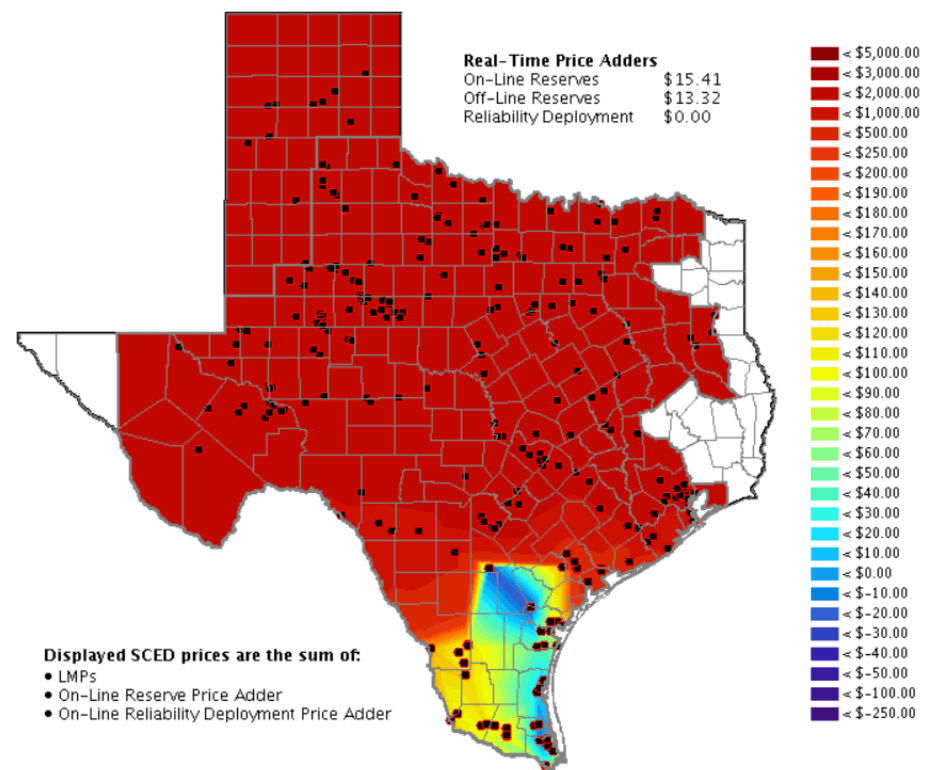
- Real-time pricing signals, SCED (Security-Constrained Economic Dispatch) prices and LMPs spike during peak demand periods. The image above shows real-time price adders across the ERCOT grid during a high-demand event, with prices exceeding $5,000/MWh across much of the state.
- Day-of-week and time-of-day patterns, 4CP events almost always occur on weekday afternoons between 2:00 PM and 6:00 PM during extreme heat waves.
WATTMORE's Prediction Engine
Intellect Operate aggregates all of these signals into a 4CP probability score that updates continuously throughout each summer day. When the probability crosses configurable thresholds, the system begins preparing the BESS for dispatch. The prediction algorithm considers not just whether today could be a peak, but how likely it is that a higher peak will occur later in the month, avoiding unnecessary battery cycling on days that are hot but not peak-setting.
How Intellect Operate Manages 4CP Response
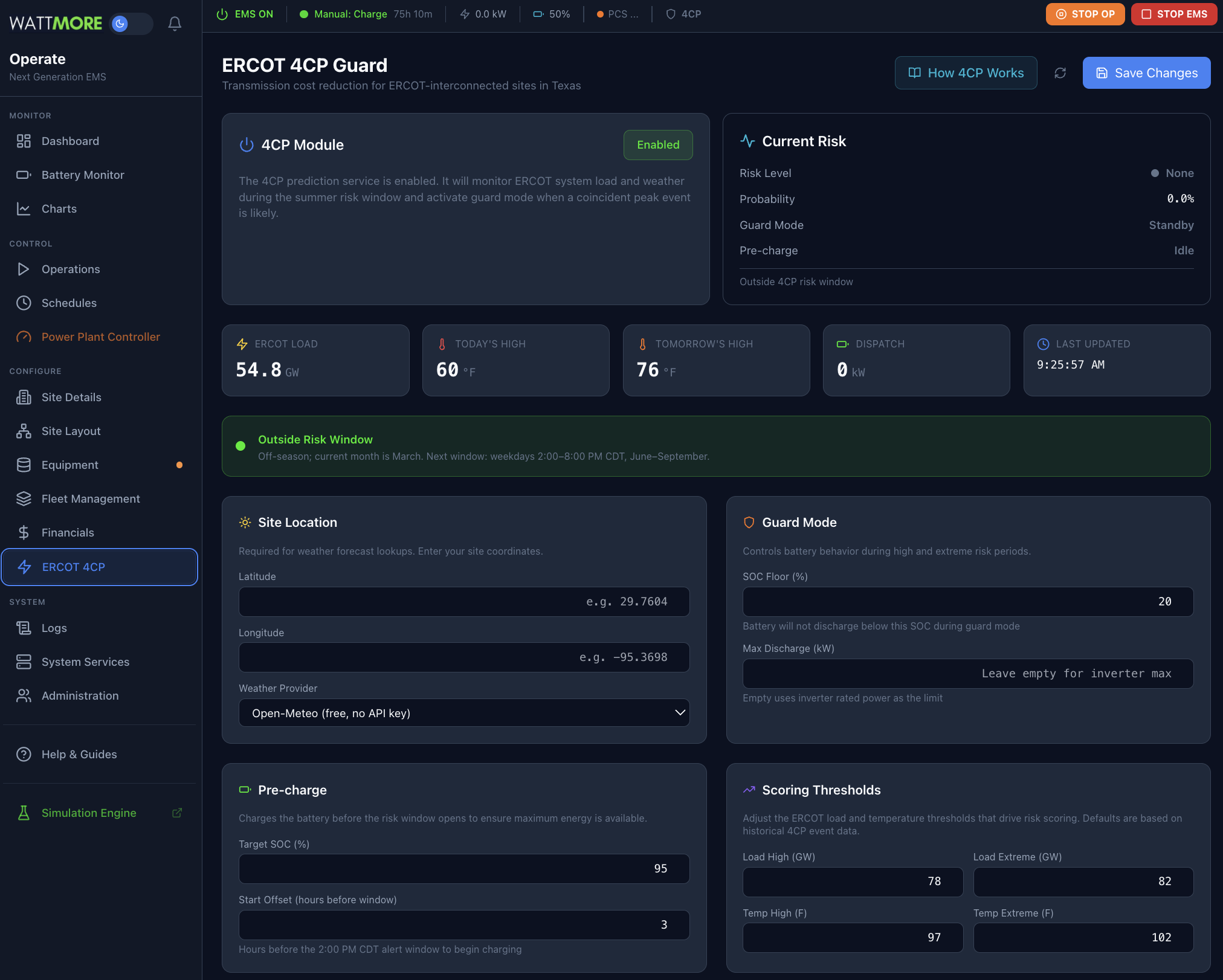
The screenshot above shows the ERCOT 4CP Guard interface inside Intellect Operate. The system monitors ERCOT load and weather in real time, calculates a risk probability score, and automatically manages guard mode, pre-charge targets, and scoring thresholds to protect your facility during coincident peak windows.
When the 4CP probability score crosses the alert threshold, Intellect Operate executes a coordinated response sequence:
1. Pre-Event Battery Preparation
Hours before a predicted peak window, the system ensures the BESS is at optimal state of charge. If the battery has been cycling for arbitrage or other value streams earlier in the day, the EMS shifts strategy to prioritize 4CP readiness. The system calculates the exact SOC needed to sustain full discharge through the peak window plus a safety margin, and charges the battery to that level.
2. Real-Time Peak Monitoring
During the afternoon peak window, Intellect Operate monitors both your site's metered demand and the ERCOT system-wide load simultaneously. The EMS tracks whether the current 15-minute interval is likely to become the month's coincident peak by comparing real-time system demand against the current monthly maximum.
3. Automated Dispatch
When the system confirms a high-probability 4CP event is in progress, Intellect Operate commands the BESS to discharge at maximum rate to offset your facility's grid draw. The goal is simple: reduce your metered demand to the lowest possible level during the 15-minute interval that becomes the coincident peak. Every kilowatt you shave during that window reduces your transmission cost allocation for the next 12 months.
4. Sustained Response
Because the exact 15-minute peak interval is uncertain, Intellect Operate sustains the discharge across the entire high-probability window, often two to four hours. The system continuously evaluates whether the peak has passed or whether load is still climbing, adjusting dispatch to maximize impact while managing battery SOC constraints.
5. Post-Event Analysis
After each potential 4CP event, the system logs your metered demand during the interval, calculates the estimated transmission cost impact, and reports how much the BESS response reduced your 4CP exposure. This data feeds back into the prediction model and provides clear documentation of the value the battery delivered.
Financial Impact: What 4CP Management Is Worth
The value of automated 4CP management depends on your facility's load profile and the size of your BESS, but the numbers are consistently significant:
- 5 MW commercial facility, reducing average 4CP demand by 3 MW saves approximately $72,000 to $180,000 per year in transmission charges.
- 10 MW industrial site, reducing average 4CP demand by 7 MW saves approximately $168,000 to $420,000 per year.
- 20 MW+ large commercial portfolio, coordinated 4CP management across multiple sites with BESS can save over $1 million annually in transmission cost allocation.
These savings are on top of any arbitrage, demand charge reduction, or grid services revenue the BESS generates during the rest of the year. 4CP management uses the battery for only a handful of hours each summer, leaving the vast majority of battery capacity available for other value streams.
4CP and Revenue Stacking
One of the key advantages of WATTMORE's approach is that 4CP management integrates seamlessly with the broader dispatch optimization in Intellect Operate. The EMS does not treat 4CP as a standalone program that overrides everything else. Instead, it incorporates 4CP probability into the overall optimization:
- On non-peak days, the BESS operates normally for arbitrage, frequency regulation, demand charge management, and other value streams.
- On potential 4CP days, the optimizer adjusts the dispatch schedule to reserve sufficient SOC for peak response while still capturing other revenue where possible.
- During confirmed 4CP events, peak response takes priority because the annualized financial value of 4CP avoidance far exceeds the opportunity cost of a few hours of alternative dispatch.
This dynamic prioritization means BESS owners capture the full annual value of 4CP management without sacrificing the other revenue streams that justify the battery investment in the first place.
Why Automation Matters
Some BESS operators try to manage 4CP manually, watching weather forecasts, monitoring ERCOT dashboards, and triggering battery dispatch by hand. This approach has serious limitations:
- Reaction time, by the time a human recognizes that a 4CP event is underway, the peak interval may already be half over. The BESS needs to be discharging before the peak, not after.
- False positives, without a data-driven prediction model, operators tend to either respond too aggressively (wasting battery cycles on non-peak days) or too conservatively (missing actual peaks).
- Weekends and after-hours, while 4CP events are most common on weekday afternoons, the system needs to be vigilant every day during the summer months. Automated systems do not take days off.
- Multi-site coordination, for portfolio operators with BESS at multiple facilities, manually coordinating 4CP response across sites is operationally impractical.
Intellect Operate eliminates all of these risks by running continuous, automated 4CP monitoring and response from June through September; no human intervention required.
Getting Started with 4CP Management
WATTMORE's 4CP management capability is available as part of Intellect Operate for any BESS operating in the ERCOT market. If you already run Intellect Operate, enabling 4CP response is a configuration change; no new hardware, no additional integration. The system uses the same edge+cloud architecture, the same BESS controls, and the same real-time data feeds that already power your dispatch optimization.
For BESS owners evaluating a new EMS or considering switching from a platform that does not offer 4CP management, the transmission cost savings alone often justify the decision. A battery that sits idle during four critical intervals each summer is leaving six figures of value on the table.
Contact WATTMORE to learn how automated 4CP management can reduce your ERCOT transmission costs and add a new high-value revenue stream to your BESS portfolio.