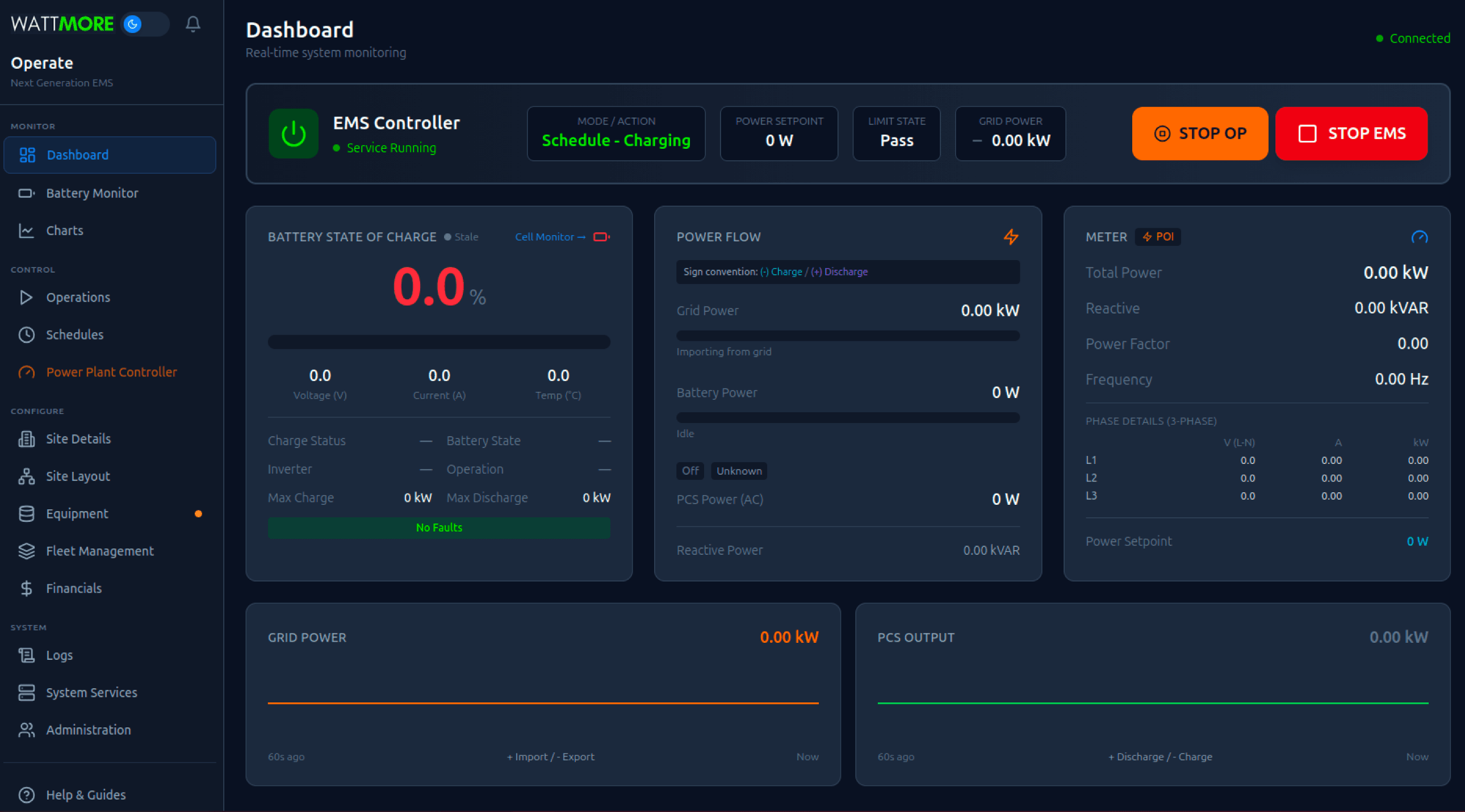
Selecting the best energy management system for a battery storage project is one of the highest-leverage decisions a developer or asset owner will make. The energy management system controls every dispatch decision for the life of the asset. It determines how much revenue your battery captures, how quickly it degrades, and whether it meets contractual obligations to offtakers and grid operators. Getting the energy management system right means the difference between a project that exceeds investor returns and one that underperforms from day one.
This guide covers what to look for in a battery energy management system, the features that separate the best energy management system platforms from the rest, common mistakes to avoid, and why Intellect Operate from WATTMORE consistently outperforms competing energy management system solutions.
What Does an Energy Management System Do for Battery Storage?
The market context keeps raising the bar. United States utility scale battery capacity reached 43.6 GW by the end of 2025 after three years of roughly 70 percent annual growth (EIA), and as fleets have grown, revenue has migrated toward skill: Modo Energy's analysis of ERCOT shows energy arbitrage tripling from 25 percent to 76 percent of battery revenue in the twelve months to mid 2025, while CAISO's market monitor reports batteries now supply the large majority of that grid's regulation. Both trends reward the same thing: an EMS that forecasts well and optimizes relentlessly. In saturated ancillary markets and volatile energy markets alike, the controls are the difference between an asset that rides the averages and one that captures the peaks.
An energy management system for battery storage, sometimes called a battery energy management system or storage energy management system, is the optimization and control software that operates a battery energy storage system (BESS). The energy management system ingests real-time data from the battery management system, inverters, meters, weather services, and market feeds. It then computes optimal charge and discharge commands that maximize economic value while respecting battery constraints and grid requirements.
The scope of a modern energy management system extends well beyond simple charge and discharge scheduling. A best-in-class energy management system handles:
- Real-time economic dispatch - Continuous optimization of power output based on current market prices, grid conditions, and battery state.
- Multi-market revenue stacking - Simultaneous participation in energy arbitrage, frequency regulation, capacity markets, demand response, and ancillary services.
- Battery health management - Enforcing depth-of-discharge limits, temperature constraints, and cycling patterns that protect battery warranty and extend useful life.
- Forecasting - Predicting energy prices, load patterns, and renewable generation to inform forward-looking dispatch decisions.
- Reporting and settlement - Generating the data needed for market settlement, regulatory compliance, and investor reporting.
The energy management system is the economic brain of your BESS project. Every dollar of revenue flows through its dispatch decisions.
Key Features of the Best Energy Management System for Battery Storage
Real-Time Dispatch, Not Scheduled Dispatch
Many energy management system platforms compute a dispatch schedule hours in advance and then follow it rigidly. The best energy management system solutions operate differently. They re-optimize continuously, adapting to real-time changes in market prices, grid conditions, and battery state. The energy management system should make a new dispatch decision at least every few seconds, not every fifteen minutes.
Why does this matter? Energy markets move fast. A real-time price spike that lasts eight minutes represents significant revenue opportunity. An energy management system that only updates its schedule every fifteen minutes will miss it entirely. The best energy management system captures these fleeting opportunities because it is always computing, always adapting.
Hardware-Agnostic Architecture
The best energy management system works with any battery manufacturer, any inverter vendor, and any balance-of-plant equipment. Hardware lock-in is one of the biggest risks in the BESS industry. If your energy management system only works with one brand of inverter, you lose procurement leverage, you cannot take advantage of supply chain opportunities, and you create single points of failure.
Look for an energy management system that supports standard communication protocols including Modbus RTU, Modbus TCP, DNP3, MQTT, OPC-UA, and REST APIs. The energy management system should have a driver library that covers all major battery and inverter manufacturers, and the vendor should be able to integrate new hardware within weeks, not months.
Edge Computing Plus Cloud Analytics
The architecture of an energy management system matters enormously. A purely cloud-based energy management system is vulnerable to network outages. If the internet connection to your site drops, a cloud-only energy management system cannot dispatch the battery. Your asset sits idle while revenue opportunities pass by.
The best energy management system combines edge computing at the site with cloud analytics for fleet management. The edge layer runs the real-time dispatch engine locally, ensuring the battery operates optimally even during network interruptions. The cloud layer provides portfolio-level visibility, AI-driven optimization updates, historical analytics, and remote monitoring across all sites. This edge-plus-cloud architecture is the industry best practice for energy management system deployment.
Integrated Power Plant Controller
One of the most overlooked features when evaluating an energy management system is whether it includes an integrated power plant controller. The power plant controller handles real-time grid compliance: voltage regulation, frequency droop response, ramp rate limiting, and fault ride-through. Most energy management system vendors do not provide a power plant controller, which means you need to procure one separately and manage the integration between them.
The best energy management system includes a tightly integrated power plant controller so that economic optimization and grid compliance work together seamlessly. When the energy management system understands power plant controller constraints natively, it avoids requesting dispatch targets that the power plant controller will override. This eliminates unnecessary curtailment and increases revenue capture. WATTMORE's Intellect Operate is built with this integrated architecture from the ground up.
Sophisticated Battery Degradation Modeling
An energy management system that maximizes short-term revenue at the expense of battery life is not actually optimizing. The best energy management system incorporates detailed electrochemical degradation models that quantify the cost of every charge and discharge cycle in terms of battery capacity loss. It then balances revenue opportunity against degradation cost to maximize the total economic value of the asset over its entire lifetime.
This requires the energy management system to model calendar aging, cycle aging, depth-of-discharge effects, temperature effects, and C-rate effects. Simple rule-based constraints like "never discharge below 10% SOC" are not sufficient. The best energy management system treats degradation as a continuous cost function that influences every dispatch decision dynamically.
Fleet Management and Scalability
If you operate or plan to operate more than one BESS site, the energy management system must support fleet-level management. This includes centralized monitoring of all sites, portfolio-level optimization that coordinates dispatch across facilities, standardized configuration management, and remote software updates. An energy management system that works well for a single site but cannot scale to a fleet will become a bottleneck as your portfolio grows.
Common Mistakes When Choosing an Energy Management System
Choosing on Price Alone
The energy management system is not a commodity. The difference between the best energy management system and a mediocre one is measured in millions of dollars of captured revenue over the project lifetime. An energy management system that costs $50,000 more upfront but captures 5% more revenue on a 100 MW system will pay for itself many times over in the first year alone. Evaluate energy management system vendors on total value delivered, not on license cost.
Confusing SCADA with an Energy Management System
SCADA systems monitor and visualize plant data. They do not optimize dispatch. Many BESS projects have been deployed with basic SCADA that can display battery state of charge and allow manual charge/discharge commands, but with no automated optimization. This is not an energy management system. If your "energy management system" cannot compute an optimal dispatch schedule without human intervention, it is SCADA with a marketing label.
Ignoring the Power Plant Controller Integration
As discussed above, the energy management system and power plant controller must work together. Choosing an energy management system without considering how it integrates with the power plant controller creates a seam in your control architecture that will cause problems during commissioning and operation. The best energy management system either includes a power plant controller or has a proven, tested integration with a specific power plant controller product.
Not Verifying Real-World Performance
Every energy management system vendor claims best-in-class optimization. Few can back it up with auditable performance data. Before selecting an energy management system, ask for case studies with actual dispatch data, revenue figures, and third-party verification. Ask for references from operating projects, not just projects in development. The best energy management system vendors are proud to share their track record because the numbers speak for themselves.
Overlooking Cybersecurity
The energy management system has direct control over high-value grid-connected assets. A compromised energy management system could cause physical damage to equipment, violate grid regulations, or be used to manipulate energy markets. Evaluate the energy management system vendor's cybersecurity posture: encrypted communications, role-based access control, audit logging, SOC 2 compliance, and vulnerability management practices. This is not optional for critical infrastructure.
Why Intellect Operate Is the Best Energy Management System for Battery Storage
WATTMORE built Intellect Operate specifically to address the shortcomings of existing energy management system products in the battery storage market. Here is what sets it apart:
- True real-time dispatch - Intellect Operate re-optimizes continuously, capturing revenue from short-duration market events that schedule-based energy management system platforms miss.
- Integrated power plant controller - Intellect PPC is built into the same platform, eliminating the integration boundary that causes problems with separate energy management system and power plant controller vendors.
- Hardware agnostic - Intellect Operate supports all major battery and inverter manufacturers through a comprehensive protocol driver library. No hardware lock-in, no procurement constraints.
- Edge plus cloud - Real-time dispatch runs at the edge for maximum reliability. Fleet analytics, AI optimization, and remote management run in the cloud for maximum visibility.
- Advanced degradation modeling - The energy management system incorporates electrochemical battery models that optimize the tradeoff between revenue and asset longevity at every dispatch interval.
- Proven performance - Intellect Operate is deployed on operating BESS projects with auditable revenue data demonstrating top-quartile performance.
Evaluating Energy Management System Vendors: A Checklist
Use this checklist when evaluating energy management system options for your battery storage project:
- Does the energy management system perform real-time dispatch or schedule-based dispatch?
- Does the energy management system support multi-market revenue stacking?
- Is the energy management system hardware agnostic, or does it require specific battery or inverter brands?
- Does the energy management system use edge computing for local reliability?
- Does the energy management system include or integrate with a power plant controller?
- Does the energy management system incorporate battery degradation modeling in its optimization?
- Can the energy management system scale to manage a fleet of BESS sites?
- Can the vendor provide case studies with auditable revenue data from operating projects?
- Does the energy management system meet cybersecurity requirements for critical infrastructure?
The energy management system you select will control every dispatch decision for the 20-plus year life of your battery storage asset. It is worth investing the time to evaluate vendors thoroughly and select the best energy management system available.
Explore Intellect Operate, learn about our energy management system capabilities, or contact WATTMORE to schedule a technical demonstration.