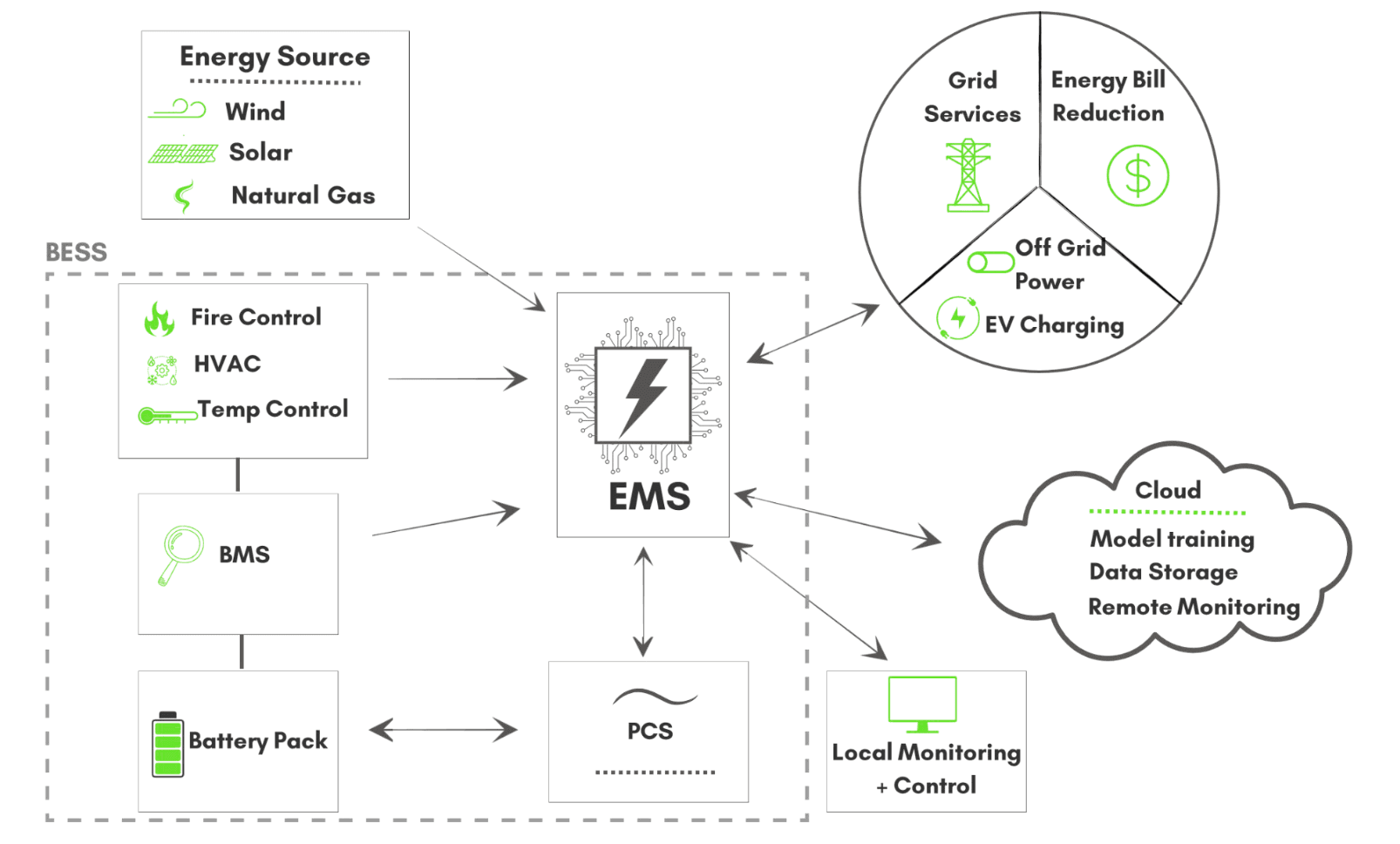
In the energy storage industry the terms "storage EMS" and "SCADA" are sometimes used as if they meant the same thing. They do not. SCADA is a supervisory system that collects data and lets operators see and steer equipment. A storage EMS is a decision system that works out what the battery should do next and does it automatically. Understanding the distinction is essential for anyone specifying, buying, or operating a battery energy storage system, because a project that buys SCADA and expects EMS results will underperform for its entire life.
What is SCADA?
SCADA stands for supervisory control and data acquisition. The National Institute of Standards and Technology describes SCADA systems as the control systems used to monitor and control geographically dispersed assets, gathering data from field devices and sending operator commands back to them (NIST). In energy storage, a SCADA system collects data from batteries, inverters, meters, and switchgear; displays it on operator dashboards; keeps a historian; raises alarms; and forwards manual or rule based commands.
SCADA has been the standard for supervising power plants for decades. It is excellent at what it was built for: reliable data acquisition, visibility, alarm management, and a well understood interface to utilities and grid operators. The key word is supervisory. SCADA reports what is happening and lets a person or a simple rule respond.
What is a storage EMS?
A storage EMS, or battery energy management system, goes beyond supervision to actively optimize battery dispatch. Where SCADA shows you what is happening, an EMS decides what should happen and then makes it happen, every few seconds, without waiting for an operator.
A storage EMS reads the same sources SCADA does, meters, inverters, the battery management system, weather stations, and adds the layers SCADA lacks: forecasts of load, solar, and prices; a model of the tariff or market; the battery's warranty and degradation constraints; and an optimization engine that solves for the best charge and discharge plan across all of it. The output is a stream of inverter setpoints and a rolling schedule for the hours ahead. Our guide to battery energy management systems covers the internals.
Key differences
Supervision versus decision
SCADA is passive by design. It monitors, records, and alerts; dispatch decisions are manual or follow simple rules such as "charge below this price, discharge above that one." An EMS uses forecasting and optimization to consider dozens of variables at once and choose the dispatch that maximizes value while respecting every constraint.
Data collection versus economic optimization
SCADA collects operational data and presents it to people. An EMS consumes that data plus market signals, weather forecasts, load predictions, and tariff structures, and turns them into a plan. The difference matters most for the value streams that depend on timing. A monthly demand charge is set by the single highest fifteen minute interval; a forecasting EMS positions the battery before that interval, while a rule waits for the meter to prove the peak has arrived.
Rules versus learning
Traditional SCADA runs fixed logic. A modern EMS uses predictive models that adapt to changing load patterns, seasons, and prices, and improves as it accumulates site history. On WATTMORE sites the EMS forecasts the coming week from historical intervals and revises the plan continuously as the day unfolds.
Single site versus fleet
SCADA typically supervises one plant. A modern storage EMS provides fleet level management: comparing performance across sites, sharing forecasts and models, and allowing a small operations team to run a large portfolio from one interface.
Where the layers meet: the control hierarchy
On a compliant battery plant, three layers work together. The EMS produces the economic schedule. The power plant controller executes the fast grid functions the interconnection agreement requires, such as frequency droop, voltage and reactive power control, and ramp rate limiting; IEEE 2800 sets the performance requirements for inverter based resources connecting to transmission systems, and the PPC is where a plant meets them (IEEE 2800). SCADA, or the SCADA functions inside the EMS, supervises everything and provides the telemetry and dispatch interface to the utility or ISO. When those layers come from one vendor they share one clock, one data model, and one commissioning; when they do not, integration becomes the project risk. We wrote about that in energy management system versus power plant controller.
Do you need both?
In most modern deployments a comprehensive storage EMS includes SCADA level monitoring. The EMS collects all the same data points, provides dashboards, alarms, and a historian, and adds the optimization layer on top. You get supervision and control in a single platform, which is how Intellect Operate is built.
Some projects, particularly large utility scale sites with detailed interconnection requirements, still run a dedicated SCADA interface to the utility. In those cases the EMS integrates with SCADA over DNP3 or Modbus and handles the economic optimization while SCADA handles the utility facing telemetry. What you should avoid is the reverse: treating a SCADA portal with a scheduling screen as an EMS.
The revenue impact
The difference is measurable on a meter. Utility scale batteries are increasingly earning their money through energy arbitrage rather than ancillary services; in ERCOT the arbitrage share of battery revenue tripled from 25 percent to 76 percent in a single year (Modo Energy). Arbitrage is a forecasting and optimization problem, exactly the problem SCADA does not solve. Behind the meter, the same logic applies to demand charges: at E.S. Fox in Ontario, the EMS forecasts a week of fifteen minute intervals, sets a target peak, and discharges within one control cycle when load crosses it, which is how a 206 kW gross peak was recorded as 156 kW on the utility meter.
Over a fifteen year project life, the gap between supervising a battery and optimizing it compounds into a large share of the asset's total return. Choosing the EMS deserves the same attention as choosing the battery.
WATTMORE's Intellect Operate combines full SCADA grade monitoring with forecast driven dispatch optimization and an integrated power plant controller. Talk to us about how it would run your site.