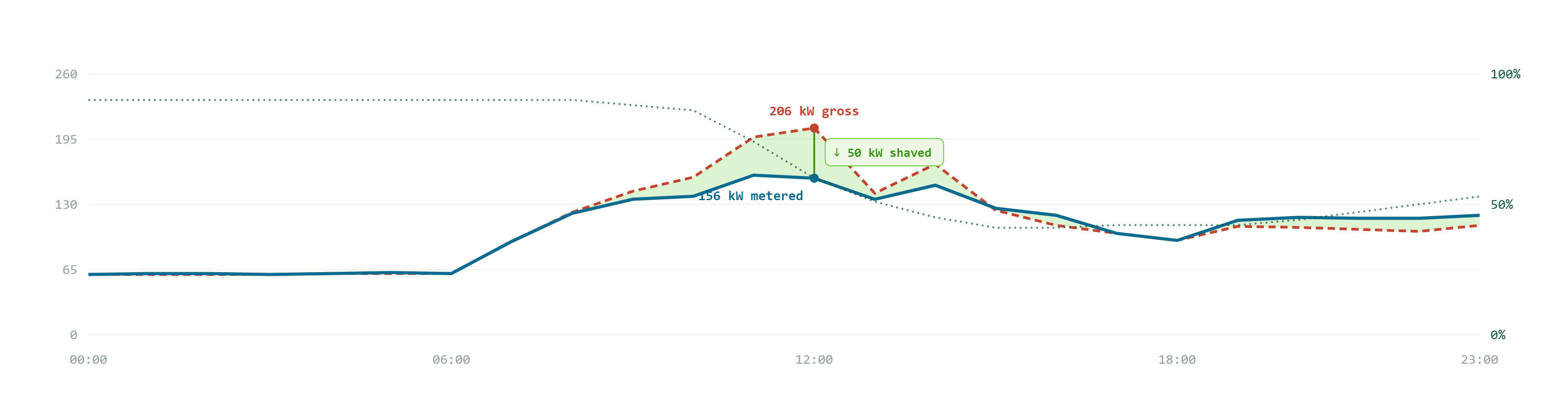
At an industrial fabrication facility in Thorold, Ontario, a 150 kW / 444 kWh battery is quietly rewriting the monthly power bill. E.S. Fox Limited’s behind-the-meter storage system, controlled end-to-end by WATTMORE’s Intellect Operate, targets the single number that drives industrial electricity costs, the monthly demand peak, and is modeled to cut it by roughly half.
This is the first in a series of field-performance reports drawn from live WATTMORE deployments. It walks through how the system works, how the savings are measured honestly from real data, and what the first four months of live operation have shown.
The one number that sets the bill
At E.S. Fox, the monthly electricity bill is driven by the facility’s highest 15-minute demand peak. Utilities bill large industrial customers on their single highest 15-minute average of the month, not on total energy consumed. At a demand rate of $26.37/kW, one 200 kW spike can add thousands of dollars to the bill for fifteen minutes of demand.
The key insight is that demand is a rolling 15-minute average. A brief five-second spike doesn’t set the peak, the average across the full 15-minute window does. That makes it a near-perfect use case for a fast battery: discharge precisely against the peaks, hold the metered load under a target, and the utility meter never sees the spike.
- Billing basis: rolling 15-minute average peak
- Modeled annual facility peak: 347 kW
- Load factor: 22%, a spiky, peak-driven load
The asset
E.S. Fox Limited is a major industrial fabrication and construction firm. At its Thorold (Port Robinson) facility, a battery energy storage system sits behind the meter to manage demand charges, the largest controllable line item on the power bill. The system pairs TROES LFP battery hardware with Intellect Operate, which reads the grid meter and commands the inverter through a single integrated controller over Modbus TCP.
- Power · energy: 150 kW · 444 kWh (3.0-hour duration)
- Power conversion: Sinexcel PCS
- Battery · BMS: TROES LFP
- Controller · meter: WATTMORE EMS / WattNode
- Control loop: 20 Hz over Modbus TCP
The control strategy: three tiers, one objective
Intellect Operate combines proactive scheduling with real-time feedback in a three-tier controller. Each tier runs at a different timescale, and together they plan the peak, hold the 15-minute average, and enforce the limit.
Tier 1 · Plan the peak (MIP optimizer, every 60 s)
A mixed-integer solver forecasts the next seven days from historical load, 672 fifteen-minute intervals, and sets the target peak that minimizes the month’s demand charge.
Tier 2 · Hold the average (energy dispatch, 20 Hz)
Energy targets become power, and the limit is re-trimmed in real time. If a spike hits early in a window, the controller makes up the budget to keep the 15-minute average on target through closed-loop accounting.
Tier 3 · Enforce the limit (PI controller, 4 Hz)
A PI loop (Kp 0.6, Ki 0.1) commands the inverter to hold net load under the limit, reacting within 250 ms of any violation and settling in two to six seconds. The integration is vendor-agnostic, the same platform talks to the Sinexcel PCS, the TROES BMS, and the meter over Modbus TCP.
Anatomy of a peak-shaving event
On 23 February 2026, facility demand surged toward a midday peak. Intellect Operate discharged the battery so the utility meter never saw it, and by reconstructing the gross load (meter + battery power), we can show exactly what was shaved.
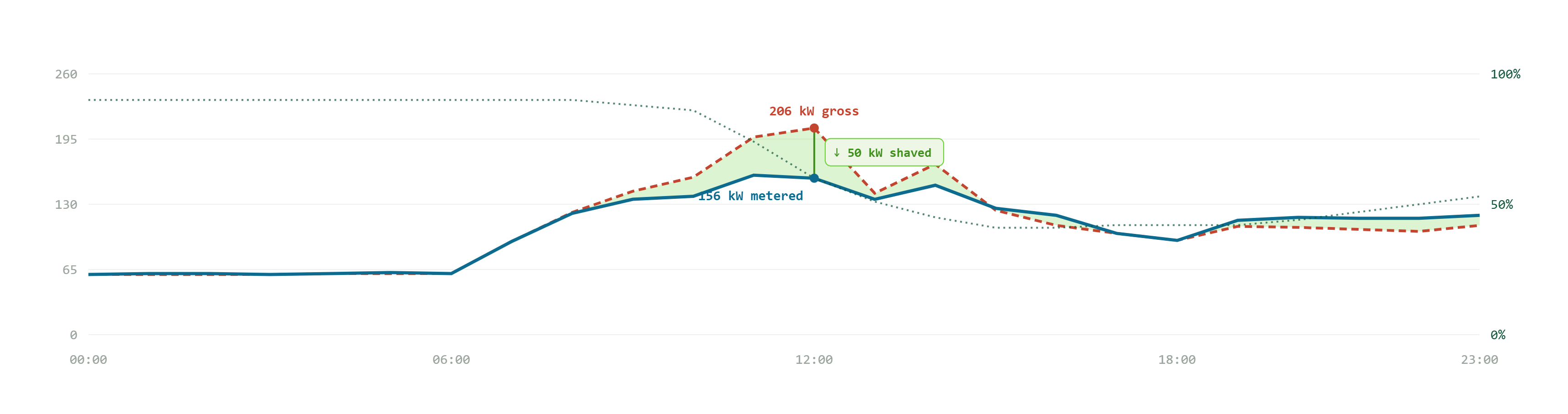
Gross load vs. metered demand, 23 Feb 2026. The dashed line is the facility’s true demand; the solid line is what the utility meter recorded.
- Gross peak (true demand): 206 kW, what the facility actually drew at noon
- Metered peak (billed): 156 kW, what the utility meter recorded
- Shaved off the peak: 50 kW, 24% lower, roughly $1,300 in avoided demand
Speed: catching the spike
When load jumps to 180 kW, the PI controller discharges within one 4 Hz cycle and settles net load back to the 150 kW limit in two to six seconds.
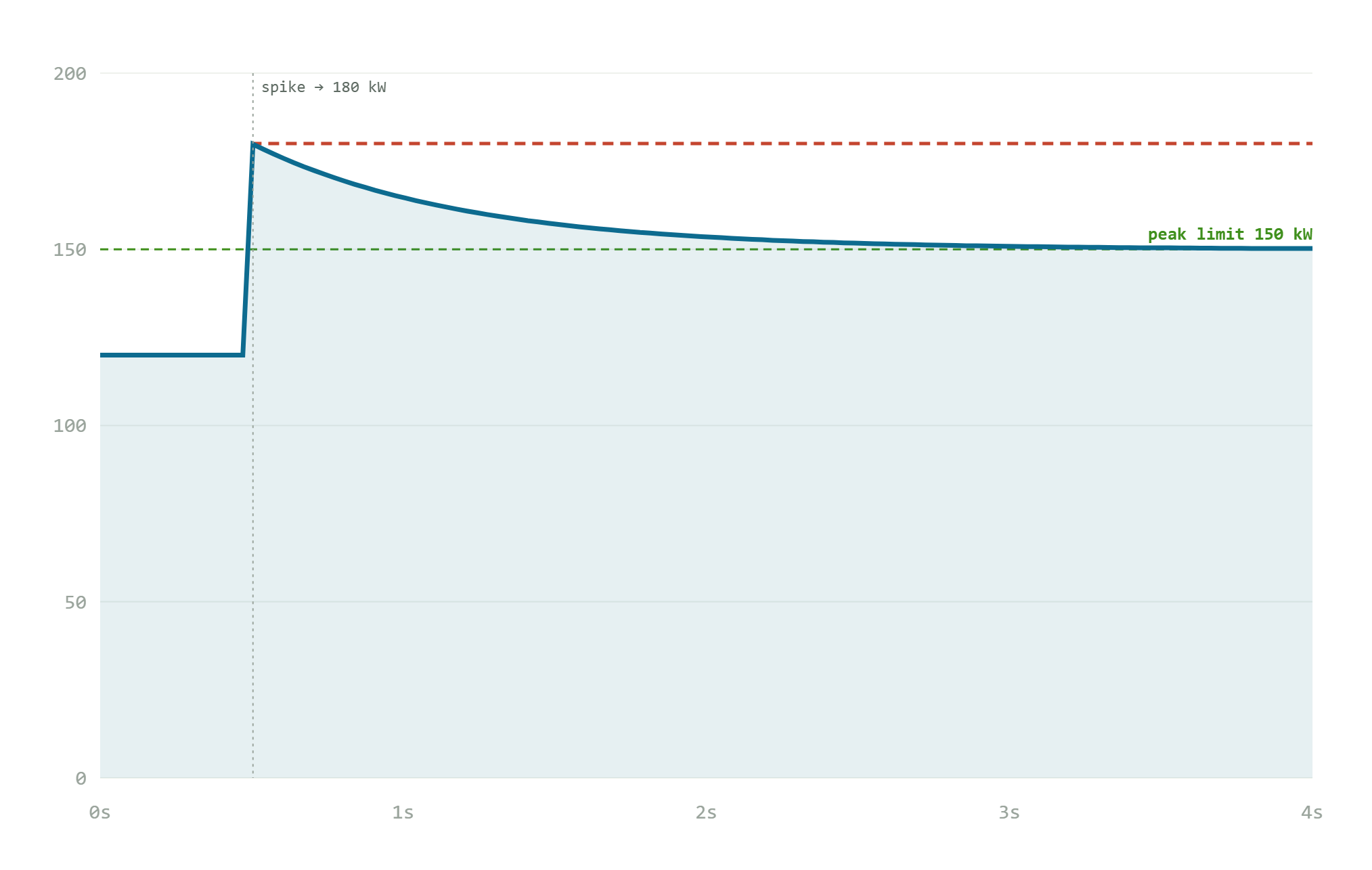
The PI controller catching a 180 kW spike, gross spike vs. net controlled load.
Measurement runs at 20 Hz to catch fast transients; actuation runs at 4 Hz to match the inverter. Splitting the two keeps energy accounting accurate without oscillating the battery, 250 ms to actuation, two to six seconds to settle.
Honest measurement: a real counterfactual
The hard question for any storage asset is the counterfactual: what would the peak have been without the battery? Intellect Operate answers it from measured data alone, no models, no assumptions.
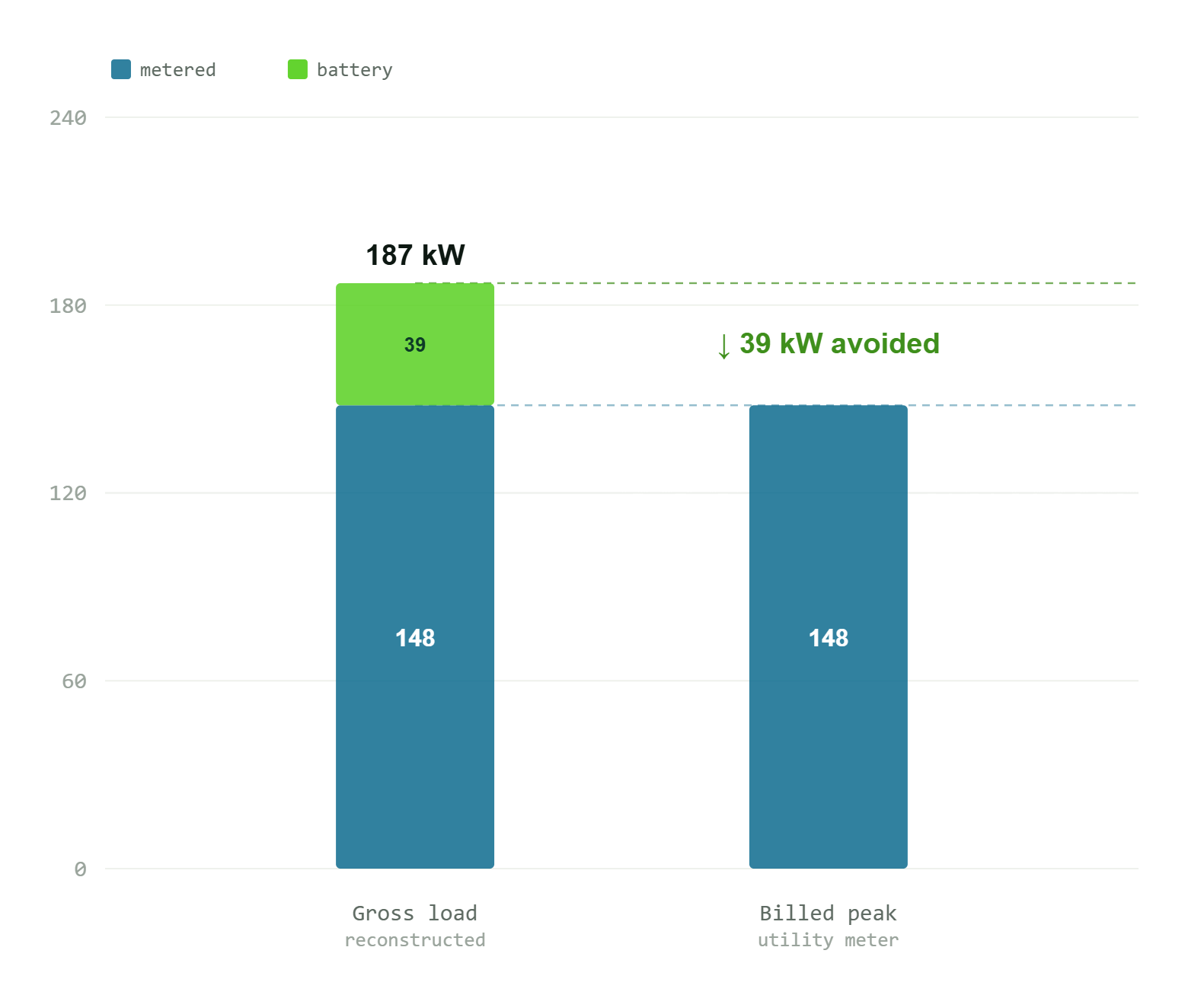
Reconstructing the peak: gross load = metered load + battery power.
Adding the battery’s contribution back to the metered load reconstructs exactly what the facility consumed, the demand the utility would have billed. Savings are then simply the gap between that reconstructed peak and the metered peak, times the demand rate. In the example above, a 39 kW gap at $26.37/kW is roughly $1,028 in avoided demand charges that month. Every figure traces back to a real measurement.
The opportunity: modeled demand reduction and ROI
Before deployment, a full year of the facility’s load was run through the sizing model. Month after month, the battery cuts the billed peak by roughly half.
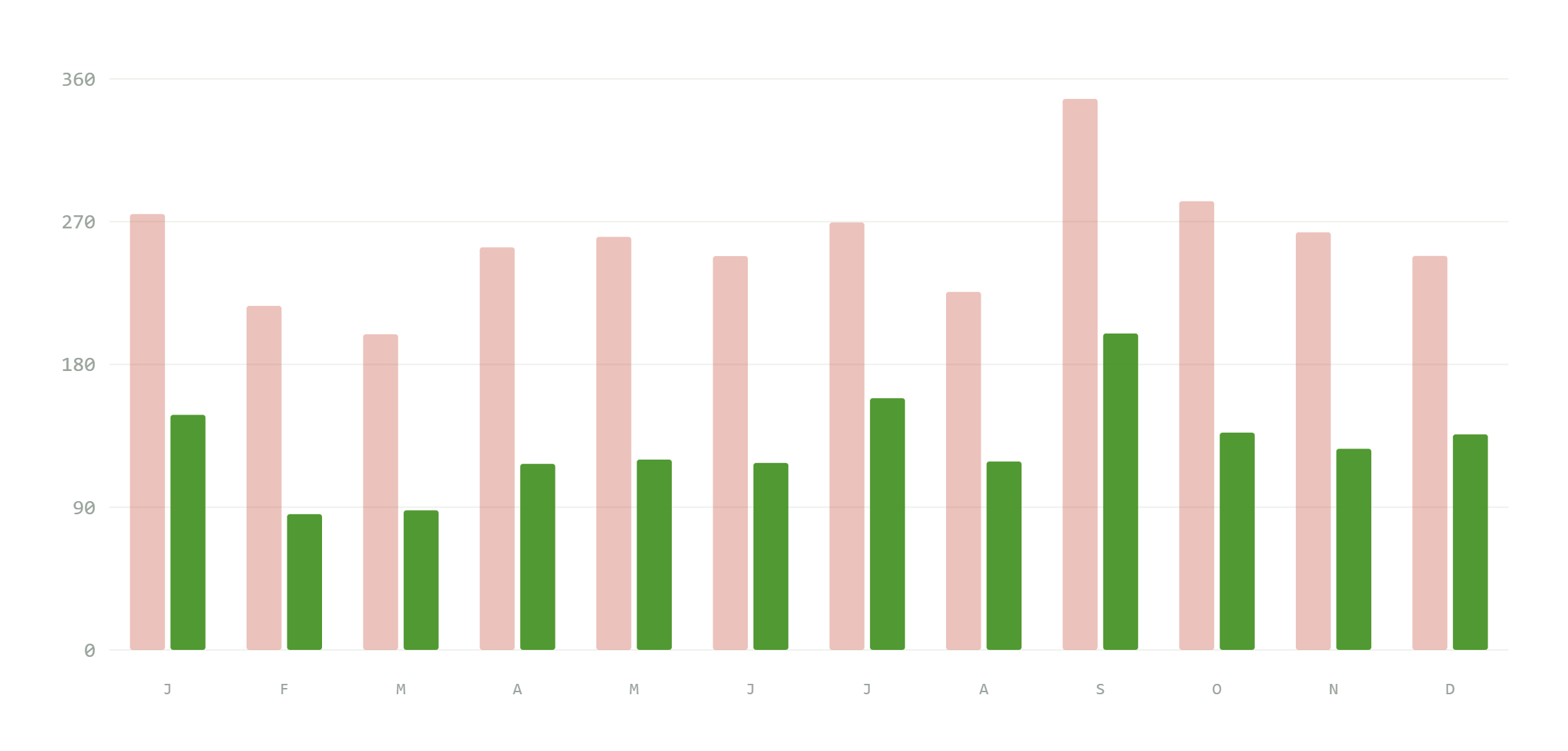
Monthly peak demand, baseline vs. with the battery, modeled from twelve months of facility load.
Across the year, modeled peaks fall 41 to 61% month to month, averaging roughly half. That is the basis for the projected economics:
- Average peak cut: ~50% across 12 months
- Net savings: ~$36k/yr after charging cost
- Payback: 8.3 years · 124% 15-year ROI
These are modeled figures from the December 2025 sizing study using a full year of historical facility load; actual results vary with load, tariff, and operating conditions.
Live validation: early operational results
Since going live in February 2026, the system has been actively shaving real peaks, validating the control in the field while the optimizer tunes to the facility’s live load. Over four months it discharged roughly 1.3 MWh into demand peaks across 29 active shaving days, with single events trimming up to 69 kW.
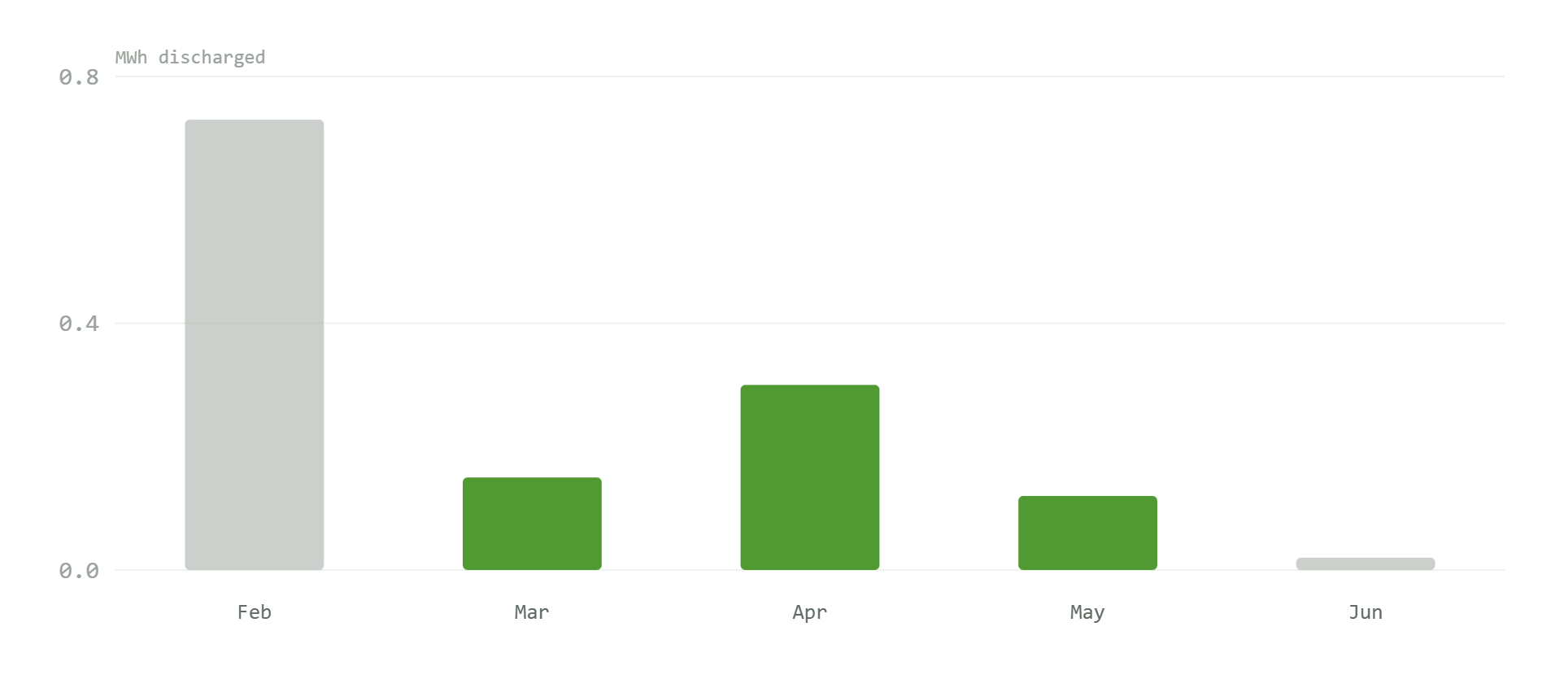
Battery energy dispatched per month, Feb to Jun 2026. Faded bars are partial months; activity scales with the season’s demand peaks.
Built for safe, unattended operation
Across 2,781 metered hours, the export zone is effectively empty, the lowest reading was just −0.5 kW. The system stays a strict net importer, with a 10 kW non-export hard stop that forces the battery to 0 W below threshold.
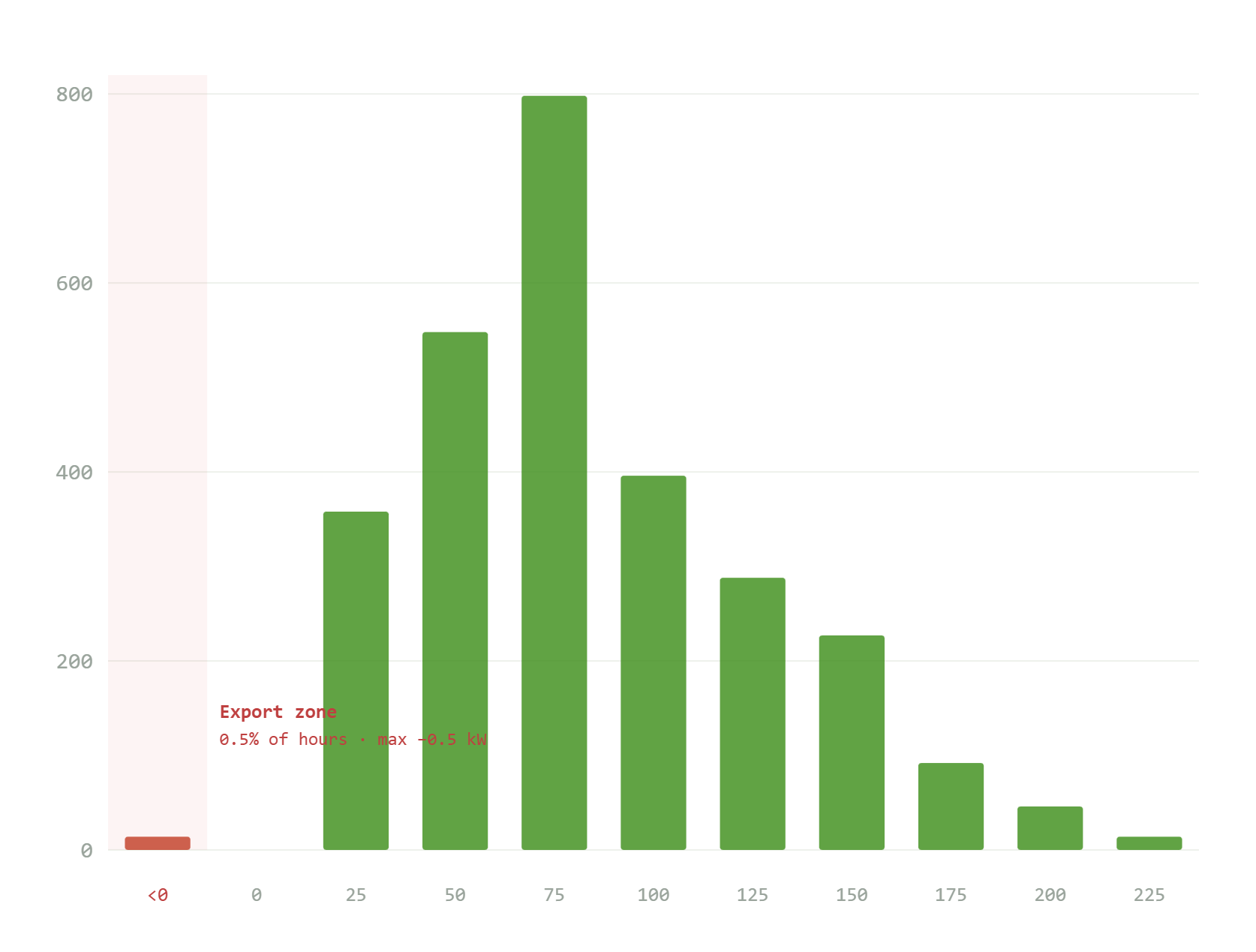
Metered grid import distribution, hours spent at each import level.
Resilience is built into the controller: a stale-data guard zeroes power if the meter reading is more than five seconds old; the EMS respects real-time BMS power limits; anti-windup control keeps the loop stable under saturation; and reconnection logic uses exponential backoff on faults. The system is FAT-validated against IEC 62933 and IEEE 2030.3.
In summary
- Intellect Operate targets the one number that sets the bill, the monthly demand peak, and is modeled to cut it ~50%.
- A three-tier controller plans, holds, and enforces the limit, reacting to spikes in 250 ms.
- Savings are measured from a real counterfactual, not a model, and the system is already shaving live peaks.
- Vendor-agnostic and FAT-validated, the same platform scales across sites and hardware.
Intellect Operate is WATTMORE’s platform for energy management, power-plant control, and dispatch for storage, vendor-agnostic, edge-to-cloud, and autonomous. Contact WATTMORE to discuss demand-charge management for your facility.