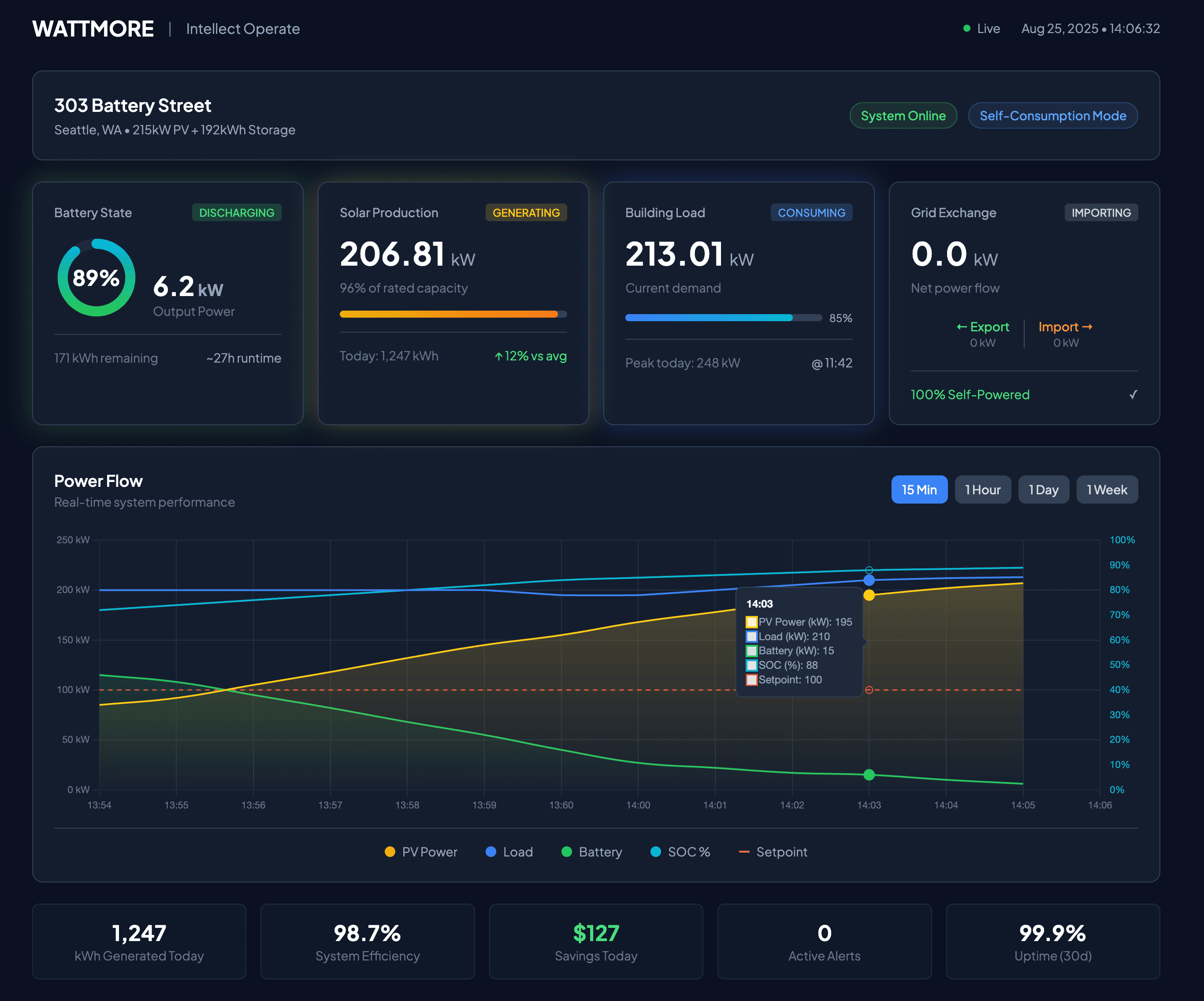
Choosing the storage EMS, the energy management system that will run your battery, is one of the most consequential decisions in an energy storage project. The EMS controls when the battery charges, when it discharges, and how it captures revenue across every value stream, every day, for the life of the asset. A poor choice does not fail loudly; it quietly leaves money on the table for fifteen years.
This guide walks through what a storage EMS is, the six criteria that matter when evaluating one, and the mistakes buyers repeat.
What is a storage EMS?
A storage EMS, also called a battery EMS or a battery energy management system, is software that optimizes the operation of a battery energy storage system. It reads the battery management system, inverters, and meters; forecasts load, solar, and prices; and dispatches the battery in real time to maximize value while staying inside safety and warranty limits. Unlike SCADA, which supervises and records, a storage EMS decides. If the distinction is fuzzy, start with what a battery energy management system is and storage EMS versus SCADA.
The stakes keep rising because the fleet keeps growing and the revenue mix keeps shifting. EIA reports United States utility scale battery capacity reaching 43.6 GW by the end of 2025 after years of roughly 70 percent growth (EIA), and market analyses show batteries earning a growing share of revenue from energy arbitrage, in ERCOT it tripled to 76 percent of revenue in a year (Modo Energy), which is exactly the use case where forecasting and optimization quality separate vendors.
Key criteria for evaluating a storage EMS
1. Real time, forecast driven dispatch
The best storage EMS platforms make dispatch decisions in real time from live data and rolling forecasts, not from fixed schedules. Look for a genuine optimizer: something that forecasts the horizon, solves for the best plan, executes, measures, and revises. Ask the vendor to walk you through one day of dispatch on a real site and explain each decision the system made.
2. Revenue optimization and stacking
Modern projects depend on stacking demand charge reduction, time of use arbitrage, frequency regulation, capacity, demand response, and solar self consumption. These streams compete for the same kilowatt hours, so the EMS must jointly optimize them rather than chase one at a time. Our guide to revenue stacking explains why simple priority rules underperform.
3. Vendor agnostic integration
Your EMS should work with any battery, inverter, and balance of plant equipment. Proprietary lock in narrows procurement, weakens your negotiating position, and becomes a real risk if a manufacturer exits the market or changes product lines. Look for native support of Modbus RTU and TCP, DNP3, MQTT, and REST, and ask for the list of models already integrated and running in the field.
4. Edge plus cloud architecture
The ideal architecture pairs an edge controller for real time control with cloud services for forecasting, fleet analytics, and reporting. The edge keeps the battery earning through network interruptions; the cloud provides portfolio visibility and model updates. A cloud only EMS turns every network outage into an idle battery, and store and forward logging is the difference between a data gap and a complete record.
5. Grid compliance and interconnection deliverables
The EMS, or the power plant controller it integrates, must meet your interconnection requirements. IEEE 1547 governs distribution connected resources and IEEE 2800 sets uniform performance requirements for inverter based resources on transmission systems, covering frequency response, voltage control, ride through, and power quality (IEEE 2800). Transmission scale projects will also be asked for plant simulation models during interconnection studies; confirm early who will produce them and how the controls will be represented. Interconnection is already the industry's slowest step, with years long queues documented by Lawrence Berkeley National Laboratory (Lawrence Berkeley National Laboratory), so avoid adding delay of your own.
6. Warranty and degradation protection
The EMS should enforce warranty limits, depth of discharge, rates, temperature, annual throughput, automatically, and include cycling cost in its optimization so it never spends a dollar of battery life to earn fifty cents of revenue. Ask how the product models degradation and what it does when a marginal opportunity is not worth the wear.
Common mistakes when selecting a storage EMS
- Choosing on price alone. An EMS that captures a few percent less revenue costs far more over the project life than any difference in fees. Compare modeled net revenue, not license costs.
- Assuming SCADA is enough. SCADA supervises; an EMS decides. Without active optimization the battery runs on rules and misses the moments that pay.
- Ignoring the power plant controller. If your project needs grid compliance functions, buying the EMS and PPC separately creates an integration project you did not budget for. See EMS versus PPC.
- Ignoring scalability. If you plan a portfolio, choose fleet management from day one; retrofitting it later means migrating live sites.
- Not verifying real performance. Ask for dispatch data and results from operating sites and for customer references. Simulations are marketing; meters are evidence.
Questions that expose the difference
Put these to every vendor on your shortlist:
- Show one month of actual dispatch on a comparable site. What did the EMS forecast, what did it do, and what did it capture?
- What happens the moment the site loses its network connection?
- Which inverter and battery models are integrated today, and how long does a new one take?
- How is degradation priced into dispatch decisions?
- Which interconnection deliverables do you provide, and how do you support the studies?
Why developers choose Intellect Operate
WATTMORE's Intellect Operate is a storage EMS built by a team that operates real battery systems every day. It combines edge based real time dispatch with cloud analytics, is vendor agnostic across major battery and inverter manufacturers, integrates the Intellect PPC power plant controller, and publishes its results: field reports like E.S. Fox and 303 Battery show the dispatch data behind the claims.
Ready to evaluate a storage EMS for your next project? Contact WATTMORE for a demo of Intellect Operate.