What Is a Battery Energy Storage EMS?
A battery energy storage EMS (energy management system) is the software layer that decides when a battery charges, when it discharges, and how much power it moves, using prices, tariffs, forecasts, grid signals, and the limits the battery reports. It sits above the battery management system and the power conversion system and turns a container of cells into a dispatchable grid asset.
In brief
- The EMS decides the power setpoint; the BMS reports what the battery can safely do and the PCS executes the command.
- A storage EMS needs five inputs: battery state, site meters, prices and tariffs, forecasts, and external dispatch signals.
- Revenue comes from stacking frequency regulation, arbitrage, reserves, and demand charge reduction against one state of charge.
- The EMS is not a BMS, not SCADA, and not a power plant controller, although one vendor may deliver all four.
- Buy for hardware independence, edge autonomy during network loss, logged setpoint writes, and warranty protection.
What does a storage EMS actually decide?
Every second or so, a storage EMS answers one question: what active power should the battery move right now, and in which direction? The answer is a setpoint in kilowatts or megawatts, positive for discharge and negative for charge, sent to each inverter in the power conversion system.
The DOE Energy Storage Handbook describes the EMS as the layer that monitors and optimally controls each storage system while interfacing with markets, utilities, and customers. In practice the EMS chooses among four kinds of work.
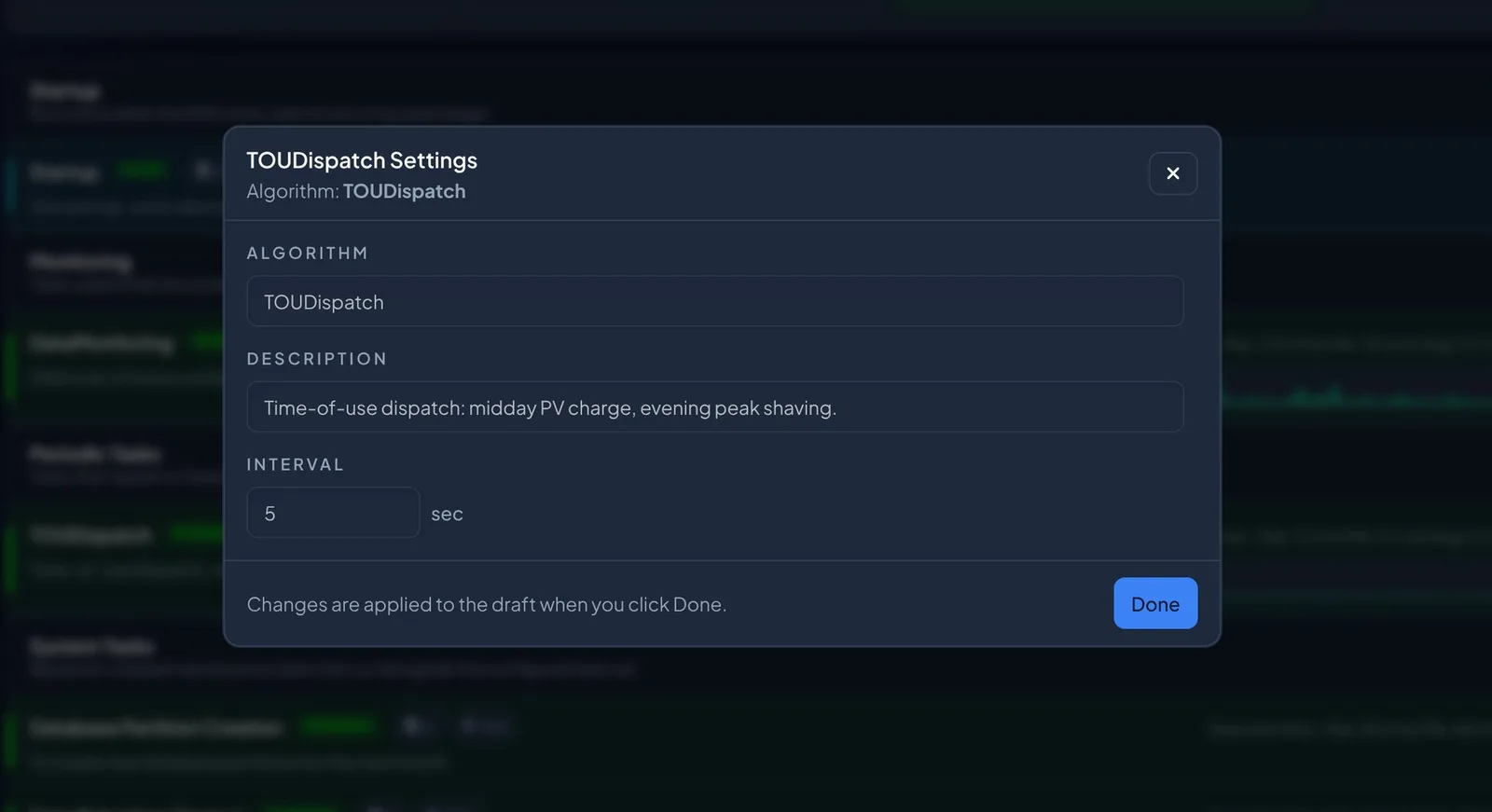
- Charge and discharge timing: when to buy energy, when to hold it, and when to sell it or serve load with it.
- Grid services: following an automatic generation control signal for frequency regulation, holding capacity for spinning reserve, or honoring a curtailment order.
- Market participation: bidding capacity into day ahead and real time markets and then delivering the awards.
- Site coordination: charging from surplus solar, shaving a demand peak, or holding reserve for backup.
What is a storage EMS not?
Three other systems share the container with the EMS. The battery management system (BMS) lives with the cells. It measures cell voltages, temperatures, and current, estimates state of charge and state of health, and publishes the maximum charge and discharge power the battery can accept. The BMS protects the battery; it does not decide when to use it. The power conversion system (PCS) is the inverter. It converts DC to AC and back and executes the command.
A SCADA system supervises and records: it polls devices, raises alarms, stores history, and relays telemetry to the utility, but it runs no optimization. A power plant controller (PPC) enforces grid code on plant output: frequency droop, voltage and reactive power control, and ramp rate limits. The EMS proposes a setpoint; the PPC makes sure it is legal at the point of interconnection.
Where does the EMS sit in the control stack?
The handbook describes a hierarchy in which operating data flows from the bottom up and commands flow from the top down. The BMS reports state of charge, state of health, and cell temperature. Those readings and PCS status reach the local EMS, which calculates the charge or discharge power and sends it to the PCS as a command. While delivering that power the PCS also checks the BMS so no battery limit is violated.
Above the local EMS there may be a central or fleet EMS that dispatches many sites against one market position. The handbook notes that in a centralized design the optimal dispatch is computed at the control center and pushed to each local EMS; in a decentralized design the local EMS does all of the work. Either way the local layer must keep running when the wide area link drops, which is why a storage EMS runs on hardware at the site.
What inputs does a storage EMS need?
A setpoint is only as good as the data behind it. A storage EMS needs five streams.
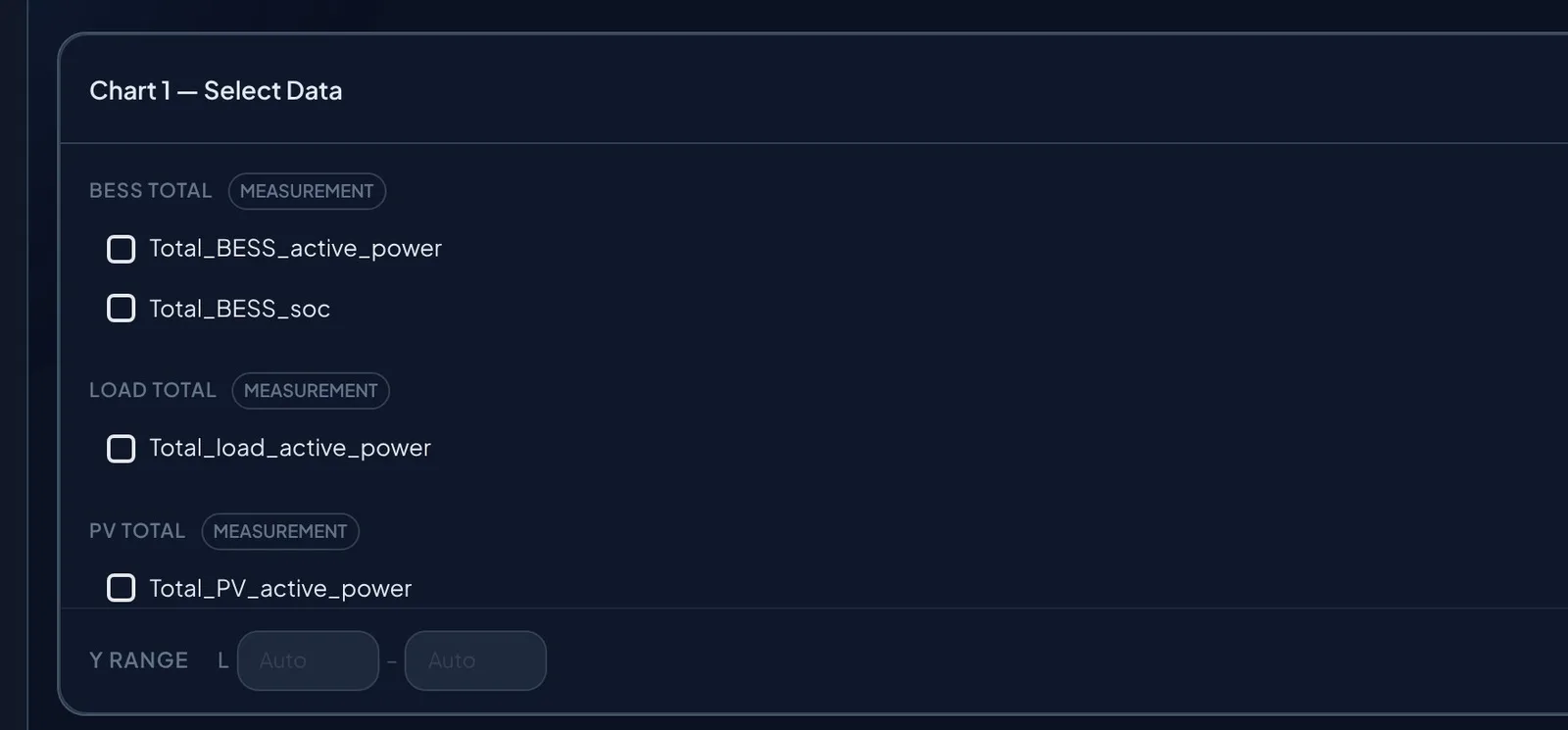
- Battery state from the BMS: state of charge, state of health, temperature, alarms, and the published charge and discharge limits.
- Site measurements: the utility meter at the point of interconnection, solar production, and building load.
- Prices and tariffs: energy prices, demand charge windows, time of use periods, and any program payments the site is enrolled in.
- Forecasts: load, solar, and price forecasts for the coming hours and days, so the EMS can hold energy for the interval that pays.
- External signals: an AGC signal, a utility curtailment order, or an aggregator dispatch, received over DNP3 or an API.
How does a storage EMS earn revenue or savings?
The value of a battery is the sum of the services it provides, and the EMS is what lets one battery provide several. The handbook chapter on applications separates power applications such as frequency regulation from energy applications such as arbitrage and demand charge reduction; the EMS schedules both against a single state of charge.
EIA reports how utility scale batteries in the United States were used in 2021: frequency regulation was served by 63 percent of installed power capacity, price arbitrage by roughly 58 percent, and ramping or spinning reserve by 42 percent. Most projects list more than one use, which is stacking in practice.
Frequency regulation is the fastest. The handbook notes that most ISOs update the AGC signal every two to four seconds, so the EMS must read the signal, check it against BMS limits and state of charge, and command the inverters inside that window.
What should you look for in a storage EMS?
Ask five questions. Does it integrate with the batteries and inverters you have and the ones you might buy next, through Modbus and DNP3 with configurable register maps? Does it keep dispatching when the internet link fails and sync later? Does it log every setpoint write with the source of the command? Does it enforce BMS limits and custom state of charge bounds in code, so the warranty survives the optimizer? Does it stack services, or run one schedule?
WATTMORE built Intellect Operate around those answers: an edge controller that runs dispatch locally, supports the major battery and inverter vendors through flexible protocol mapping, respects BMS published limits on every command, and stacks demand charge management, arbitrage, regulation, and reserves under one control loop with an integrated power plant controller.
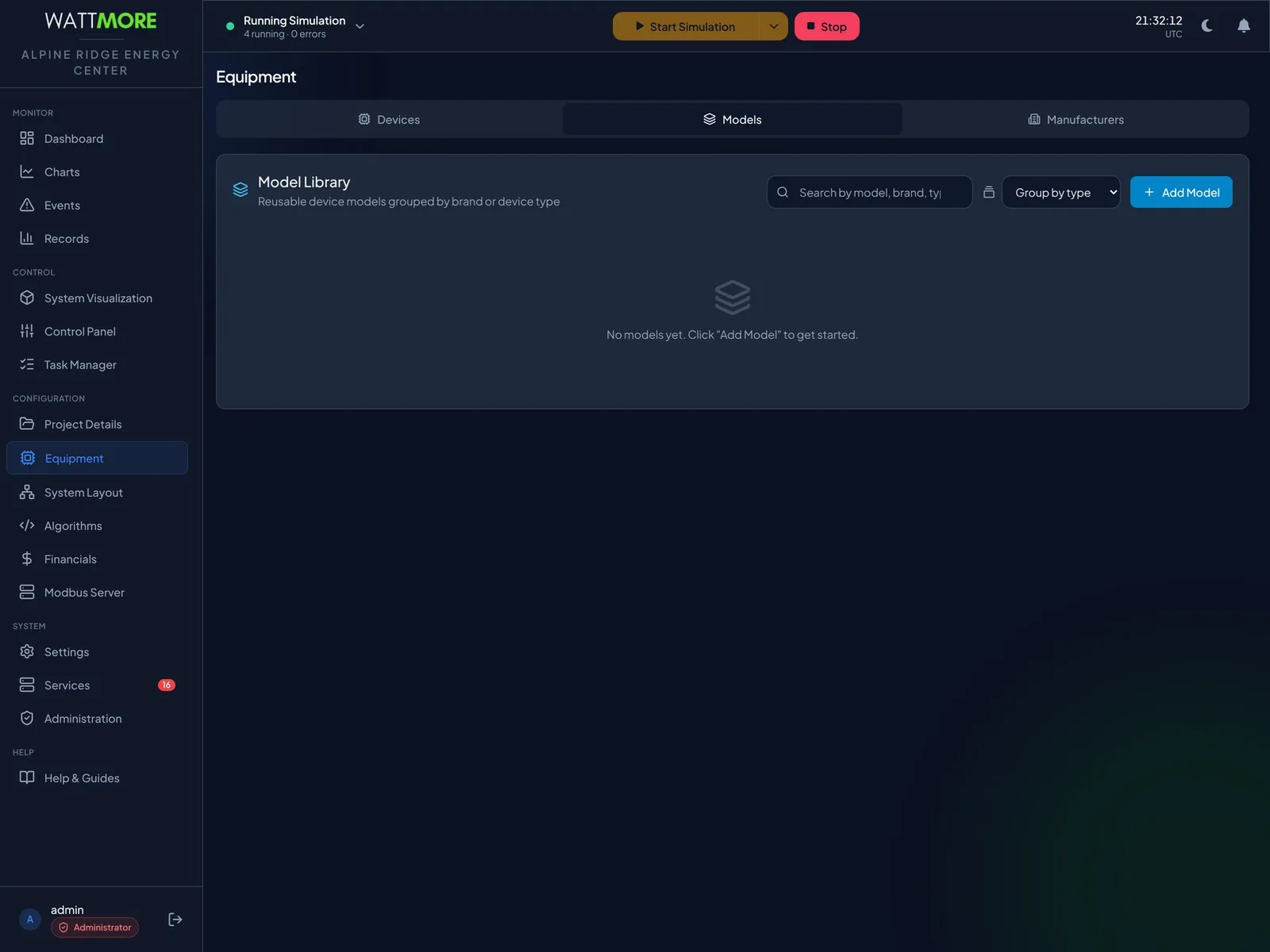
Intellect Operate
Intellect Operate is a battery energy management system that runs dispatch at the edge, integrates the major battery and inverter vendors over Modbus and DNP3, enforces BMS limits on every command, and includes a power plant controller for grid compliance.
Frequently asked questions
- Is a battery EMS the same as a BMS?
- No. The battery management system measures cells, estimates state of charge and state of health, and publishes safe charge and discharge limits. The energy management system reads those limits and decides how much power to move and when. The BMS never commands the inverters; the EMS does, and it must stay inside what the BMS allows.
- Does a storage EMS need an internet connection to work?
- It should not. Demand charge management, frequency response, and BMS limit enforcement are time critical, so the dispatch logic belongs on hardware at the site. The cloud adds fleet analytics, forecasting, and reporting. A well designed EMS keeps operating during a network outage, stores data locally, and syncs when the link returns.
- What protocols does a storage EMS use?
- On site, most batteries, inverters, and meters speak Modbus RTU or Modbus TCP. Utilities and ISOs typically dispatch over DNP3, which is standardized as IEEE 1815, and sometimes ICCP. Cloud links and third party integrations use MQTT or REST over TLS.
- How does a storage EMS reduce demand charges?
- The EMS reads the site meter continuously and forecasts when load will peak. Before the peak, it discharges the battery so the utility meter records a lower maximum demand for the billing interval. It then recharges during cheap hours while keeping enough state of charge in reserve for the next expected peak.
- Can one EMS run solar, storage, and a generator together?
- Yes. It charges the battery from surplus solar, curtails solar when the interconnection requires it, and sequences a generator with storage during an outage or a peak. All of the assets share one limit at the point of interconnection, so one controller has to arbitrate among them.
Sources
- Energy Storage Handbook, Chapter 15: Energy Storage Management Systems, Sandia National Laboratories for the U.S. Department of Energy
- Energy Storage Handbook, Chapter 23: Applications and Grid Services, Sandia National Laboratories for the U.S. Department of Energy
- Energy Storage for Electricity Generation, U.S. Energy Information Administration
- Battery Storage in the United States: An Update on Market Trends, U.S. Energy Information Administration
- Overview of the DNP3 Protocol, DNP Users Group
Keep reading
- GuideEMS vs BMS vs SCADA vs PPC: Who Does What in a BESS
- GuideHow Does a Power Plant Controller Work?
- GuideWhat Is Peak Shaving With Battery Storage?
- From the blogWhat a battery energy management system does, in depth
- From the blogHow to choose a storage EMS
- From the blogCase study: demand charge peak shaving at ES Fox