EMS vs BMS vs SCADA vs PPC: Who Does What in a BESS
In a battery energy storage system (BESS), the BMS, EMS, PPC, and SCADA are four distinct layers: the battery management system protects the cells and publishes limits, the energy management system decides the power setpoint, the power plant controller enforces grid code on that setpoint, and SCADA supervises and records everything. Commands flow down the stack and measurements flow up it.
In brief
- Only two layers make decisions: the EMS decides what the battery should do, and the PPC decides what the grid will allow.
- The BMS is a protection and measurement system that publishes limits; it never commands an inverter.
- SCADA observes, alarms, records, and relays; it does not optimize and it does not enforce interconnection requirements.
- Time scales separate the layers: PPC in tens of milliseconds, EMS in seconds to 15 minute intervals, SCADA at logging rates.
- Boundaries blur when the inverter runs grid functions itself or when one vendor bundles two or three layers.
What does each layer do in one line?
The DOE Energy Storage Handbook lays out a hierarchy in which operating data goes from the bottom to the top and commands go from the top to the bottom. The table reads left to right: what each layer decides, how fast it acts, and who usually supplies it.
| Layer | Decides | Time scale | Typical owner or vendor |
|---|---|---|---|
| BMS | Safe charge and discharge limits; contactor open on fault | Continuous; limits published every second or faster | Battery OEM, ships with the racks |
| EMS | Active power setpoint: charge, discharge, or hold | Seconds to 15 minute intervals | EMS software vendor or integrator |
| PPC | Legal plant output at the POI: droop, volt VAR, ramp, curtailment | Tens to hundreds of milliseconds | EMS vendor, PCS vendor, or separate PPC vendor |
| SCADA | Nothing; polls, alarms, records, relays to the utility | Logging rate, 1 second to 15 minutes | Integrator, utility, or EMS vendor |
What does the BMS decide?
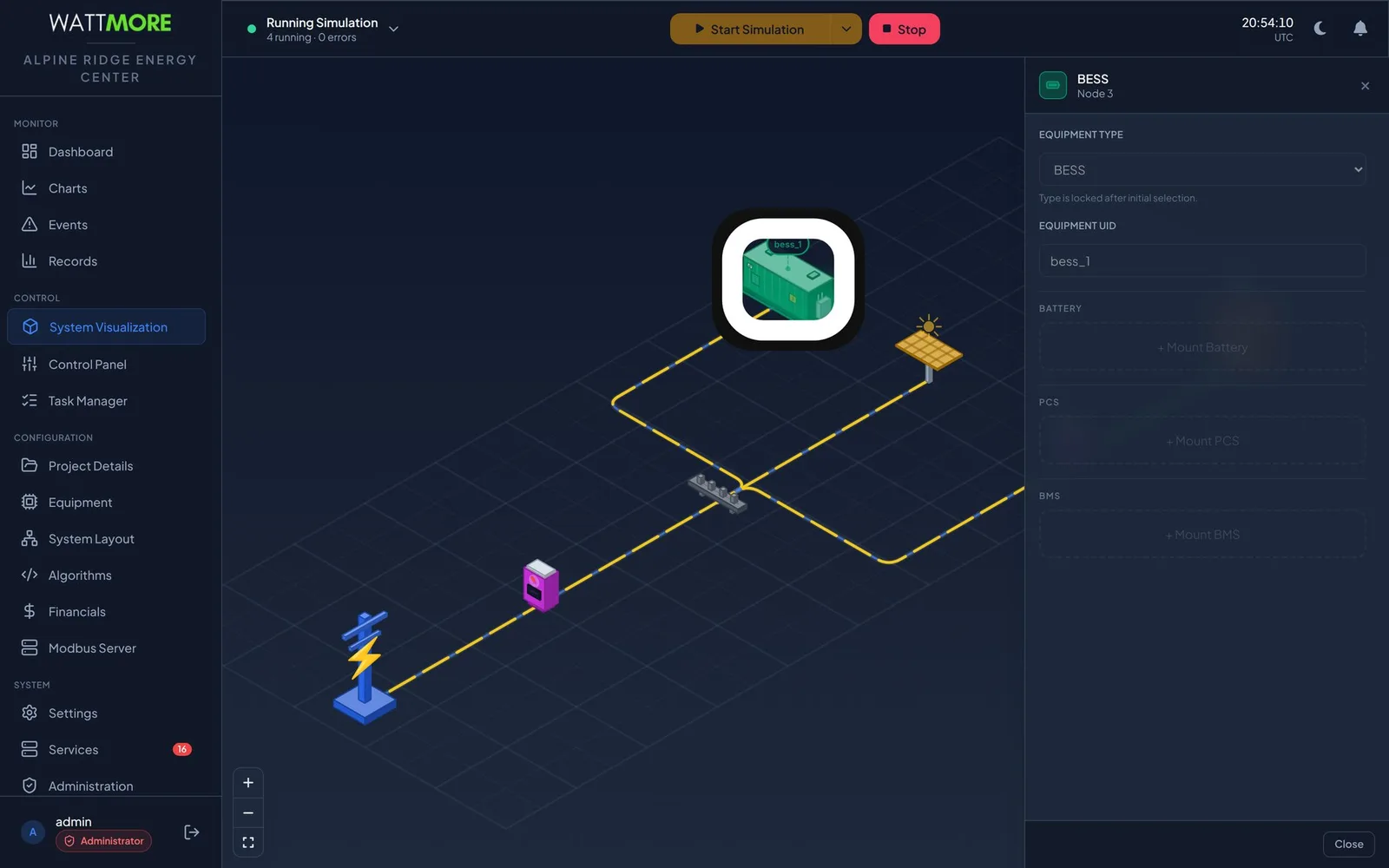
The battery management system measures cell voltage, current, and temperature, estimates state of charge and state of health, and enforces the battery safety envelope. Its output to the rest of the stack is a set of published limits: the maximum charge and discharge power the battery will accept right now, plus alarms.
What the BMS does not do is choose; it does not know the price of energy or the utility tariff. The handbook notes a BMS active protection mechanism will disconnect a module if needed, but normal power flow is commanded by the EMS and executed by the PCS, which checks the BMS so no limit is violated.
What does the EMS decide?
The energy management system chooses the active power setpoint. It reads BMS limits, the site meter, prices and tariffs, forecasts, and any external dispatch signal, then computes the charge or discharge power that maximizes value while staying safe. The handbook describes exactly this flow: BMS and PCS data reach the local EMS, which calculates the power command and sends it to the PCS.
Its horizon runs from the next second to the next day. An EMS following an AGC signal reacts inside the two to four second update cycle the handbook cites for most ISOs, and the same EMS plans state of charge across a demand charge window or a day ahead award. EIA data shows why: in 2021, frequency regulation, arbitrage, and reserves were each served by large shares of installed battery capacity.

What does the PPC decide?
The power plant controller decides what the plant is allowed to do at the point of interconnection. It measures frequency, voltage, active power, and reactive power at the POI meter and modifies the EMS setpoint to satisfy the interconnection agreement and the applicable standard: IEEE 2800 for inverter based resources on transmission and sub transmission systems, IEEE 1547 for distributed resources on distribution systems.
Concretely the PPC adds frequency droop power, clamps output to a curtailment ceiling, derates as state of charge nears its bounds, limits the rate of change of power, computes a reactive power or power factor command for voltage, and splits the result across inverters. It runs in tens to hundreds of milliseconds.

What does SCADA decide?
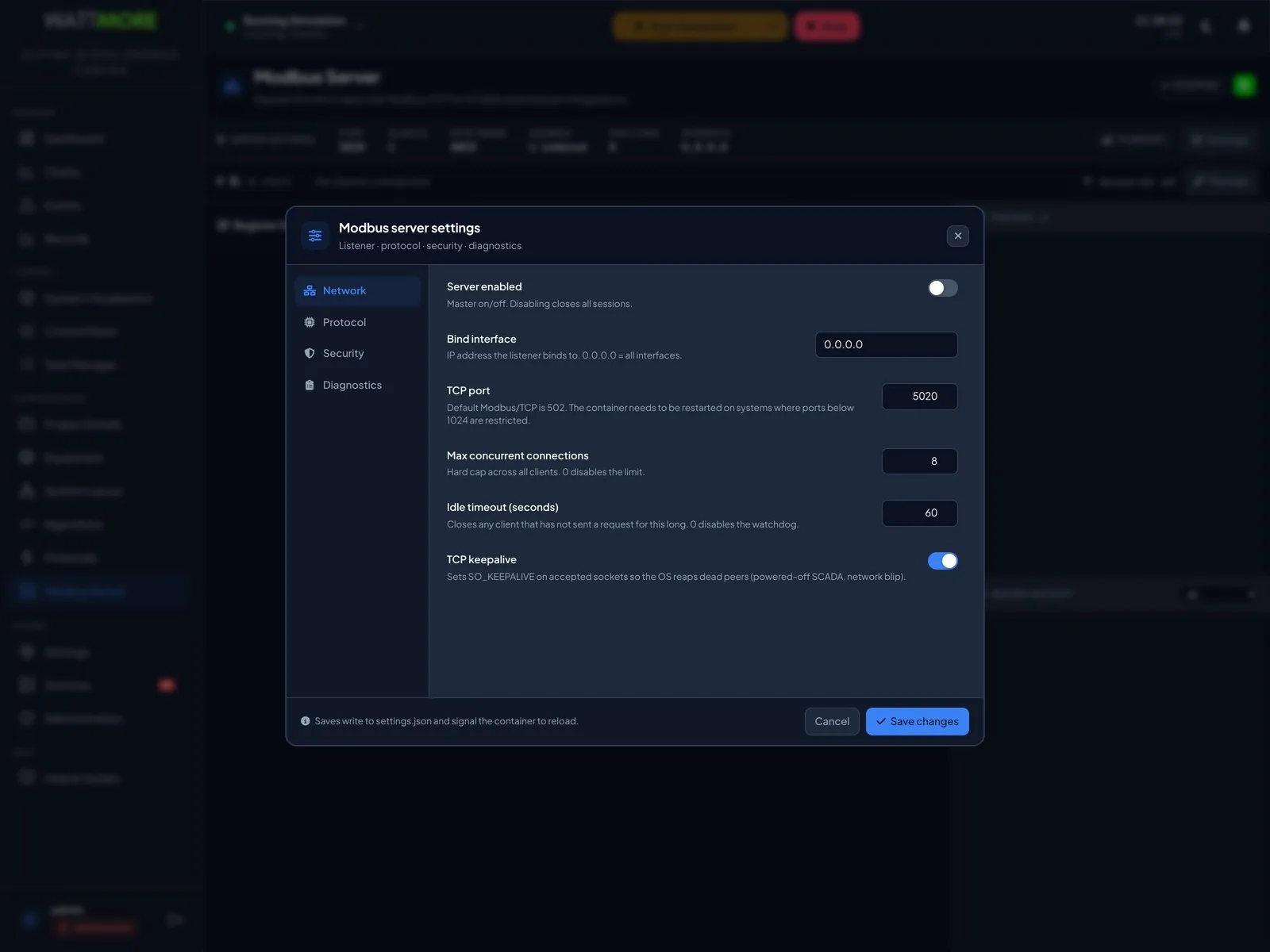
Nothing, and that is the point. Supervisory control and data acquisition polls every device, raises alarms, stores history, presents a human machine interface, and relays telemetry and commands between the plant and the utility or ISO. The handbook notes that DNP3 plays an important part in modern SCADA systems and that Modbus TCP is common across devices; DNP3 has been standardized as IEEE 1815 since 2010.
When people say SCADA runs their battery, they usually mean an operator is typing setpoints into an HMI, which is a manual EMS and a slow one.
Where do the boundaries blur?
Three places. First, the inverter. The handbook observes that advanced inverter functions such as volt VAR, volt watt, and constant power factor are moving into the PCS secondary control. A plant can end up with droop implemented in both the inverter and the PPC, and the two must be coordinated so they do not fight.
Second, the vendor boundary. A PCS vendor may bundle a plant controller, and an EMS vendor may bundle SCADA and a PPC. The functions stay distinct even when the boxes do not. Third, state of charge: the BMS estimates it, the EMS plans around it, and the PPC derates on it, so all three must agree on the number and its bounds.
The test for any boundary: which layer owns the decision and which can veto it. The EMS proposes, the PPC vetoes on grid code, the BMS vetoes on safety, and SCADA records who did what.
How should you buy these layers?
The BMS comes with the battery, so the real choice is whether the EMS, PPC, and SCADA come from one vendor or three. Separate vendors mean every setpoint crosses two interfaces, and a failed interconnection test becomes a question of whose loop was late. One vendor means one data bus and one support call; verify the PPC functions are real and configurable.
WATTMORE delivers all three in Intellect Operate: the EMS decides dispatch, the integrated Intellect PPC power plant controller enforces droop, voltage, ramp, curtailment, and state of charge protection on the same control loop (documented at wattmore.com/ppc), and SCADA integration over DNP3, Modbus, and MQTT carries telemetry to the utility.
Intellect Operate
Intellect Operate combines the EMS, an integrated power plant controller, and SCADA integration in one platform, so dispatch, grid compliance, and telemetry share a single control loop and a single vendor.
Frequently asked questions
- Does the BMS control the inverters?
- No. The battery management system publishes what the battery can safely accept: maximum charge power, maximum discharge power, state of charge, and alarms. The EMS reads those values and commands the inverters within them. The BMS can open contactors in a fault, but routine power flow is commanded through the EMS and executed by the PCS.
- Can SCADA replace an EMS?
- Not for a battery that needs to earn revenue. SCADA polls, alarms, records, and relays; it does not forecast, price, or optimize. An operator can type a setpoint into a SCADA screen, but that manual dispatch cannot follow an AGC signal updated every few seconds or catch a demand peak. SCADA and EMS are complementary, not interchangeable.
- Do I need a PPC if I already have an EMS?
- If the plant must meet IEEE 2800 or an interconnection agreement with droop, voltage, and ramp requirements, yes. The EMS decides the economically best setpoint; the PPC makes that setpoint legal at the point of interconnection. Some EMS products include the PPC functions in the same control loop, which removes the separate box but not the function.
- What is the difference between a PPC and SCADA?
- SCADA tells you what the plant is doing; the PPC decides what the plant is allowed to do. SCADA collects data and raises alarms at logging rates. The PPC measures the point of interconnection and adjusts active and reactive power in tens of milliseconds to satisfy frequency, voltage, and ramp requirements.
- Which layer decides state of charge limits?
- All three touch it. The BMS estimates state of charge and enforces the hard cell level bounds. The EMS plans dispatch across the day so the battery arrives at the right state of charge for the next service, and may enforce tighter bounds to protect the warranty. The PPC derates power as state of charge approaches a bound.
Sources
- Energy Storage Handbook, Chapter 15: Energy Storage Management Systems, Sandia National Laboratories for the U.S. Department of Energy
- Energy Storage Handbook, Chapter 23: Applications and Grid Services, Sandia National Laboratories for the U.S. Department of Energy
- IEEE 2800: Standard for Interconnection and Interoperability of Inverter Based Resources Interconnecting with Associated Transmission Electric Power Systems, IEEE Standards Association
- IEEE 1547: Standard for Interconnection and Interoperability of Distributed Energy Resources with Associated Electric Power Systems Interfaces, IEEE Standards Association
- Overview of the DNP3 Protocol, DNP Users Group
- Energy Storage for Electricity Generation, U.S. Energy Information Administration
Keep reading
- GuideWhat Is a Battery Energy Storage EMS?
- GuideHow Does a Power Plant Controller Work?
- GuideIEEE 2800 Requirements for the Power Plant Controller
- From the blogStorage EMS, SCADA, and power plant controller compared
- From the blogEnergy management system vs power plant controller
- From the blogThe difference between a storage EMS and SCADA