IEEE 2800 Requirements for the Power Plant Controller
IEEE 2800 is the IEEE standard that sets uniform technical minimum requirements for the interconnection, capability, and lifetime performance of inverter based resources connecting to transmission and subtransmission systems. Published in April 2022, it covers voltage and frequency ride through, active and reactive power control, power quality, protection, and measurement, and most of those requirements are implemented at the plant level by the power plant controller.
In brief
- IEEE 2800 applies to transmission and subtransmission connected inverter based resources, including solar, wind, battery storage, and hybrid plants; distribution connected systems fall under IEEE 1547.
- The standard defines capability; the transmission operator decides how it is used, so the actual droop, deadband, and voltage settings come from your interconnection agreement.
- Reactive power and voltage control, primary frequency response, active power and ramp control, ride through coordination, and measurement data all land on the plant controller.
- FERC Order 901, issued in October 2023, directed NERC to write inverter based resource standards, and MISO, PJM, and ERCOT are each adopting IEEE 2800 requirements into their own rules.
- Ask a PPC vendor to show the reference point of control, the settable range for each function, and how the controller coordinates with inverter ride through.
What is IEEE 2800 and who does it apply to?
IEEE 2800 is the IEEE Standard for Interconnection and Interoperability of Inverter Based Resources Interconnecting with Associated Transmission Electric Power Systems. The IEEE Standards Association lists it as published on April 22, 2022, and its scope is the one in the definition above: uniform minimum requirements for interconnection, capability, and lifetime performance.
An inverter based resource, or IBR, is any plant that delivers power through inverters: solar, wind, battery storage, and hybrids. The standard addresses the plant as a whole, and plant level functions such as regulating voltage at one point or responding to frequency with the whole fleet belong to the power plant controller (PPC).
The standard defines what a plant must be capable of doing. It does not define an interconnection process or decide which capabilities are switched on; that belongs to the transmission operator and the interconnection agreement.
Which IEEE 2800 requirements land on the power plant controller?
Six requirement areas fall on the plant controller rather than on the inverters alone. Clause numbers are those cited in MISO and ERCOT adoption documents.
- Reactive power and voltage control. MISO summarizes clause 5.1 as requiring reactive power of at least 32.87 percent of continuous rating at the point of measurement, equal to a 0.95 power factor, and clauses 5.2.1 through 5.2.4 as defining three modes, voltage control (the default), constant power factor, and constant reactive power, each damped at a ratio of 0.3 or higher.
- Active power and frequency response. Clause 6.1 covers primary frequency response with ranges of settings for droop and deadband and targets for reaction, rise, and settling time. The controller measures frequency at the reference point and adjusts active power across all inverters.
- Active power control and ramp rate. The plant must follow active power limits from the transmission operator and limit its rate of change, while letting frequency response act faster than the normal ramp limit.
- Ride through coordination. Clause 7 sets voltage, frequency, rate of change of frequency, and consecutive voltage deviation ride through. Inverters do most of this, but the controller must hold its command, avoid tripping the plant on a transient, and recover smoothly.
- Measurement data. Clause 11 requires sequence of events, digital fault, and dynamic disturbance recordings plus inverter fault codes, in defined formats with defined retention.
- Interoperability. The plant must accept setpoints and mode commands from the transmission operator and report status back; the controller is where those commands arrive.
| Requirement area | Controller function |
|---|---|
| Reactive power and voltage control | Closed loop voltage, power factor, or Q regulation |
| Primary frequency response | Frequency watt droop with deadband and timing |
| Active power control and ramp | Setpoint tracking, curtailment ceiling, rate limiter |
| Ride through coordination | Hold command, no plant trip, orderly recovery |
| Measurement and monitoring | Event capture, high resolution logging, retention |
| Interoperability | Operator command interface and telemetry |
How does IEEE 2800 relate to NERC, FERC Order 901, and ISO tariffs?
IEEE 2800 is a consensus standard that becomes binding when a regulator or grid operator adopts it. PJM notes that FERC Order 901, issued in October 2023, directed NERC to develop reliability standards for inverter based resources, including performance requirements.
MISO proposed in March 2024 to adopt clauses 5.1, 5.2.1 through 5.2.4, 6.1, 7.2.2.4, and 11 into its generator interconnection agreement, and noted that the agreement already required a maximum 5 percent droop and a 0.036 Hz deadband.
PJM ran a clause by clause gap analysis in 2024, starting with Section 7 ride through alongside the NERC ride through standard and moving next to reactive capability, voltage control, modeling, and measurement.
ERCOT moved first on ride through. The Public Utility Commission of Texas approved NOGRR 245 effective October 1, 2024; newer resources must meet or exceed the voltage ride through requirements in IEEE 2800 sections 5, 7, and 9, with a December 31, 2025 deadline for most resources to maximize their capability.
What is in the standard versus what is in your interconnection agreement?
The standard sets the reference point of applicability, which MISO states is the point of measurement by default, and sets ranges for each function. The agreement picks the values: the exact droop and deadband, and for voltage control the maximum step response time, which MISO suggested should fall between 1 and 30 seconds.
Read the agreement for utilization. MISO stated that adopting the frequency response clause would not require plants to hold headroom for under frequency events. Confirm which functions are enabled, at what settings, and where they are measured.
What should a developer ask a PPC vendor?
The standard is written for the plant, so ask how the controller closes each loop and how it proves it.
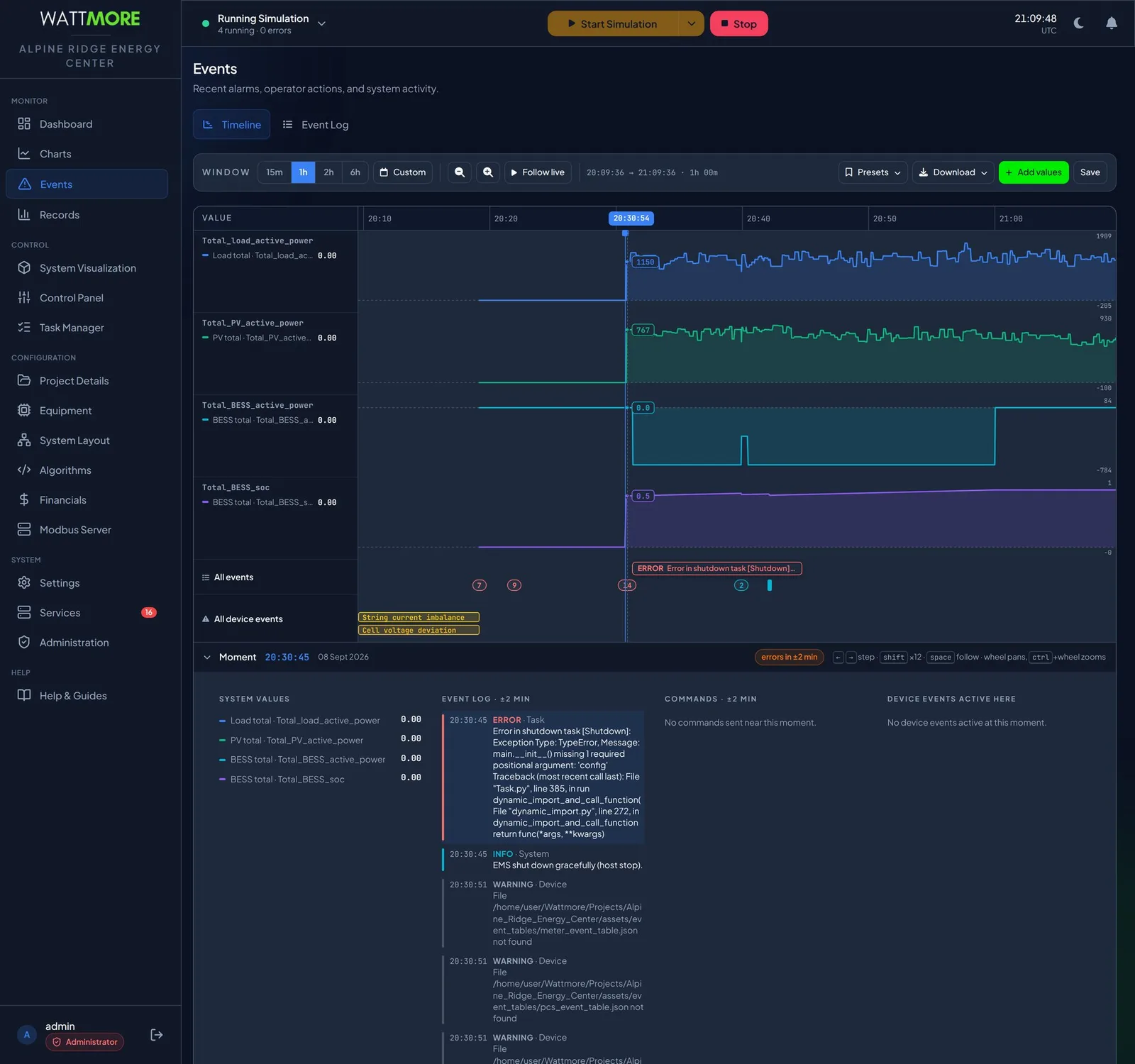
- Where does the controller measure? It should regulate at the point of measurement named in your agreement, not at an inverter terminal.
- What are the settable ranges for droop, deadband, ramp rates, and voltage damping, and can each function be enabled or disabled at runtime?
- Does frequency response bypass the ramp limiter? A ramp limit that also slows droop will miss the reaction time targets.
- How does the controller behave during a ride through event, and how does it recover without a step change?
- Can the vendor supply the controller model and parameters used in a prior EMT interconnection study?
How does a plant controller implement these functions in practice?
A controller built for these requirements runs a fast local loop, on the order of 10 to 100 milliseconds, that reads frequency, voltage, and power at the point of interconnection and reads state of charge and limits from the battery management system. It applies the functions in a fixed order: the energy management setpoint, droop correction, the curtailment ceiling, state of charge derating, the ramp limiter, reactive power, and finally allocation across inverters.
Intellect PPC follows this pipeline: frequency watt droop with configurable droop percentage, deadband, and a bypass of the ramp limiter during frequency events; three reactive power modes (constant power factor, closed loop voltage regulation, and a volt VAR curve); asymmetric ramp limits set per the interconnection agreement; soft and hard state of charge limits with smooth derating; equal, proportional, and priority fleet dispatch; and AGC signal following.
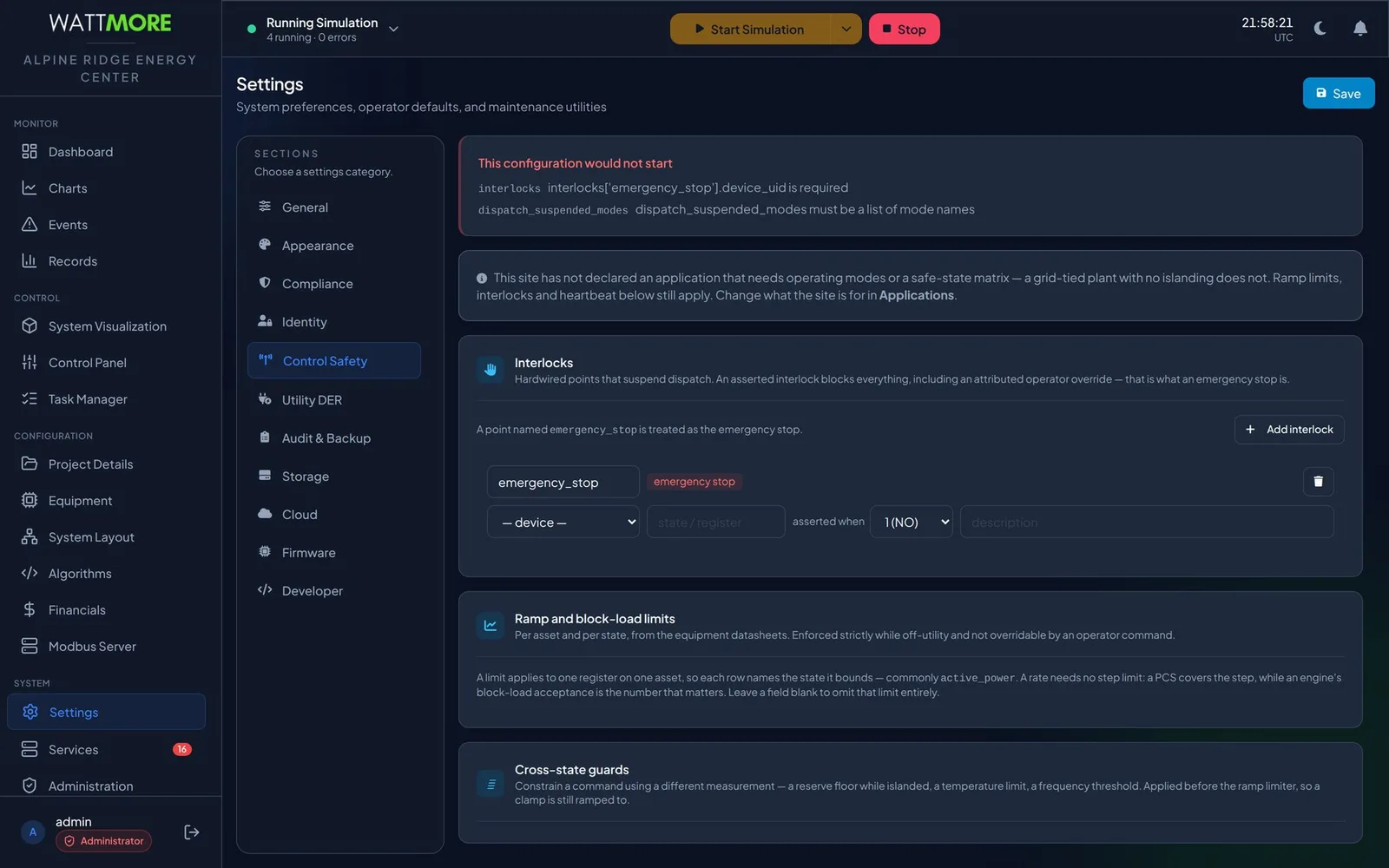
Intellect PPC
Intellect PPC is the WATTMORE power plant controller, an add on to the Intellect energy management platform. It runs frequency watt droop, three reactive power modes, asymmetric ramp limiting, state of charge protection, fleet dispatch, and AGC following in one control loop at the point of interconnection.
Frequently asked questions
- Does IEEE 2800 apply to battery storage?
- Yes. The standard covers inverter based resources on transmission and subtransmission systems regardless of energy source, and battery storage is an inverter based resource. MISO adoption notes state that reactive power requirements apply while a storage plant absorbs active power as well as while it injects.
- Is IEEE 2800 mandatory?
- Not by itself. It is a consensus standard that becomes binding when a grid operator or regulator adopts it. FERC Order 901 directed NERC to develop inverter based resource standards, and MISO, PJM, and ERCOT are writing IEEE 2800 requirements into their interconnection agreements or operating guides. Your obligations come from those documents.
- What is the difference between IEEE 2800 and IEEE 1547?
- IEEE 1547 governs distributed energy resources on distribution systems. IEEE 2800 governs inverter based resources on transmission and subtransmission systems. The functions overlap, such as voltage regulation and frequency response, but IEEE 2800 adds plant level ride through, measurement, and interoperability requirements that assume a controller coordinates many inverters.
- What droop and deadband does IEEE 2800 require?
- The standard specifies ranges of available settings rather than one value, and the transmission operator selects the values in the interconnection agreement. As a reference, MISO reported that its existing agreement already required a maximum 5 percent droop and a 0.036 Hz deadband, and the IEEE 2800 clause adds dynamic performance targets.
- Which ISOs have adopted IEEE 2800?
- ERCOT adopted ride through requirements referencing IEEE 2800 through NOGRR 245, effective October 1, 2024. MISO proposed adopting reactive power, voltage control, frequency response, consecutive voltage ride through, and measurement clauses in 2024. PJM began a phased adoption in late 2024, starting with ride through.
Sources
- IEEE 2800, IEEE Standard for Interconnection and Interoperability of Inverter Based Resources Interconnecting with Associated Transmission Electric Power Systems, IEEE Standards Association
- Inverter Based Resource Performance Requirements (IEEE 2800), Interconnection Process Working Group, March 12, 2024, MISO
- Inverter Based Resources Requirements and Standards, Interconnection Process Subcommittee, September 26, 2024, PJM Interconnection
- Implementation of Requirements in NOGRR 245, Inverter Based Resource Ride Through Requirements, ERCOT
- Developing IEEE Std 2800 Compliant Algorithms for Transmission Connected Inverter Based Resources, National Renewable Energy Laboratory via OSTI
- Solar Integration: Inverters and Grid Services Basics, U.S. Department of Energy
Keep reading
- GuideHow Does a Power Plant Controller Work?
- GuideEMS vs BMS vs SCADA vs PPC: Who Does What in a BESS
- GuideWhat Is a Battery Energy Storage EMS?
- From the blogWhat a power plant controller does on a storage project
- From the blogEMS versus power plant controller
- From the blogERCOT 4CP management with battery storage