Every grid connected energy storage and solar facility needs a power plant controller (PPC). It is not optional. Your interconnection agreement requires it. Your utility demands it. And if your PPC fails or responds too slowly, your facility gets curtailed, penalized, or disconnected.
The PPC's Job
A power plant controller manages your facility's behavior at the point of interconnection with the grid. It receives commands from the grid operator or utility: active power limits, reactive power requirements, voltage regulation setpoints, frequency response signals; and translates those commands into real time control actions across your inverters, battery systems, and other controllable equipment.
The PPC ensures your facility operates within the bounds of your interconnection agreement at all times. When the grid operator says curtail to 50%, the PPC curtails to 50%. When the utility requires a specific power factor, the PPC maintains that power factor. When the grid frequency deviates, the PPC responds within the required timeframe.
Grid Compliance Requirements
Modern interconnection standards are demanding. IEEE 1547 and UL 1741 SA define the baseline requirements for grid connected systems, but many utilities layer additional requirements on top:
Active power curtailment: Facility must reduce output to a specified level within seconds of receiving the command
Reactive power control: Facility must maintain power factor, voltage, or reactive power output within specified ranges
Frequency response: Facility must adjust output in response to grid frequency deviations, often within 200 milliseconds
Ramp rate limits: Power output changes must not exceed specified rates (MW per minute) to prevent grid disturbances
Voltage ride through: Facility must remain connected and operational during voltage sags and swells
Communication protocols: Grid operators typically require DNP3 or IEEE 2030.5 communication with specific point maps and polling intervals
A PPC that cannot meet these requirements puts your entire project at risk. Utilities conduct compliance testing during commissioning, and facilities that fail do not receive permission to operate.
PPC Architecture: Standalone vs. Integrated
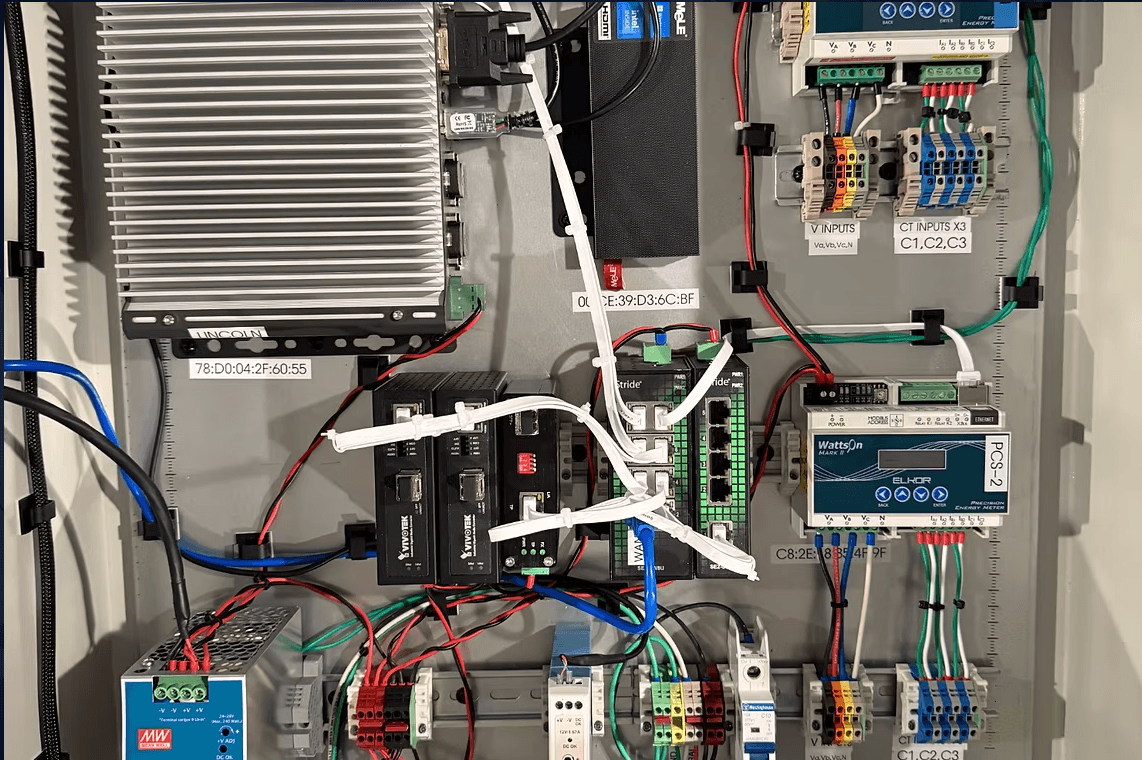
Traditional project architectures use a standalone PPC: a dedicated hardware controller (typically a ruggedized industrial PC or PLC) that sits between the utility communication interface and the site equipment. The PPC receives grid commands, processes them, and sends setpoints to inverters and battery controllers.
This approach works but creates integration complexity. The PPC must communicate with the EMS (if one exists) to coordinate economic dispatch with grid compliance. Two separate control systems issuing commands to the same equipment creates the potential for conflicts, communication delays, and commissioning challenges.
The integrated approach: where the EMS and PPC are a single system eliminates these issues. The optimization engine and the grid compliance engine share the same data, the same control loop, and the same command path to equipment. Grid constraints are incorporated directly into dispatch optimization, and there is zero latency between receiving a grid command and adjusting the dispatch strategy.
Why WATTMORE Integrates the PPC Into Intellect Operate
WATTMORE's Intellect Operate includes full power plant controller functionality. It handles all grid compliance requirements: DNP3 and IEEE 2030.5 communication, active and reactive power control, frequency response, ramp rate management, and voltage ride within the same platform that handles SCADA monitoring and economic dispatch.
Commissioning is faster because there is one system to test instead of two. Operations are smoother because there are no conflicts between the EMS and PPC. And when grid constraints change, the optimization engine adapts immediately because it has direct access to all grid compliance data.
Your project needs a PPC. It also needs an EMS. It also needs SCADA. Intellect Operate is all three. Contact WATTMORE to learn more.