How Does a Power Plant Controller Work?
A power plant controller (PPC) is the real time controller that measures active power, reactive power, voltage, and frequency at the point of interconnection, compares them to a setpoint or a utility command, and dispatches the plant’s inverters so the plant as a whole meets its interconnection requirements. It is the layer that makes an inverter based plant behave like one generator at the grid boundary.
In brief
- The PPC runs one loop, tens of milliseconds long: measure at the POI, compare to the target, correct, and dispatch.
- Its functions: active power control, ramp rate limiting, frequency droop, voltage and reactive power control, power factor, curtailment, and state of charge protection.
- The EMS decides the economic setpoint; the PPC makes it legal at the POI; SCADA records and relays what happened.
- IEEE 2800 covers transmission connected inverter based resources; IEEE 1547 covers distribution connected resources.
- For a battery, the PPC must handle both directions of power flow and derate near state of charge bounds instead of cutting off.
What is the PPC control loop?
Everything a power plant controller does happens inside one repeating loop. First it measures: a meter at the point of interconnection (POI) reports frequency, voltage, active power, and reactive power. Second it compares: the target may be a setpoint from the energy management system, a curtailment ceiling or an automatic generation control signal from the grid operator, or a voltage schedule from the interconnection agreement. Third it corrects: the error passes through the grid functions below, which add droop power, clamp to limits, and shape the rate of change. Fourth it dispatches: the plant level commands are split across every online inverter and written over Modbus.
Then it repeats, every tens to hundreds of milliseconds. The Department of Energy describes the inverter behaviors this loop coordinates: adjusting output when frequency drops, supplying or absorbing reactive power to support voltage, riding through brief disturbances, and following operator signals such as AGC.
What functions does a power plant controller run?
The functions below run in sequence on every loop as separately configurable stages. Order matters: droop must be able to bypass the ramp limiter, and the state of charge stage must see the curtailed value, not the raw one.

- Active power control: hold the plant at the commanded active power or follow an AGC signal, then split the result across inverters.
- Ramp rate limiting: cap how fast plant output can rise or fall, in MW per minute or percent of rating per minute, with separate up and down rates.
- Frequency droop: outside a deadband around nominal frequency, change active power in proportion to the deviation, without waiting for the ramp limiter or the grid operator.
- Voltage and reactive power control: regulate POI voltage by commanding reactive power, along a volt VAR curve or with a closed loop regulator to a voltage target.
- Power factor control: hold a constant power factor at the POI when the utility specifies one instead of a voltage schedule.
- Curtailment: enforce a ceiling on active power from the grid operator or the interconnection limit.
- State of charge protection, for storage: derate charge power as the battery nears full and discharge power as it nears empty, on a smooth curve rather than a hard cutoff.
Where does the PPC sit relative to the EMS and SCADA?
The energy management system decides what the plant should do for economic reasons, producing a base setpoint from prices, tariffs, forecasts, and battery limits on a horizon of seconds to 15 minute intervals. The PPC decides what the plant is allowed to do at the POI and modifies that setpoint on a horizon of milliseconds.
SCADA supervises both. It polls the PPC and the inverters, raises alarms, stores history, and carries utility commands and telemetry over DNP3, but it does not compute the response. The DOE Energy Storage Handbook notes that volt VAR, volt watt, and constant power factor functions are migrating into the inverter itself, so the PPC must coordinate with inverter level settings.
What standards drive a power plant controller?
Two IEEE standards define the behaviors, split by where the plant connects. IEEE 2800, published in April 2022, is the standard for interconnection and interoperability of inverter based resources with transmission and sub transmission systems. It covers voltage and frequency ride through, active power and frequency response, reactive power and voltage control, and protection for bulk system plants.
IEEE 1547 covers distributed energy resources connected at distribution voltages. The 2018 revision added requirements for ride through and for voltage and reactive power support, and the Energy Storage Handbook notes that UL 1741 is the certification used to show an inverter meets IEEE 1547. On distribution connected plants the inverters carry much of the compliance, and the PPC coordinates them and enforces plant level limits. Beneath both standards sits the interconnection agreement, which sets the specific ramp rates, power factor range, voltage schedule, and curtailment interface for that plant.
What is different about a PPC for battery storage?
A solar PPC only ever reduces output. A storage PPC commands power in both directions. Droop can respond to low frequency by discharging and to high frequency by charging. Curtailment applies separately to import and export limits. And the battery has a state of charge the controller must respect: a droop response that runs the battery to empty leaves the plant unable to honor its next command.
That is why the state of charge stage sits in the loop: it derates smoothly as the battery approaches a bound and keeps a reserve for frequency response, while the EMS manages the longer horizon.
What should you look for in a power plant controller?
Confirm that each function is individually enabled and tuned at runtime, that droop can bypass the ramp limiter, that every setpoint write is logged with its source, and that it speaks Modbus to any inverter and DNP3 to the utility. For storage, ask how it derates near state of charge bounds and how it allocates across racks, and whether it shares a control loop with the EMS, because a setpoint that crosses a vendor boundary can arrive late.
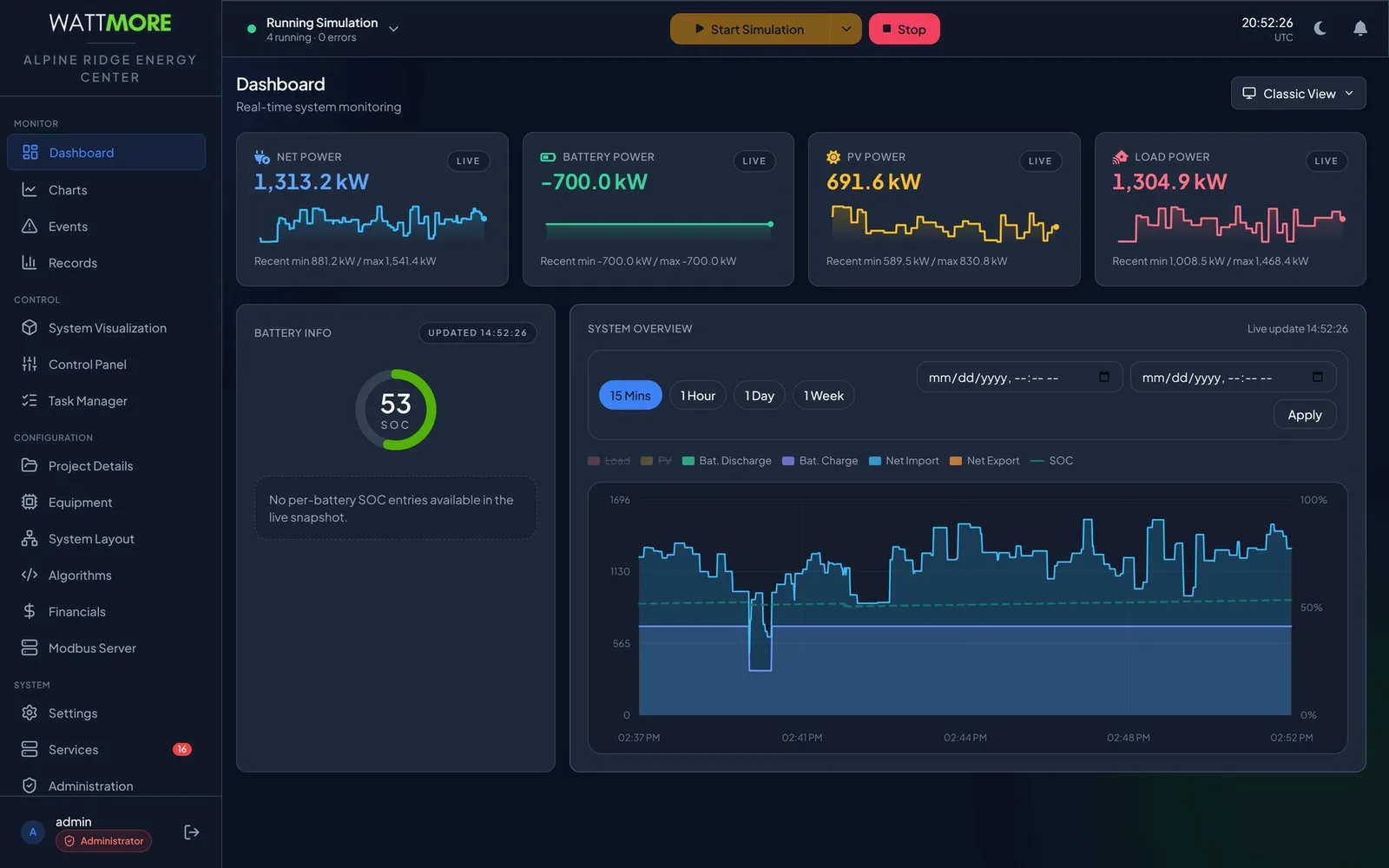
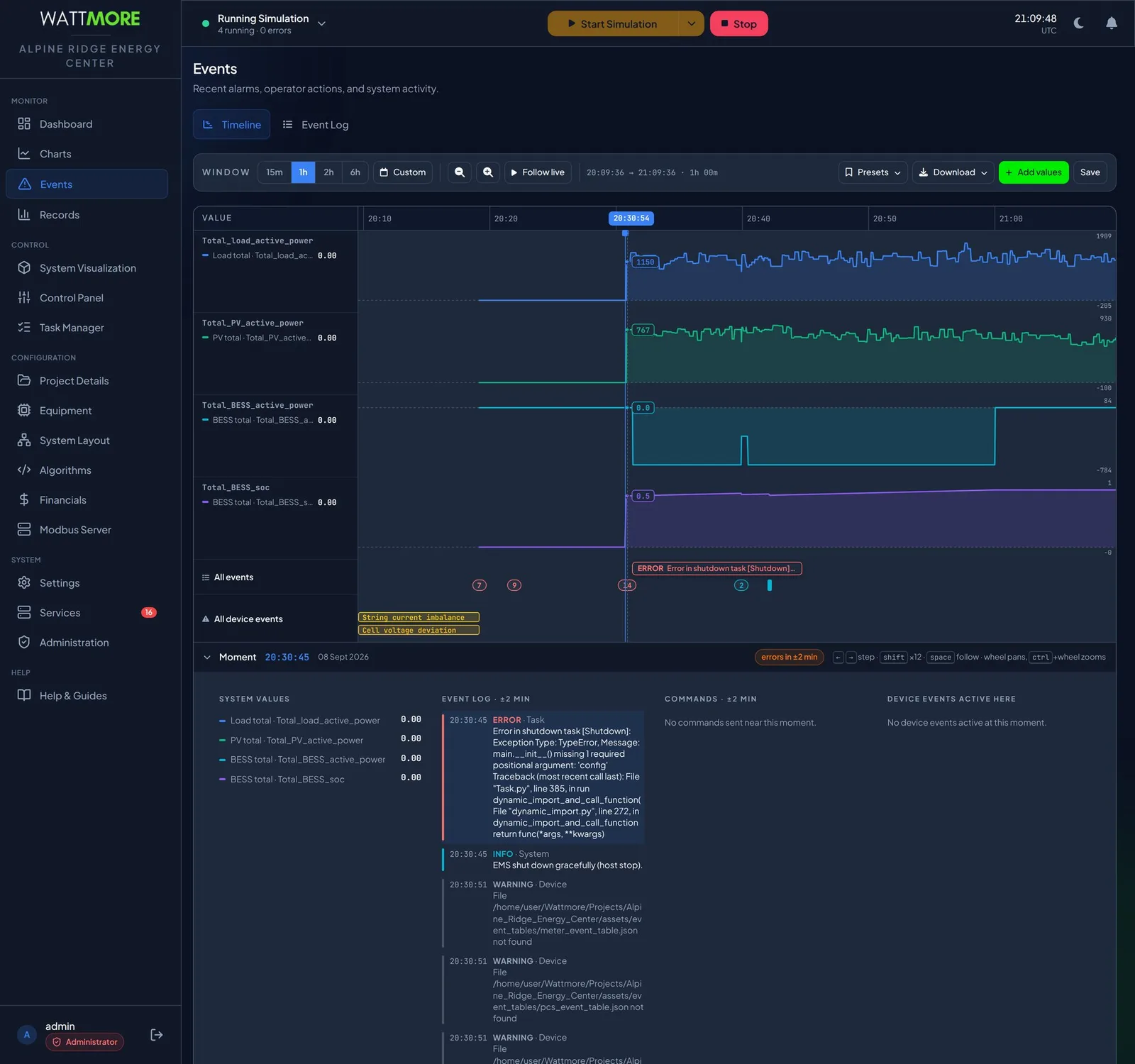
WATTMORE built Intellect PPC as the compliance layer inside Intellect Operate: frequency watt droop with configurable deadband and ramp bypass, three reactive power modes, asymmetric ramp limits, soft and hard state of charge protection, equal, proportional, and priority fleet dispatch, AGC following, and IEEE 2800 ready grid support, all on the same loop as the dispatch optimizer.
Intellect PPC
Intellect PPC is the power plant controller inside Intellect Operate: frequency watt droop, volt VAR and power factor control, asymmetric ramp limiting, curtailment and AGC following, and state of charge protection for storage, on the same control loop as the EMS.
Frequently asked questions
- Does every solar or storage plant need a power plant controller?
- Any plant that must meet plant level requirements at the point of interconnection does. Transmission connected plants are held to IEEE 2800, and interconnection agreements specify ramp rates, voltage schedules, and curtailment interfaces that individual inverters cannot satisfy alone. Small distribution connected systems may rely on IEEE 1547 certified inverter settings.
- What is frequency droop in a power plant controller?
- Droop is a proportional response: when grid frequency moves outside a deadband around nominal, the controller changes active power in proportion to the deviation. Low frequency means more output, or discharge for a battery; high frequency means less output, or charge. It runs locally without waiting for the grid operator, and most grid codes require it to bypass the normal ramp limit.
- How does a PPC control voltage?
- Through reactive power. The controller measures voltage at the point of interconnection and commands reactive power from the inverters to push it toward a target, either along a volt VAR curve or with a closed loop regulator. Where the utility specifies a power factor instead, the controller holds that ratio at the POI.
- What is the difference between a PPC and an EMS?
- The EMS is the optimization layer: it decides when to charge or discharge and how much, based on prices, tariffs, forecasts, and battery limits. The PPC is the compliance layer: it takes that setpoint and enforces droop, voltage, ramp, curtailment, and state of charge rules before anything reaches the inverters. Both are required.
- How fast does a power plant controller respond?
- The loop runs in tens to hundreds of milliseconds, fast enough to provide frequency response inside the windows grid codes require and to track an AGC signal, which most ISOs update every two to four seconds. Speed also depends on the inverters and the communication path, so the chain is tested at commissioning.
Sources
- IEEE 2800: Standard for Interconnection and Interoperability of Inverter Based Resources Interconnecting with Associated Transmission Electric Power Systems, IEEE Standards Association
- IEEE 1547: Standard for Interconnection and Interoperability of Distributed Energy Resources with Associated Electric Power Systems Interfaces, IEEE Standards Association
- Solar Integration: Inverters and Grid Services Basics, U.S. Department of Energy, Solar Energy Technologies Office
- Energy Storage Handbook, Chapter 14: Integrating Energy Storage, Grid Interconnection Process and Policy, Sandia National Laboratories for the U.S. Department of Energy
- Energy Storage Handbook, Chapter 15: Energy Storage Management Systems, Sandia National Laboratories for the U.S. Department of Energy
- Energy Storage Handbook, Chapter 23: Applications and Grid Services, Sandia National Laboratories for the U.S. Department of Energy
Keep reading
- GuideIEEE 2800 Requirements for the Power Plant Controller
- GuideEMS vs BMS vs SCADA vs PPC: Who Does What in a BESS
- GuideWhat Is a Battery Energy Storage EMS?
- From the blogWhat a power plant controller does on storage projects
- From the blogEnergy management system vs power plant controller
- From the blogERCOT 4CP management with a BESS