What Is Peak Shaving With Battery Storage?
Peak shaving is the use of a battery to discharge during the intervals when a facility draws the most power from the grid, so the measured peak demand, and the demand charge billed on it, is lower. The battery recharges during lower demand periods; it does not reduce how much energy the facility uses, only the height of its peak.
In brief
- Demand charges bill the highest average draw in a defined interval, usually 15 minutes, in dollars per kW, and typically make up 30 to 70 percent of a commercial electric bill.
- A battery shaves the peak by holding net grid draw below a target; its kW must cover the excess above the target and its kWh must cover that excess for as long as it lasts.
- Holding a 500 kW facility to 400 kW with a 100 kW battery at $20 per kW saves $2,000 per month, but only if the battery holds the line in every interval.
- The main failure modes are a mispredicted peak, a depleted battery when the real peak arrives, and ratchet clauses that carry one bad month into the next twelve.
- Peak shaving, load shifting, and demand response are different objectives, and the software must know which one it is optimizing in each interval.
How do demand charges work?
The U.S. Energy Information Administration defines a demand charge as the portion of a customer bill for electric service based on the customer maximum electric capacity usage under the applicable rate schedule. A 2017 National Renewable Energy Laboratory survey explains the mechanics: demand charges are typically based on the highest average usage within a defined interval, usually 15 minutes, during a billing period.
That survey, covering more than 10,000 tariffs, found that demand charges typically represent 30 to 70 percent of a commercial bill and that nearly 5 million commercial customers can subscribe to tariffs with demand charges above $15 per kW. Lawrence Berkeley National Laboratory describes the design variants: non coincident charges on the monthly maximum regardless of timing, peak period charges in a utility defined window, seasonal charges, averaging intervals from 15 minutes to one hour, and ratchets, where billing demand cannot fall below a fixed percentage of the peak billing demand in the previous 12 months.
How does a battery shave the peak?
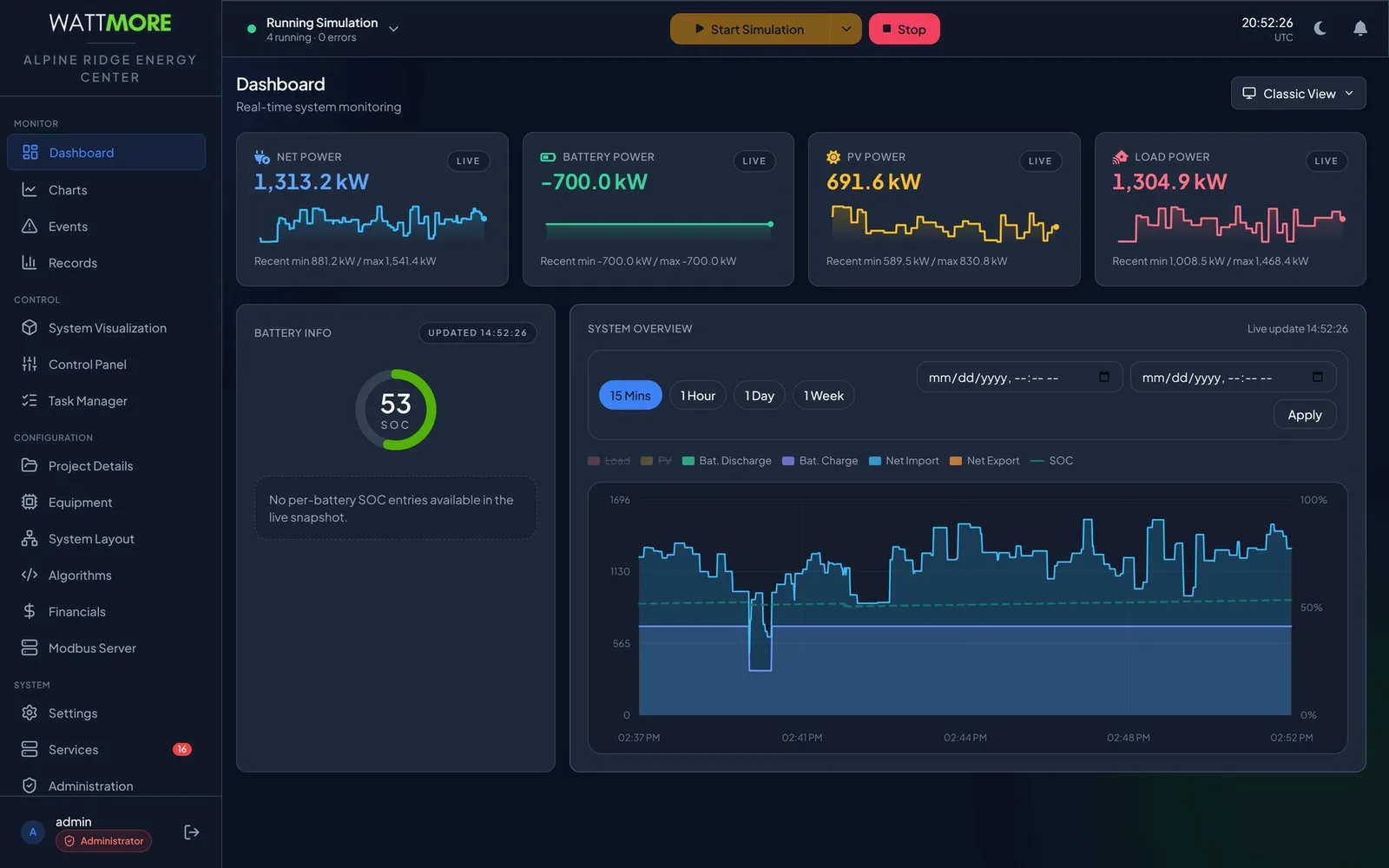
The controller reads the utility meter continuously and sets a target for net grid draw. When load rises above the target, the battery discharges the difference so the meter sees only the target. When load falls below it, the battery recharges, slowly enough that charging does not create a new peak.
Two ratings decide whether this works. Power in kW must be at least the gap between the facility peak and the target. Energy in kWh must cover that gap for the full duration of the excess, after losses. A battery with enough kW but too few kWh runs dry partway through the peak, and the meter records full load for the rest of the interval.
What does a worked example look like?
Take a facility with a 500 kW monthly peak, a 100 kW battery, and a demand charge of $20 per kW; the $20 figure is illustrative, though the NREL survey found tariffs at or above $20 per kW in several states. The controller sets the target at 400 kW. During the peak the battery discharges up to 100 kW and the meter records 400 kW. Savings are 100 kW times $20, or $2,000 for the month, and $24,000 per year if the battery holds the line in all twelve billing periods.
Now size the energy. Suppose load exceeds 400 kW for two hours, averaging 75 kW above target, so the battery must deliver 150 kWh. At the 85 percent round trip efficiency the NREL Annual Technology Baseline adopts for commercial storage, that takes about 176 kWh of charge, so a 100 kW, 200 kWh system fits with modest margin. If the same peak lasted four hours, 200 kWh would fall short and the month would be billed at a higher peak.
Why does forecasting matter?
Energy is the constraint. The battery can discharge its stored kWh only once before it must recharge, so the controller has to decide which intervals deserve that energy. If it discharges at 2 p.m. against a modest rise and the real peak arrives at 4 p.m., the battery is partly empty when it matters. One missed 15 minute interval sets the demand charge for the month, and under a ratchet it can set a floor for the next year.
A load forecast from interval history, weather, and occupancy tells the controller when the peak is likely and how long it will last, so it can hold energy in reserve and set a target it can defend. On a solar plus storage site the forecast must include solar too, because a passing cloud can lift net load by hundreds of kW in minutes.

What are the failure modes?
Peak shaving fails in predictable ways, and each one shows up on the bill as a higher kW than planned.
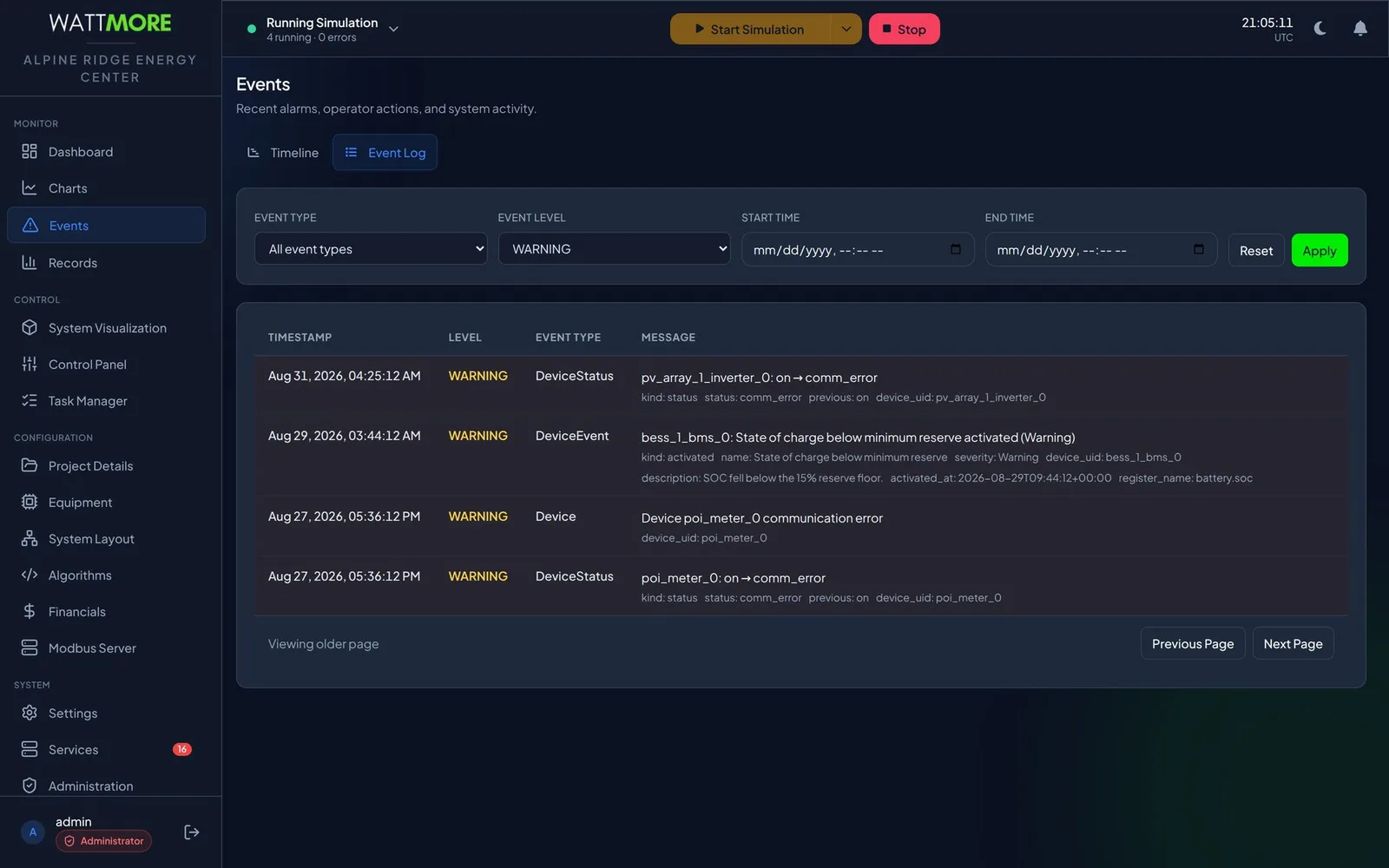
- Mispredicted peak: the target is set too low, load crosses it by more than the battery can supply, and the meter records the excess.
- Depleted battery: energy is spent early or the peak outlasts the kWh rating, so the last intervals go unshaved.
- Ratchet clauses: one high interval raises billing demand for up to 12 months, so a single failure costs far more than one month of savings.
- Charging into the peak: recharging too fast, or at the wrong time, creates a new peak the battery itself caused.
- Capacity fade: a battery sized with no margin loses usable kWh over its life and stops covering the duration it was sized for.
Peak shaving vs load shifting vs demand response: what is the difference?
The three strategies use the same battery but target different line items, and they can conflict in the same hour. Load shifting moves energy from high price to low price periods under a time of use rate. Demand response reduces load on request from a utility or aggregator for a payment. Peak shaving targets only the maximum kW, and a controller doing all three must rank them.
| Strategy | Bill item targeted | What triggers discharge | Sizing driver |
|---|---|---|---|
| Peak shaving | Demand charge, $ per kW | Load crossing a kW target | Peak height and duration |
| Load shifting | Energy charge, $ per kWh | Time of use price window | Hours of high price |
| Demand response | Program payment | Utility or aggregator event | Committed kW and event length |
What should you look for in peak shaving software?
The software, not the battery, determines how much of the demand charge is removed. Look for a controller that runs locally and keeps shaving when the internet drops; forecasts load and solar and adjusts its target as the month unfolds; respects the limits published by the battery management system; and manages recharge so it never creates a new peak.
Intellect Operate is an energy management system built for this job. It runs its control algorithms on ruggedized edge hardware so demand charge management continues through network outages, forecasts load and solar, reads battery management system limits every second and constrains dispatch to them, and stacks peak shaving with time of use optimization and demand response in one control loop.
Intellect Operate
Intellect Operate is the WATTMORE energy management system for battery storage. It runs peak shaving and demand charge management on edge hardware at the site, forecasts load and solar, respects battery management system limits, and stacks time of use and demand response value in the same control loop.
Frequently asked questions
- What is peak shaving in simple terms?
- Peak shaving means using a battery to supply part of a building load during its highest demand periods so the utility meter records a lower maximum. Commercial bills include a demand charge based on that maximum, in dollars per kW, so cutting the peak cuts the bill even though the building uses the same total energy.
- How much can peak shaving save?
- Savings equal the kW removed from the monthly peak times the demand charge rate, repeated each billing period the battery holds the line. Demand charges typically make up 30 to 70 percent of a commercial bill, and NREL found nearly 5 million commercial customers with access to tariffs above $15 per kW, so the value depends on the tariff and the load shape.
- What size battery do I need for peak shaving?
- The kW rating must cover the difference between the facility peak and the target you want the meter to record. The kWh rating must cover that difference for the full duration of the peak, divided by round trip efficiency, with margin for capacity fade. A full year of interval load data is needed to find both numbers.
- Does peak shaving work with solar?
- Yes, and the combination usually works better than either alone. Lawrence Berkeley National Laboratory found that demand charge savings from PV combined with storage are almost always greater than the sum of the savings from each separately, because storage covers the morning and evening peaks that solar leaves behind.
- What is a demand ratchet?
- A ratchet is a tariff rule under which billing demand for a month cannot be lower than a fixed percentage of the highest billing demand in the previous 12 months. One interval where the battery fails to hold the peak can raise the bill for up to a year, which is why peak shaving controllers set conservative targets and hold energy in reserve.
Sources
- Identifying Potential Markets for Behind the Meter Battery Energy Storage: A Survey of U.S. Demand Charges, National Renewable Energy Laboratory
- Demand Charge Savings from Solar PV and Energy Storage, Lawrence Berkeley National Laboratory via OSTI
- Demand Charge Savings from Solar PV and Energy Storage, full text, Lawrence Berkeley National Laboratory and NREL
- Glossary: Demand Charge, U.S. Energy Information Administration
- Electricity Explained: Prices and Factors Affecting Prices, U.S. Energy Information Administration
- Annual Technology Baseline 2024: Commercial Battery Storage, National Renewable Energy Laboratory
Keep reading
- GuideWhat Is a Battery Energy Storage EMS?
- GuideHow to Size a Battery for Solar Plus Storage
- GuideEMS vs BMS vs SCADA vs PPC: Who Does What in a BESS
- From the blogPeak shaving with battery storage, how it works
- From the blogES Fox demand charge peak shaving case study
- From the blogERCOT 4CP coincident peak management