Peak shaving with battery storage is one of the most reliable use cases for energy storage and one of the easiest to model, because the thing it targets, the monthly demand charge, is set by a single number that a fast battery can control. This guide explains what demand charges are, how peak shaving works, what drives the savings, and what it looks like on a live industrial site.
What are demand charges?
Demand charges are fees based on your highest power draw, measured in kW, during a billing period. Most utilities use the single highest fifteen minute average demand in the month. Unlike energy charges, which are based on total kWh consumed, demand charges penalize you for a peak regardless of how brief it is.
If a facility averages 200 kW but hits 500 kW for fifteen minutes during the month, it pays demand charges on the full 500 kW. Demand charges are widespread and often large. A National Renewable Energy Laboratory study of commercial tariffs found that demand charges above $15 per kW are common across the United States and that roughly five million commercial customers face demand charges above that level (NREL survey of United States demand charges). On tariffs like that, a single spike can add thousands of dollars to a month's bill.
How peak shaving works
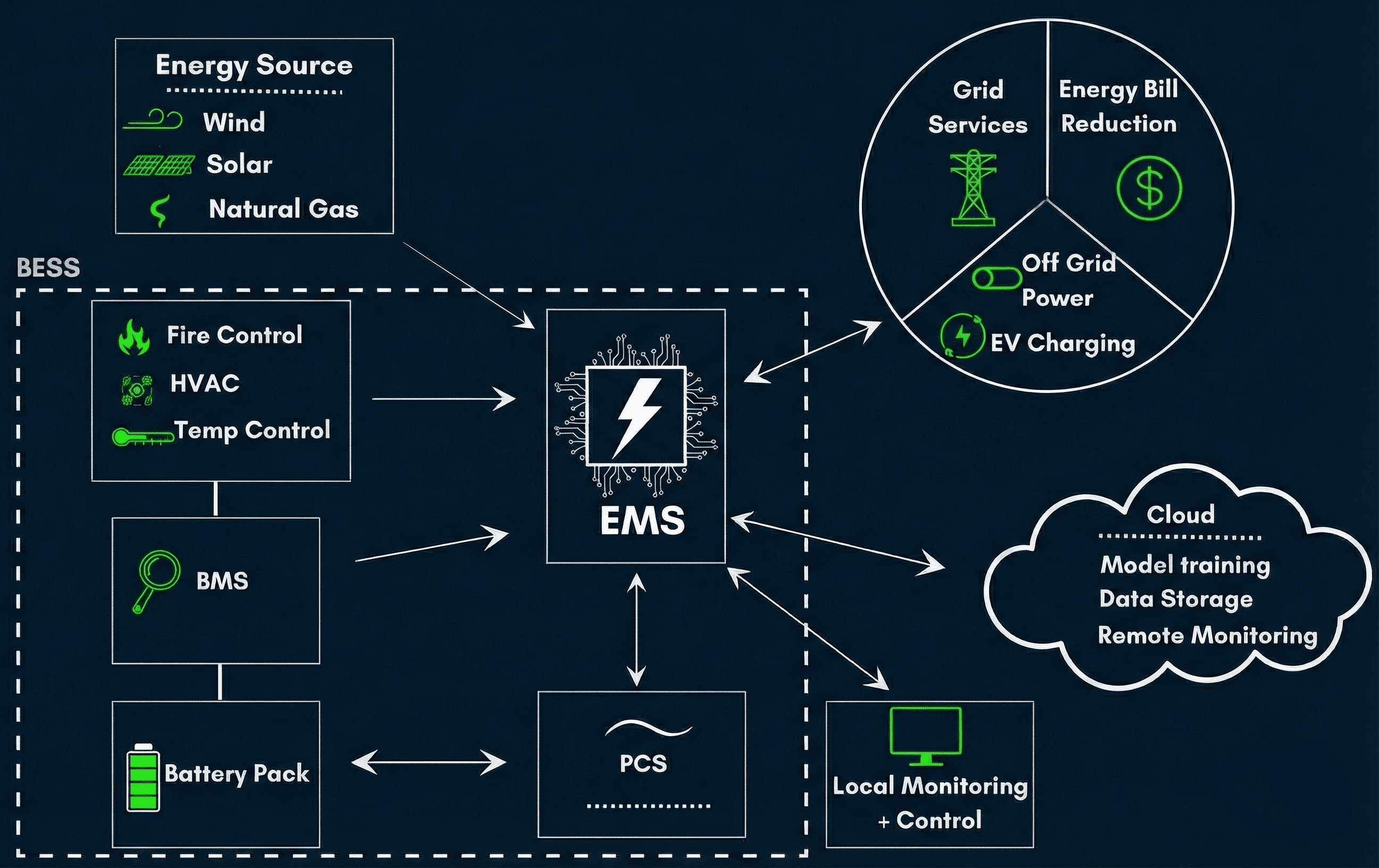
Peak shaving uses a battery energy storage system to cut the demand peak the meter records. The battery charges during low demand periods, typically overnight or in low rate hours, and discharges during high demand periods so the facility draws less from the grid at the moment that sets the bill.
The process has three steps:
- Predict the peak. The storage EMS forecasts when demand peaks will occur from historical intervals, weather, day of week, and production schedules.
- Position the battery early. The EMS makes sure the battery is charged before the risk window opens and keeps it there until the risk passes.
- Shave the peak. When load rises above a target threshold, the battery discharges to offset the excess, holding metered demand under the target while the spike passes.
The physics helps. Demand is a rolling fifteen minute average, so a brief spike does not set the peak on its own; the average across the full window does. A battery that discharges precisely against the spike keeps the average, and therefore the bill, under control.
What a peak shaving event looks like
At E.S. Fox, an industrial fabrication facility in Thorold, Ontario, a 150 kW, 444 kWh battery controlled by Intellect Operate targets the facility's monthly peak on a tariff with a demand rate of $26.37 per kW. In one recorded event the facility's true demand reached 206 kW at midday while the utility meter recorded 156 kW, a 50 kW reduction, about 24 percent, worth roughly $1,300 in avoided demand charges for that month. The controller discharged within one 4 Hz control cycle when load crossed the target and settled net load back to the limit within a few seconds.
The site's load factor, about 22 percent, is what makes it such a good candidate: demand is spiky and peak driven, so a modest battery can remove a large share of the billed peak.
How much can you save?
Savings depend on the demand rate, the load shape, and the battery size. Three factors dominate:
- Demand rate. Every kW shaved is worth the tariff's rate, every month. At $15 per kW a 100 kW reduction is $1,500 a month; at $26 per kW it is $2,600.
- Load factor. The lower the average demand relative to the peak, the more of the peak a given battery can remove.
- Predictability. Peaks driven by schedules, weather, or production are easier to forecast than random ones, and forecast accuracy sets the achievable reduction.
Facilities with peaky profiles see the best returns: manufacturing plants with large motors, data centers with cooling spikes, cold storage, and commercial buildings with high HVAC demand. A flat, steady load has little to shave.
Why load forecasting decides the outcome
Effective peak shaving is a forecasting problem before it is a hardware problem. If the battery discharges too early it may be empty when the actual peak arrives; too late and the meter has already recorded the peak. Because the bill is set by the single worst interval of the month, one missed peak can erase the month's savings.
Intellect Operate approaches this the way an optimizer would: a mixed integer solver forecasts the coming week from historical load, 672 fifteen minute intervals, and sets the target peak that minimizes the month's demand charge. A fast local control loop then holds the meter under that target in real time, and the plan is revised continuously as the day unfolds. The EMS also decides when to charge so that charging itself never creates a new peak.
Stacking peak shaving with other value streams
Peak shaving is usually the foundation of a broader stack. The same battery can also provide:
- Time of use arbitrage: charging in off peak hours and discharging in peak rate periods
- Solar self consumption: storing midday solar for use in the evening
- Backup power: carrying critical loads through an outage
- Demand response: earning program payments by discharging during called events
These uses compete for the same energy, so the EMS has to jointly optimize them against the month's demand risk rather than run them in sequence. Our guide to revenue stacking explains how that tradeoff is solved.
Getting started
The first step in any peak shaving project is analyzing interval load data against the tariff. Intellect PLAN takes twelve months of fifteen minute data and the rate schedule and returns the battery size, expected peak reduction, and projected savings, using the same dispatch algorithms that run Intellect Operate in the field. Contact us for an analysis of your site.