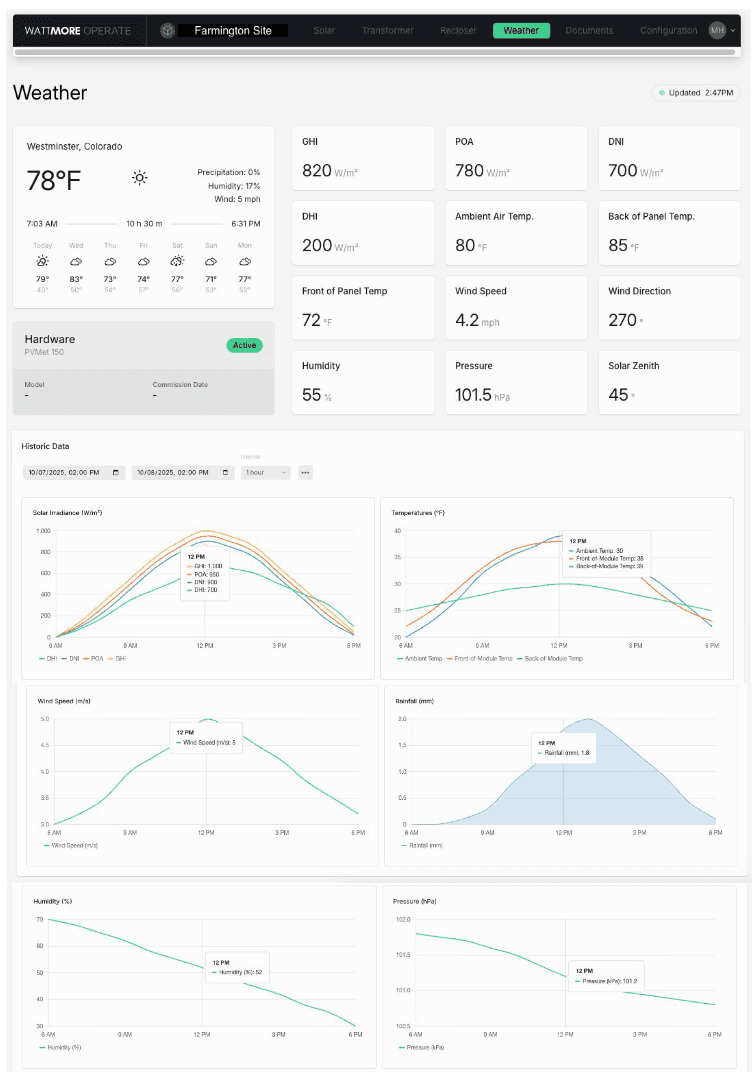
Weather data acquisition is a foundational component of professional solar and energy storage operations, and one of the most commonly underbuilt. Accurate, continuous weather measurement is what makes performance verification possible on the solar side and what feeds the forecasts that drive battery dispatch on the storage side. A site without good weather data is a site whose performance can only be guessed at.
What is weather data acquisition?
Weather data acquisition is the collection, transmission, and processing of meteorological measurements at a solar or storage installation. A weather station for a data acquisition system (DAS) typically includes irradiance sensors, temperature sensors for both air and module, an anemometer, and precipitation instruments, wired to a logger that transmits to the monitoring platform alongside the electrical data.
The parameters that matter for solar
Irradiance: GHI and POA
Global horizontal irradiance (GHI) and plane of array (POA) irradiance are the most important measurements on a solar site. POA, measured in the same plane as the modules, is the direct input for computing expected production and performance ratio; without it, actual output has nothing to be judged against, and underperformance hides inside weather. The IEC 61724 standard defines monitoring practice, including how irradiance should be measured and how performance ratio is computed (IEC 61724), and ISO 9060 defines the accuracy classes for the pyranometers themselves (ISO 9060). Specify the sensor class your contracts require, and calibrate on schedule; a drifting pyranometer corrupts every metric downstream of it.
Temperature
Photovoltaic efficiency falls as cell temperature rises, by the temperature coefficient on the module datasheet. Ambient and module temperature measurements let the performance model set honest expectations, distinguish thermal effects from real faults, and support degradation analysis across seasons.
Wind
Wind data serves several purposes: tracker equipped sites use wind speed to trigger protective stow; wind cools modules, which the performance model should know; and for combined sites, wind feeds load and weather forecasting.
Precipitation and humidity
Rain data calibrates soiling models: heavy rain cleans arrays, light mist can make soiling worse. Since soiling commonly costs several percent of annual energy, and much more in dry regions (NREL soiling research), knowing when the array was last washed by weather turns cleaning from a calendar item into an economic decision.
Weather data and energy storage
Weather instrumentation is not just for solar. For battery systems, weather is forecasting fuel:
- Load forecasting: temperature drives HVAC, often the largest variable component of commercial demand, so tomorrow's temperature forecast is tomorrow's peak forecast
- Solar forecasting: for solar plus storage, expected production sets how much energy will be available to shift into the evening
- Dispatch quality: the EMS optimizes against forecasts, and forecast error is the main reason modeled savings and captured savings diverge, as our guide to peak shaving explains
- Thermal management: ambient temperature data helps the enclosure HVAC hold batteries in their happy range, which protects both performance and warranty
Best practices for a solar DAS
- Specify sensors by standard: pyranometer class per ISO 9060, monitoring practice per IEC 61724, matched to what your performance contracts require
- Install redundancy: at least two irradiance sensors per site, so readings cross validate and a failure does not blind the plant
- Calibrate on schedule: pyranometers drift; recalibration on the manufacturer's cycle keeps the record defensible
- Sample fast, average sensibly: one second sampling with one minute averages captures transients without drowning the historian
- Log at the edge: store and forward loggers cache data through network outages and backfill automatically, so the record has no gaps
- Cross check with satellite: satellite derived irradiance is a useful sanity check on site sensors and a fallback during sensor maintenance
From measurements to decisions
The value of weather data is realized in software. A monitoring platform turns irradiance into expected production and performance ratio, temperature into honest models, wind into stow decisions, and rain into cleaning economics; an EMS turns forecasts into dispatch. WATTMORE's Intellect EnFORM integrates weather stations from major manufacturers, validates and gap fills the data, and feeds both the performance analytics and the forecasting that Intellect Operate dispatches against. Contact us to review the instrumentation plan for your site.