Power Plant Controller Vendors Compared for Solar and Storage
A power plant controller (PPC) vendor supplies the real time controller that sits between the grid operator’s instructions and a plant’s inverters, holding the point of interconnection inside the grid code and the interconnection agreement. This comparison reads twelve vendors’ own published pages for the same eleven facts, so a buyer can see what each one states in writing and what each one leaves unsaid. WATTMORE makes one of the twelve, and the comparison says so.
In brief
- Most vendors publish the control functions they support; far fewer publish a response time, a named standard such as IEEE 2800, or a cybersecurity standard. Absence in the table means the vendor did not publish it, not that the product lacks it.
- Form factor splits three ways: a hardware cabinet or skid, software on an industrial controller, and software integrated into an energy management system. The split decides who owns the integration between the EMS setpoint and the grid code layer.
- Only two of the twelve name IEEE 2800 and IEEE 1547 on their product pages. Several European vendors instead name national grid codes and carry component certificates for them.
- Published response times range from under 200 milliseconds to under a second. Vendors that do not publish one should be asked for a measured figure at the interconnection point.
- The questions that separate vendors in an RFP are not on any product page: the dynamic model for interconnection studies, closed loop accuracy at the POI, behavior when a block of inverters drops, and who is on the phone at 2 a.m.
Who wrote this, and how to read it
WATTMORE builds Intellect PPC, the power plant controller inside Intellect Operate. That is a reason to be careful with this page, not a reason to skip it. Every claim below about another vendor comes from that vendor’s own product page, datasheet, or press release, linked in the sources, as read in September 2026. Where a vendor does not publish a fact, the table says not published rather than guessing. Intellect PPC is described from the same kind of material, its public product page and technical brief, and gets no extra credit for being ours.
Read the table as a record of what each vendor is willing to state in writing. A blank is a question to ask, not a verdict. A vendor with a short public page may have a long datasheet under NDA, and the reverse is also true.
What does a PPC do that an EMS does not?
The energy management system decides what the plant should do: the MW setpoint that earns the most given prices, forecasts, and the battery’s state. The power plant controller decides what the plant is allowed to do: it measures frequency, voltage, and power at the point of interconnection and adjusts every inverter so the plant meets its interconnection agreement. Frequency watt droop, voltage and reactive power control, ramp rate limiting, curtailment, and state of charge protection are PPC functions. The EMS plans on one second to fifteen minute timescales; the PPC enforces in tens of milliseconds.
PPC, EMS, and SCADA are increasingly overlapping products. A vendor may call something an EMS that does not provide the deterministic POI control a PPC does, and a SCADA vendor may bundle a PPC on an industrial controller. The architecture should be specified functionally rather than by product name: who computes the setpoint, who enforces the grid code on it, and whether they share a control loop.
The vendors, side by side
Twelve vendors with a published PPC product for solar, storage, or hybrid plants. Grid codes and standards are listed only where the vendor names them on the cited page.
| Vendor and product | Form factor | Grid codes and standards named | Protocols named | Response time | Redundancy |
|---|---|---|---|---|---|
| WATTMORE Intellect PPC | Software in the Intellect Operate EMS on the site appliance, same control loop as the EMS | IEEE 2800, IEEE 1547, SunSpec, Modbus | Modbus TCP and RTU, DNP3, IEEE 2030.5 | Control loop on the order of 10 to 100 ms; droop bypasses the ramp limiter for subsecond response | Not published |
| Power Factors Unity PPC | Software control system with panel assembly as a service | UK, CAISO, ERCOT, AEMO, and 70 plus grids named; ISO 27001 and 27019 certified, supporting NERC CIP, NIS2, and IEC 62443 | IEC 60870, IEC 61850, DNP3, Modbus TCP and RTU | Well under 200 ms | Redundant fault tolerant servers, active failover, clustering |
| Hitachi Energy PPC | Modular control solution; hardware platform not published | Regional references only: HECO, LUMA, CAISO, Australia GPS, Chile, Mexico | Not published | Not published | Extra modules provide built in redundancy |
| GE Vernova FLEXIQ | Cabinet with plant controller and SCADA on the Mark VIe platform | Not published | Not published | Not published | Not published |
| Ingeteam INGECON SUN Plant Controller | Hardware skid with PLC, power meter, switch, and engineering PC | Country specific standards, none named | Modbus TCP by default; DNP3, IEC 60870, or OPC UA optional | Less than a second | Hot redundancy optional |
| Elum Energy ePowerControl PPC | Hardware cabinet, 30 kg | Spanish NTS, Portuguese Portaria 73/2020, EU regulation 2016/631; certified in France, Spain, Portugal | IEC 61850, Modbus, DNP3 | Not published | Hot redundancy optional with automatic failover |
| TMEIC PPC and Solar Ware Main Site Controller | Hardware controller managing up to 255 inverters | Not published | Modbus, DNP3 | Not quantified | Not published |
| FlexGen HybridOS Solar PPC | Software platform; hardware not published | Not published | Modbus, DNP3, CAN, synchrophasor | Not quantified | Advanced metering redundancy |
| Emerson Ovation PPC | Real time control hardware with embedded logic under the Ovation DCS | Not published; cybersecurity suite without a named standard | Comprehensive protocol suite, unnamed | Not published | Built in redundancy, self healing options |
| ETAP Power Plant Controller | Software tools and control hardware, parameterized rather than programmed | National and international grid codes, none named | Not published | Not published | Not published |
| IHI Terrasun Assured Controls | Software installed at commissioning with HMI and cloud analytics | ISO, RTO, and utility requirements, none named | Not published | Not published; 99.5 percent uptime claimed | Stable through loss of an entire block of inverters and batteries |
| Gantner Q.reader PPC | Hardware cabinet, real time Linux, IP65 enclosure with UPS | VDE AR N 4110, 4120, 4130 certified | Modbus TCP; IEC 60870 or DNP optional; digital and analog IO | Not published | Not published |
| meteocontrol PPC on blue’Log XC | Hardware control cabinet built on a DIN rail logger | VDE AR N 4110 and 4120, Spanish NTS, Polish and Italian codes, component certificates by DNV; IEC 62443 4 1 | IEC 60870 5 101 and 104, IEC 61850, DNP3, Modbus, SunSpec, OPC UA, MQTT | Settling time per VDE test, loop rate not published | Not published |
Which control functions does each vendor name?
Every vendor names active power control and some form of reactive power or voltage control. The differences are in what else is stated. Ramp rate control is named by WATTMORE, Power Factors, GE Vernova, Elum, TMEIC, Emerson, ETAP, IHI Terrasun, Gantner, and meteocontrol. Frequency response is named by WATTMORE, Power Factors, GE Vernova, Ingeteam, Elum, Emerson, ETAP, Gantner, and meteocontrol. Closed loop coordination of a hybrid PV plus BESS plant at the POI is described explicitly by Power Factors, FlexGen, Emerson, ETAP, IHI Terrasun, and Ingeteam.
Functions that only some vendors name are worth asking every vendor about: state of charge protection and balancing, which WATTMORE, Elum, ETAP, IHI Terrasun, and Hitachi Energy mention; automatic generation control signal following, which WATTMORE, Trimark on the SCADA side, and IHI Terrasun mention; islanding and black start, which Elum and Emerson mention; nighttime reactive power and capacitor bank control, which FlexGen and Power Factors mention; and zero export, which Gantner and meteocontrol mention. Fleet dispatch across inverters, with equal, proportional, and priority allocation, is a WATTMORE claim; Power Factors describes optimal power distribution.
Where does the PPC live, and why does it matter?
Three architectures appear in the table. A hardware cabinet or skid, from Ingeteam, Elum, Gantner, meteocontrol, TMEIC, and GE Vernova, arrives as a certified box and connects to whatever EMS and SCADA the site has. Software on an industrial controller, from Emerson, Hitachi Energy, and the SCADA vendors, runs in the plant automation platform. Software integrated into the EMS, from WATTMORE, FlexGen, IHI Terrasun, and Power Factors, shares a data bus with the optimizer.
The choice decides who owns the boundary between the setpoint and the grid code. When the EMS and the PPC come from different vendors, every dispatch command crosses a vendor boundary, and the integration between them is tested at commissioning and defended during every incident. When they share a control loop, the EMS cannot send a command the PPC cannot execute safely, and one support team answers for both. The counter argument is real too: a certified standalone cabinet with a national grid code component certificate is what some utilities and lenders want to see, and it survives a change of EMS vendor.
What should an RFP ask that the product pages do not answer?
The facts that separate PPC vendors in practice are rarely on a product page. A short scorecard of twenty to thirty criteria, weighted for the plant, settles the choice faster than a feature list.
- The plant dynamic model: is a validated PSCAD or PSS/E model of the controller available for the interconnection study, and who maintains it through firmware updates?
- Closed loop accuracy at the POI: the measured error between the commanded and delivered active and reactive power at the meter, under steady state and during a ramp.
- Response time as measured, not as claimed: from a frequency excursion crossing the deadband to the change in plant output at the POI.
- Inverter, PCS, and BMS interoperability: the list of models integrated in the field, and how a new register map is added.
- State of charge management: what the controller does as the battery approaches its limits, and whether derating is smooth or a step.
- Curtailment and ramp behavior: separate up and down rates, ramp limiter bypass during frequency events, and what happens when a curtailment order and a droop response conflict.
- Fault ride through and islanding: which functions are in the controller and which are executed and certified at the inverter.
- Redundancy and failure modes: what the plant does when the controller loses a block of inverters, the meter, or its own power.
- Cybersecurity: the named standard, the audit record, role based access, and the network posture the controller expects.
- Support: the escalation path during an event, the release cadence, and how a rollback is performed.
How Intellect PPC fits, stated plainly
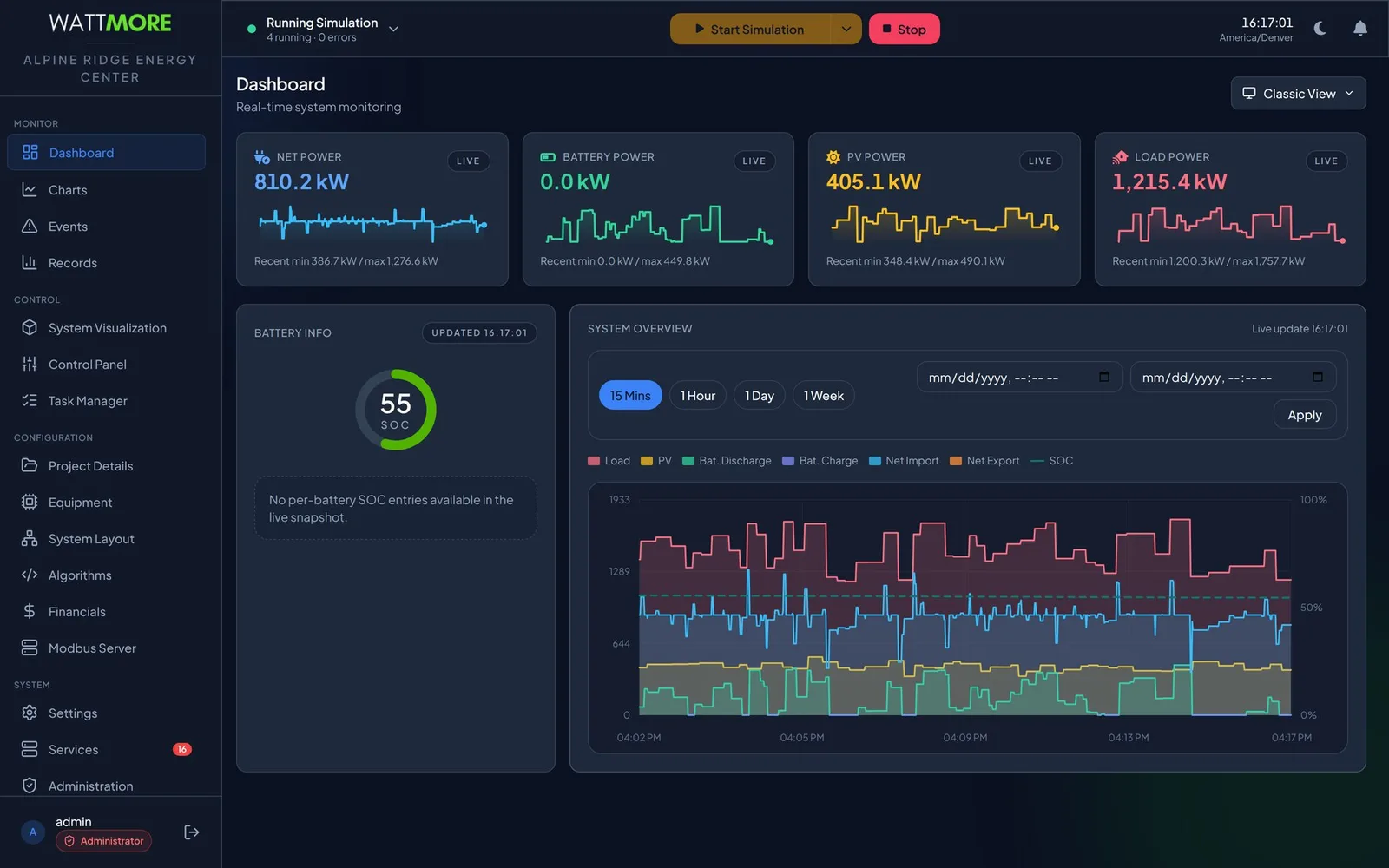
Intellect PPC is a software power plant controller that ships as part of Intellect Operate and runs in the same control loop as the EMS on the site appliance. Its published functions are frequency watt droop with a configurable droop percentage and deadband and a ramp limiter bypass during frequency events, three reactive power modes including constant power factor, voltage regulation, and a volt var curve, asymmetric ramp rate limiting, soft and hard state of charge limits with derating curves, fleet dispatch with equal, proportional, and priority allocation, and AGC signal following. It communicates with inverters over Modbus TCP with flexible register mapping and is designed to the IEEE 2800 and IEEE 1547 grid support requirements.
What it is not: a standalone certified cabinet with a national grid code component certificate, and a product with a published redundancy architecture on its public page. A buyer who needs either should ask, and the table above shows which vendors publish them. The strongest reason to choose an integrated PPC is the one integration boundary it removes; the strongest reason to choose a standalone one is the certificate it carries.
Intellect PPC
Intellect PPC is the WATTMORE power plant controller for battery storage: frequency droop, voltage and reactive power control, ramp rate limiting, state of charge protection, and fleet dispatch, running in the same control loop as the Intellect Operate EMS.
Frequently asked questions
- Which power plant controller vendors are certified to IEEE 2800?
- IEEE 2800 is a performance standard for inverter based resources rather than a product certification scheme, so vendors describe their controllers as designed or compliant to it rather than certified. Among the twelve vendors compared, WATTMORE names IEEE 2800 and IEEE 1547 on its product pages, and Trimark names both on its SCADA page. Several European vendors instead carry component certificates against national grid codes such as VDE AR N 4110 and the Spanish NTS.
- How fast does a power plant controller need to respond?
- Fast enough to meet the frequency response and ramp requirements in the interconnection agreement, which for primary frequency response is typically a change in plant output within a few hundred milliseconds of the deadband being crossed. Power Factors publishes under 200 milliseconds, Ingeteam under a second, and WATTMORE a control loop of 10 to 100 milliseconds. Most vendors publish no figure, so the RFP should ask for one measured at the point of interconnection.
- Is it better to buy the PPC from the EMS vendor or separately?
- It depends on what the plant must prove. An integrated PPC removes the vendor boundary that every dispatch command would otherwise cross, so the optimizer cannot issue a command the compliance layer cannot execute and one team supports both. A standalone hardware PPC arrives with its own grid code certificate and survives a change of EMS vendor. Lenders and utilities in some markets ask for the certificate; operators in others value the single control loop.
- Which protocols should a PPC support?
- Toward the inverters and meters, Modbus TCP is universal and IEC 61850 appears at larger plants. Toward the grid operator or plant SCADA, DNP3 in North America and IEC 60870 5 104 in Europe, with OPC UA for historians. Meteocontrol and Stem AlsoEnergy publish the longest lists; several vendors publish none, which is a question to ask rather than a gap to assume.
- Does this comparison rank the vendors?
- No. It records what each vendor publishes for the same set of facts so a buyer can see who states what. WATTMORE makes one of the products and has said so; the fair way to handle that is to report every vendor from its own material, including ours, and to leave the weighting to the buyer’s scorecard.
Sources
- Intellect PPC product page, WATTMORE, Inc.
- Unity Power Plant Controller, Power Factors
- Power Factors PPC drives complex operations at a solar plus storage plant in California, Power Factors
- Power Plant Controller (PPC), Hitachi Energy
- FLEXIQ, GE Vernova
- INGECON SUN Plant Controller, Ingeteam
- ePowerControl PPC, Elum Energy
- Power Plant Controller, TMEIC
- HybridOS Solar Power Plant Controller, FlexGen
- Ovation Power Plant Controller, Emerson
- Power Plant Controller and eSCADA, ETAP
- Assured Controls, IHI Terrasun
- Gantner Power Plant Controller, Gantner Instruments
- Power Plant Controller (PPC), meteocontrol
- blue’Log X Series XM and XC, meteocontrol
- True:SCADA, Trimark Associates
- IEEE 2800, Standard for Interconnection and Interoperability of Inverter Based Resources, IEEE Standards Association