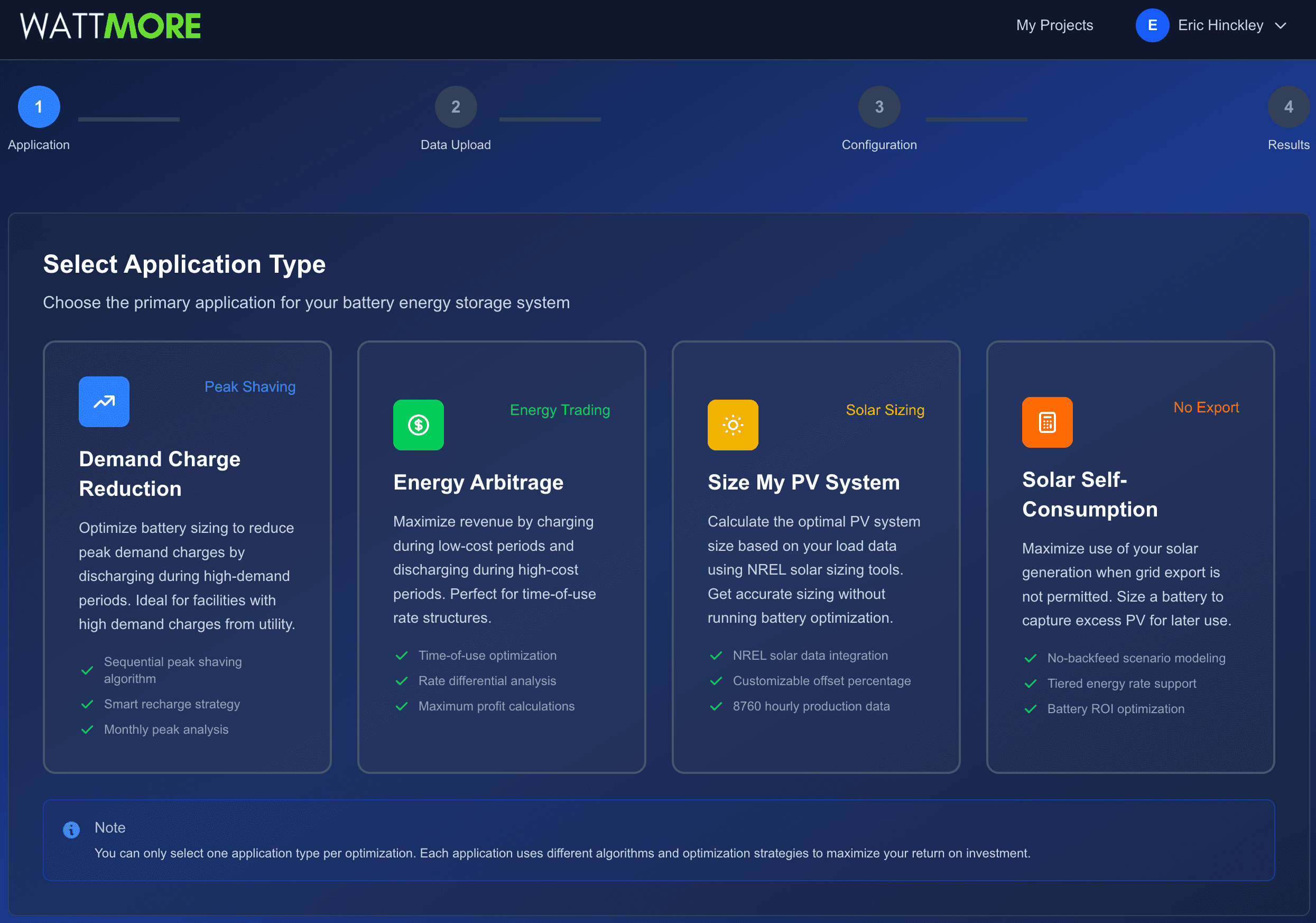
Battery sizing is one of the most consequential decisions in an energy storage project. An undersized battery leaves revenue on the table; an oversized battery wastes capital that the project never earns back. Getting it right requires rigorous analysis of the load profile, the tariff, the revenue goals, and the site constraints, and it is worth doing carefully because the answer is locked in for the life of the asset.
This guide walks through the sizing process step by step.
Step 1: Gather your load data
The foundation of any battery sizing analysis is historical load data: at minimum, twelve months of fifteen minute interval data from the utility meter. That data reveals:
- Peak demand: the kW value that drives demand charges
- Load shape: when peaks occur, how long they last, and how predictable they are
- Seasonality: summer cooling peaks, winter heating peaks, production schedules
- Base versus variable load: how much consumption is constant and how much moves
If interval data is unavailable, monthly bills can support a rough screen, but the results will be far less accurate: bills show the size of the peak, not its timing or duration, and timing and duration are what determine whether a battery can shave it.
Step 2: Understand your tariff
The tariff determines the economic value of every kWh the battery stores and delivers. Components to analyze:
- Demand charges: dollars per kW of peak demand, often the largest savings opportunity; NREL's tariff research found rates above $15 per kW common across United States utilities (NREL survey of United States demand charges)
- Time of use rates: different energy prices by period, which set the arbitrage spread
- Coincident peak charges: charges based on your demand during system wide peaks, such as ERCOT's four coincident peak mechanism
- Ratchets and standby provisions: clauses that carry a high peak forward for months or add fees when grid demand falls below a threshold
Step 3: Define your use case
Different use cases want different shapes of battery:
- Peak shaving only: high power relative to energy; typical duration one to two hours. See how peak shaving works.
- Time of use arbitrage: more energy for longer discharge windows; typically two to four hours.
- Solar self consumption: sized to the mismatch between midday production and evening load; usually two to four hours.
- Backup power: sized to the critical load and required runtime; often four hours or more.
- Grid services: program dependent; frequency regulation wants power, capacity programs typically want four hour duration.
The market's own choices are instructive: CAISO's market monitor reports a fleet of about 13,000 MW and 47,300 MWh at the end of 2024, an average duration around three and a half hours, because that is where today's use cases pay.
Step 4: Model the economics
With load data, tariff, and use case defined, run optimization models across candidate sizes to find where the economics peak. A credible sizing analysis evaluates:
- Multiple power and energy combinations, not one candidate
- Revenue from all applicable value streams, jointly optimized because they compete for the same energy
- Capital cost benchmarks such as NREL's 2025 utility scale storage update, which puts a four hour system at $334 per kWh installed (NREL cost projections)
- The investment tax credit: standalone storage qualifies for the credit under the Inflation Reduction Act, a change that reshaped project economics (IRS)
- Round trip efficiency losses and parasitic loads such as HVAC and controls
- Tariff escalation scenarios
The output should include ROI, NPV, IRR, payback period, and annual savings for each configuration, so the choice is a comparison rather than a guess. Our guide to energy storage financial modeling covers those metrics in depth.
Step 5: Account for degradation
Lithium ion batteries lose capacity with time and cycling. A battery sized perfectly for year one will be undersized by year ten unless the plan accounts for it. Best practice is to size for the performance required in the later contract years, which usually means modest oversizing on day one or a planned augmentation, and to let the EMS enforce the warranty limits that keep the degradation curve on plan.
Step 6: Validate with real dispatch algorithms
Most sizing tools assume simplified or perfect dispatch, and that is the largest source of error in storage pro formas: a model that assumes the battery always catches the peak will overstate savings that a real controller, working from imperfect forecasts, cannot fully capture. The most accurate approach is to size with the same optimization algorithms that will run the battery in the field, so the projection and the operation are the same math.
That is how WATTMORE builds it: Intellect PLAN sizes and models projects using the same dispatch engine that runs Intellect Operate on live sites, including the solver behavior documented in our E.S. Fox field report. Contact us for a sizing analysis of your project.