Intellect Management
Every asset. Every work order. One record.
Intellect Management is a power infrastructure asset management platform that keeps the asset register, work orders, preventive maintenance, spare parts, and compliance calendar for solar, energy storage, substations, and other power equipment in one application. WATTMORE also builds the data acquisition hardware that feeds it.
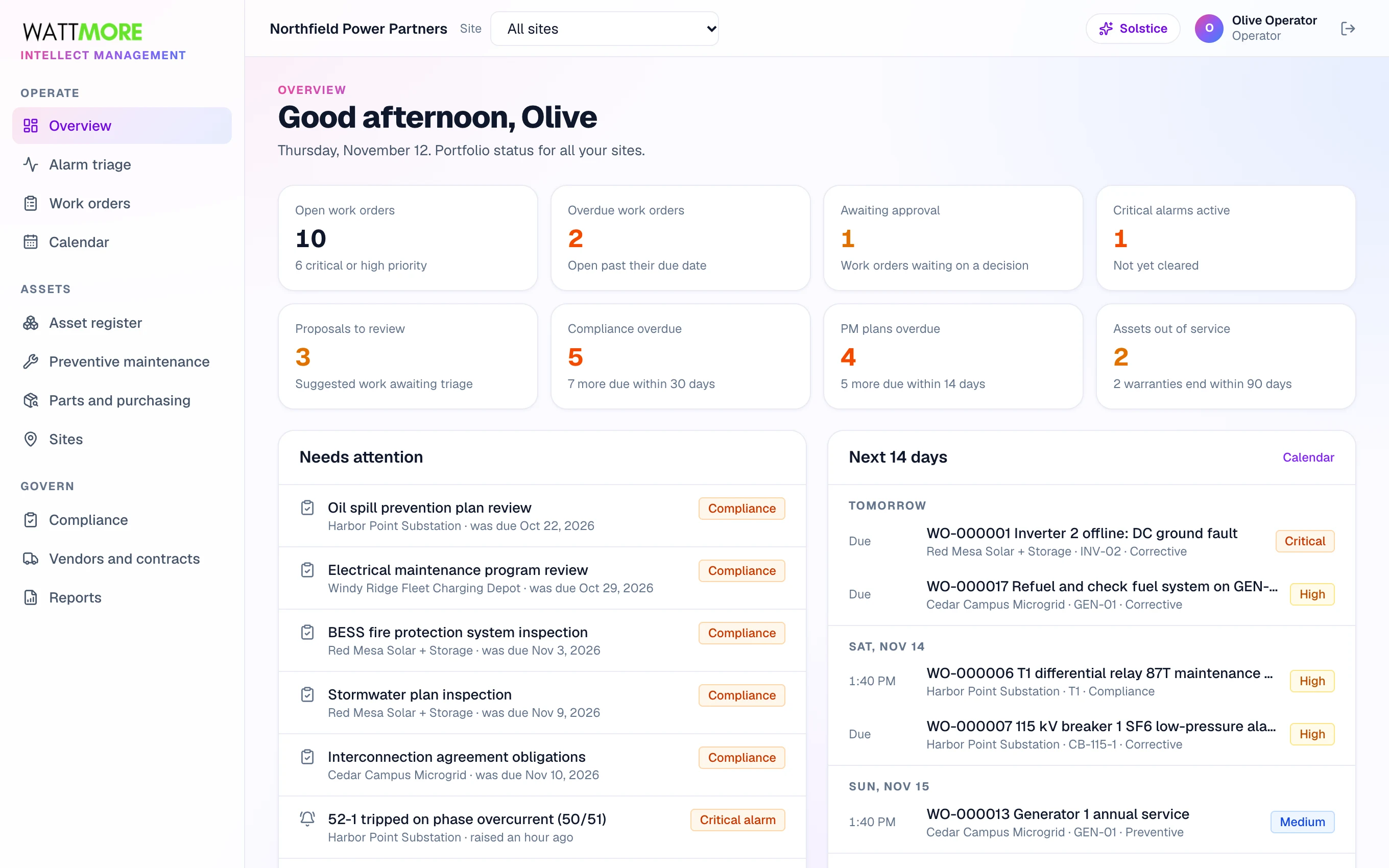
Know what you own. Know what it needs.
One register for the equipment, and the work, parts, and obligations that go with it.
Keep one asset register
Record hierarchy, nameplate, criticality, warranty, and meters for every asset, with an asset health indicator and cost of ownership.
Run work orders end to end
Plan checklists, labor, parts, approvals, and safety prerequisites, then close out with failure codes. Use the dispatch board and calendar to schedule the work.
Schedule preventive maintenance
Trigger maintenance by calendar, by meter, or by whichever comes first, starting from a library of procedures for electrical and storage equipment.
Track parts and purchasing
Hold spare parts stock by site with reorder points, and raise purchase orders with approval and receipt.
Turn alarms into a short queue
Repeated and related alarms are grouped into proposed work orders with a plain-language reason. A person approves or rejects each one.
Report on reliability and cost
Review MTTR, MTBF, first-time-fix rate, preventive maintenance compliance, backlog ageing, availability, downtime losses, and maintenance cost.
The record, the alarm, and the meter. One source.
WATTMORE builds Intellect EnFORM, the data acquisition hardware that feeds Intellect Management. The asset record, the alarm that starts the work, and the meter that schedules maintenance come from one vendor. Software-only asset management depends on whatever data other vendors’ hardware supplies.
- Alarms from the field become proposed work orders
- Meter readings drive meter-based maintenance
- Any other sender can use the same API
From alarm to approved work.
- 1
Alarms and readings arrive
Intellect EnFORM hardware, or any other sender, posts alarms and meter readings through the token-authenticated API.
- 2
Related alarms are grouped
Repeated and related alarms become a short queue of proposed work orders, each with a plain-language reason.
- 3
A person decides
Someone on your team approves or rejects each proposal. Nothing becomes a work order without that decision.
Solstice drafts. Your team approves.
Solstice answers questions about assets, maintenance, compliance, and alarms from your organization’s own records, and drafts work orders that wait for a person to approve them. It never changes records on its own.
From asset list to planned work.
Set up the register, connect your data, and keep people in charge of every decision.
- 01
Build your register
Import your assets by CSV. Set the hierarchy, nameplate, criticality, and warranty, then print QR asset tags for the field.
- 02
Connect alarms and meters
Send alarms and meter readings through the token-authenticated API, typically from Intellect EnFORM data acquisition hardware.
- 03
Plan, approve, and close out
Schedule preventive maintenance, approve or reject proposed work orders, and close completed work with failure codes and an evidence trail.
Built for the teams that keep power infrastructure running.
Owners & asset managers
See asset condition, maintenance cost, and downtime across sites and technologies in one register.
Operations & maintenance teams
Schedule, dispatch, and close out work with the checklists, parts, and safety prerequisites attached.
Compliance & reliability staff
Track recurring obligations with reminders, and keep evidence for each completed occurrence.
Contractors & service vendors
Sign in with a contractor login limited to the work assigned to you.
Need the monitoring and data acquisition too?
Intellect EnFORM collects site data on WATTMORE-built field hardware and sends alarms and meter readings to Intellect Management.
Frequently Asked Questions
What is Intellect Management?
Intellect Management by WATTMORE is a power infrastructure asset management platform. It keeps one asset register for solar, energy storage, substations and switchgear, transformers, reclosers and breakers, EV charging, standby generation, and microgrids, and connects it to work orders, preventive maintenance, spare parts and purchasing, vendors, a compliance calendar, alarm triage, and reporting. It is a standalone application with its own login.
How is this different from the asset management tab in EnFORM?
Intellect EnFORM keeps its built-in asset management tab for monitoring customers who want work orders and maintenance alongside their site data. Intellect Management is the standalone platform for teams managing power infrastructure across sites and technologies. It covers solar, storage, substations, and other equipment in one register, with a compliance calendar, alarm triage, and its own application and login.
Do I need WATTMORE hardware to use Intellect Management?
No. Alarms and meter readings arrive through a token-authenticated API, and any sender can use it. Intellect EnFORM data acquisition hardware is the turnkey path, because WATTMORE builds both the hardware and the platform.
What does Solstice do without being asked?
Nothing that changes your records. Solstice answers questions about assets, maintenance, compliance, and alarms from your organization’s own records, and it drafts work orders. Every draft waits for a person to approve it. Solstice never changes records on its own.
How does alarm triage work?
Alarms and meter readings are sent to Intellect Management through its API. Repeated and related alarms are grouped into a short queue of proposed work orders, each with a plain-language reason for the proposal. A person reviews the queue and approves or rejects each one, so an alarm becomes scheduled work only after someone has agreed to it.
Which types of equipment can Intellect Management track?
The register covers solar, energy storage, substations and switchgear, transformers, reclosers and breakers, EV charging, standby generation, and microgrids. Equipment classes follow an ISO 14224-style taxonomy, so different technologies and sites share one structure for hierarchy, nameplate data, criticality, warranty, and meters.
How is preventive maintenance scheduled?
Each preventive maintenance plan can be calendar-based, meter-based, or set to whichever comes first. Meter-based plans use readings such as run hours, cycles, throughput, and state of health. A library of starter procedures for electrical and storage equipment is included, which your team can adapt to its own practice.
Does Intellect Management support an NFPA 70B maintenance program?
The starter procedures for electrical equipment are aligned to industry practice such as NFPA 70B, and the platform supports a program under it with scheduled maintenance, safety prerequisites on each work order, and a record of completed work. Intellect Management is a tool for running your program. It is not a certification, and your organization remains responsible for meeting the requirements that apply to it.
How does the compliance calendar work?
The compliance calendar is a register of recurring obligations such as permits, insurance, land leases, interconnection requirements, standards, and regulatory programs. Each obligation has reminders, and each completed occurrence keeps an evidence trail so your team can show what was done and when.
Can contractors and service vendors use it?
Yes. Contractors can be given logins that are limited to their own assigned work. Vendors and service contracts are tracked in the platform, including contract renewal dates.
How are accounts and access controlled?
Accounts are provisioned by an administrator; there is no self sign-up. Access is role-based with six roles, two-factor authentication is mandatory for administrators, each organization’s data is kept separate, and the platform keeps an audit log.
Which reports does Intellect Management produce?
Reports include mean time to repair (MTTR), mean time between failures (MTBF), first-time-fix rate, preventive maintenance compliance, backlog ageing, time-based availability, downtime energy and revenue loss, and maintenance cost. An outage event export is available to support NERC GADS reporting. The export supports your reporting process; it is not a certified submission.
Further Reading
More on data acquisition, availability, access control, and the terms used on this page.
- explainerWhat is a DAS in solar?
- explainerGlossary: data acquisition system (DAS)
- explainerGlossary: availability
- explainerGlossary: state of health
- explainerGlossary: role-based access control
- explainerGlossary: audit log
- guideWhy a DAS is infrastructure, and why you should standardize on one
- guideSolar monitoring best practices for asset owners and operators
Bring your assets into one record.
Talk with our engineers about your sites, your equipment, and the data you already collect.