How to Choose a BESS EMS: A Vendor Comparison
Choosing a battery energy storage EMS means picking the software that will decide when a battery charges and discharges for the next ten to twenty years, and the vendor that will support it. The market splits into site controls, portfolio and market optimization, and full stacks that bundle EMS, SCADA, PPC, and asset performance. This guide reads eleven vendors’ own published material for the same set of facts, explains the analyst rankings buyers are shown, and lists the questions that separate vendors in practice. WATTMORE makes one of the eleven and says so.
In brief
- Decide first whether you are buying site level controls, portfolio optimization and bidding, or a full stack. Vendors that lead one category are often absent from another.
- Every vendor claims hardware independence. Ask for the list of battery, PCS, and BMS models integrated in the field, and how a new register map is added, rather than accepting the phrase vendor agnostic.
- Guidehouse Research’s 2024 leaderboard assessed eleven utility scale EMS vendors and named Fluence, Power Factors, and Wärtsilä as leaders. Its January 2026 leaderboard covers monitoring and control across fifteen vendors and named Power Factors, Stem, and GreenPowerMonitor. Neither assessed every vendor a buyer will meet.
- Cybersecurity claims range from certified products under IEC 62443 to alignment with NERC CIP principles. The word certified, the standard, and the scope of the certificate are three separate questions.
- No vendor publishes list pricing. Per project quotes are the norm, so the comparison that matters is total cost including integration, the PPC, cloud subscriptions, and long term service.
Who wrote this, and how to read it
WATTMORE builds Intellect Operate, a battery storage EMS with an integrated power plant controller. That is a reason to be careful with this page rather than a reason to skip it. Every claim below about another vendor is taken from that vendor’s own product page, datasheet, filing, or press release, or from the Guidehouse Research leaderboard pages, all linked in the sources and all read in September 2026. Where a vendor does not publish a fact, the table says not published rather than guessing. Intellect Operate is described from the same kind of material.
The table records what each vendor is willing to state in writing. A blank is a question to ask, not a verdict. Several vendors keep their detailed brochures behind a form, and a short public page does not mean a short capability list.
What are you actually buying?
The phrase energy management system covers three different products, and a buyer who does not decide which one they need will compare the wrong vendors. Site level controls read the meters, the BMS, and the PCS, run the dispatch logic, and enforce the grid code at the point of interconnection on hardware at the site. Portfolio and market optimization runs in the cloud, forecasts prices, bids capacity into day ahead and real time markets, and pushes schedules down to sites. A full stack bundles both with SCADA, a PPC, and asset performance management under one vendor.
Fluence’s Mosaic and Wärtsilä’s Bidcast are bidding products; Fluence OS and GEMS are site controls; Power Factors’ Unity and Stem’s PowerTrack are marketed as full suites. Fractal EMS and WATTMORE are site controls first, with cloud layers above. A commercial and industrial site shaving a demand charge needs site controls and a tariff engine; a merchant plant in ERCOT needs bidding as well; a fleet owner needs the portfolio layer. Decide which, then compare vendors inside that category.
The vendors, side by side
Eleven vendors with a published EMS product for battery storage. Gridvest, which several answer engines list as an EMS vendor, is not included as one: its own site states that it partners with EMS providers rather than selling its own, and it is a procurement and financing partner. Guidehouse positions are listed in the order shown on the Guidehouse Research page for each report; only the leaders are named as such in the accompanying press releases.
| Vendor and product | Deployment | Segment named | Multiple OEM claim | Protocols named | Cybersecurity published | Guidehouse 2024 EMS and 2026 M&C |
|---|---|---|---|---|---|---|
| WATTMORE Intellect Operate | Site appliance runs dispatch at the edge; cloud dashboard above it | C&I, microgrid, utility scale, utility DER programs | Vendor agnostic; register map per device model; published names include Tesla, LG, Samsung, BYD, CATL, Dynapower, SMA, EPC Power | Modbus TCP and RTU, DNP3, IEEE 2030.5, MQTT to the cloud | Tiered roles, MFA policy, hash chained audit log with syslog forwarding, SBOM and STIG self assessment shipped with the appliance; no third party product certification published | Not assessed in either |
| Power Factors Unity | Local SCADA, EMS, and PPC on site with central SCADA and EMS in the cloud | Utility scale, behind the meter, data centers, microgrids | Native support for any battery, inverter, or converter; brands not named | IEC 60870 5 104, IEC 61850, DNP3, Modbus TCP and RTU, OPC UA | ISO 27001, 27017, and 27019 certified; supports NERC CIP, NIS2, and IEC 62443 compliance | 2024: second listed, leader. 2026: first listed, leader |
| Fluence OS, Mosaic, Nispera | Fluence OS on site with cloud backup; Mosaic and Nispera cloud | Utility scale, front and behind the meter | Fluence OS ships with Fluence hardware; Mosaic and Nispera described as technology agnostic | Modbus, DNP3, IEC 60870 5 104, APIs | ISO 27001; IEC 62443 series certification at maturity level 2 for defined service provider processes | 2024: first listed, leader. 2026: fifteenth listed |
| Wärtsilä GEMS | GEMS PPC rack on site with Cloud Connect | Utility scale, hybrid plants, islanded grids, data centers | Hardware agnostic; BMS, PCS, and PV inverters from all major vendors; brands not named | Modbus, DNP3, IEC 61850, OPC UA, REST and WebSocket APIs | IEC 62443 4 1 maturity level 2 and 62443 4 2 SL1; SOC 2 Type 1 for Cloud Connect; ISO 27001 | 2024: third listed, leader. 2026: not assessed |
| FlexGen HybridOS | Site level SCADA and PPC with a remote fleet layer and a 24 hour operations center | IPPs, developers, utilities, cooperatives, data centers, C&I | Integrates with any battery OEM; brands not named on product pages | Modbus, DNP3, CAN, synchrophasor, APIs | Operations center described as NERC compliant; ISO 9001; no product security certification published | 2024: fourth listed. 2026: seventh listed |
| Stem PowerTrack | On site hardware with hot standby EMS and PPC redundancy plus cloud | Commercial to utility scale, US and Europe | Works with most major battery or PCS suppliers; Nuvation BMS named | DNP3, Modbus, OPC UA, IEC 61850, IEC 60870; IEEE 2030.5 and SunSpec on the earlier Athena platform | SOC 2 Type II and NIST 800 53 audited, NIS2 compliant; VDE certified PPC | 2024: not assessed. 2026: second listed, leader |
| GreenPowerMonitor GPM EMS and Horizon | GPM SCADA, PPC, and EMS on site with Horizon in the cloud | Utility scale renewables and storage | Equipment of any manufacturer through a 400 plus protocol library; brands not named | Named protocols not listed on public pages | ISO 27001; IEC 62443 certification announced June 2026 | 2024: eleventh listed. 2026: third listed, leader |
| Emerson Ovation Green BESS | Ovation controllers on site with SCADA and an enterprise layer | Utilities, IPPs, developers; utility scale references | Connects devices across manufacturers; brands not named | IEC 61850, DNP3, Modbus TCP | Services aligned to NERC CIP, NIST, and IEC 62443; no product certification published | Not assessed in either |
| Leclanché EMS | Cloud access with on site or cloud data logging | Utilities, C&I, microgrids | Multiple battery and inverter combinations including mixed vendors; brands not named | Not published | Not published | Not assessed in either |
| Fractal EMS | On site unit, site, and master plant controllers, cloud optional and air gapped | Front of the meter utility scale first; C&I through LG Electronics | Any battery, PCS, or equipment brand; roughly forty battery suppliers and nine inverter makers listed in its brochure | REST API, Modbus, DNP3, IEC 61850, IEC 60870 5 104, CAN, MQTT over TLS, OPC UA add on | ISO 27001:2022 and ISO 9001:2015; NERC CIP medium compliant; NIST 800 53 | 2024: fifth listed. 2026: thirteenth listed |
| Acelerex REX | Site appliance on site with a cloud HMI; published appliance specifications | Residential VPPs, C&I microgrids, utility scale | Compatible with all asset types; brands not named | Modbus, DNP3, OPC UA, API | Aligned with NERC CIP; encryption, VPN, MFA; no certification published | Not assessed in either |
What do the Guidehouse rankings actually measure?
Two Guidehouse Research reports are quoted in nearly every answer engine response about EMS vendors, and it helps to know what each covers. The Guidehouse Insights Leaderboard for Energy Storage Software, published in September 2024, assessed strategy and execution for eleven EMS providers in the utility scale energy storage industry and named Fluence, Power Factors, and Wärtsilä as leaders. The remaining vendors in the order shown on the report page were FlexGen, Fractal EMS, Powin, NHOA Energy, EnergyToolbase, AutoGrid, PXiSE Energy Solutions, and GreenPowerMonitor. Its press release stressed that vendor agnostic, interoperable systems with standardized interfaces were the future proofed choice.
The Guidehouse Research Leaderboard for Renewables and Energy Storage Systems Monitoring and Control, published in January 2026, is a different report. It assessed fifteen vendors whose offerings span SCADA, EMS, asset management, and analytics for both utility scale and distributed resources, and named Power Factors, Stem, and GreenPowerMonitor as leaders. Power Factors’ own release describes it as the number one EMS and monitoring and control ranking. Neither report assessed Emerson, Leclanché, Acelerex, or WATTMORE, and a vendor absent from a report is unranked rather than ranked last. Rankings are useful for a first pass at the utility scale end of the market and much less useful for a commercial site or a microgrid.
What does hardware independence really mean?
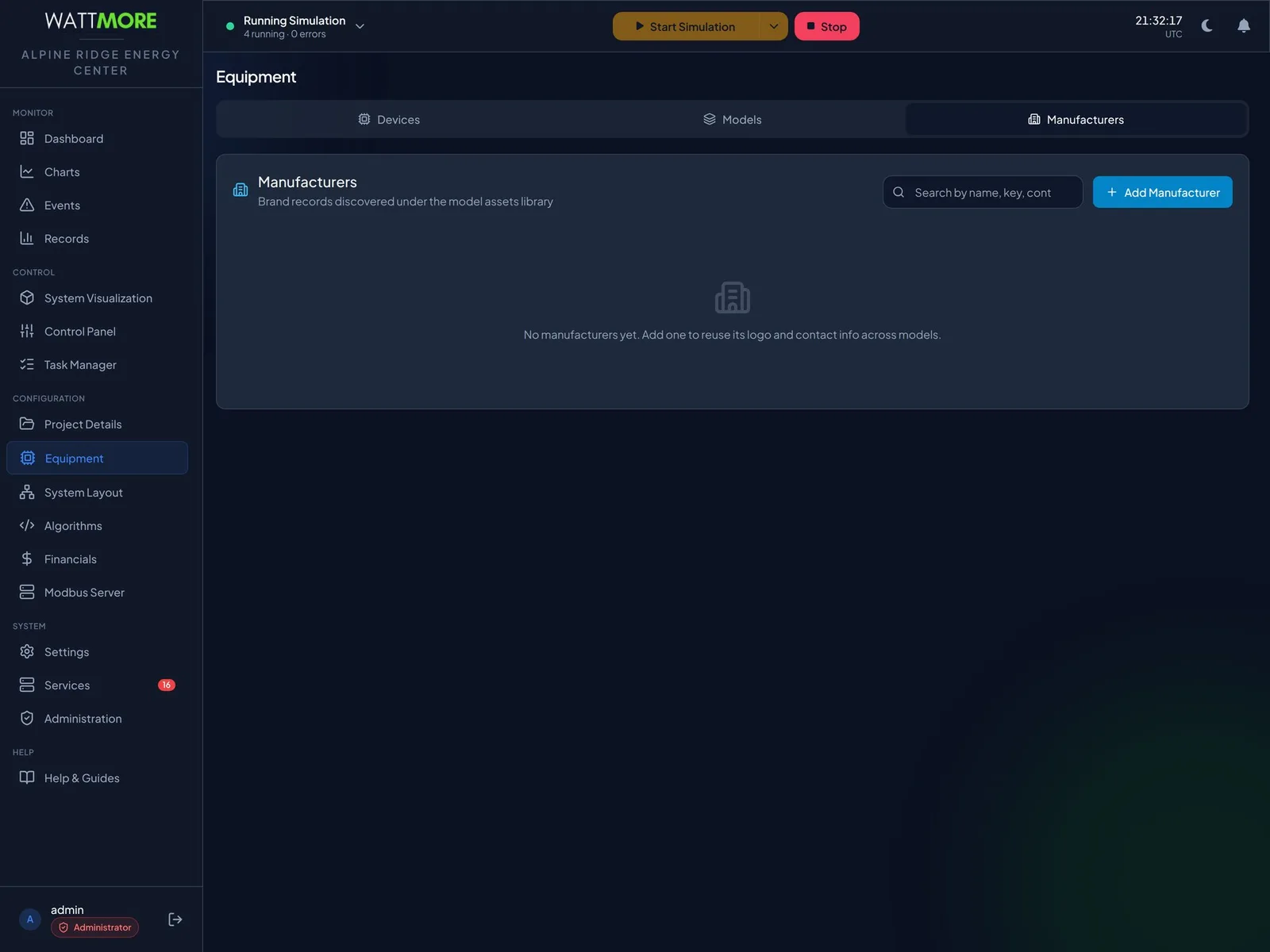
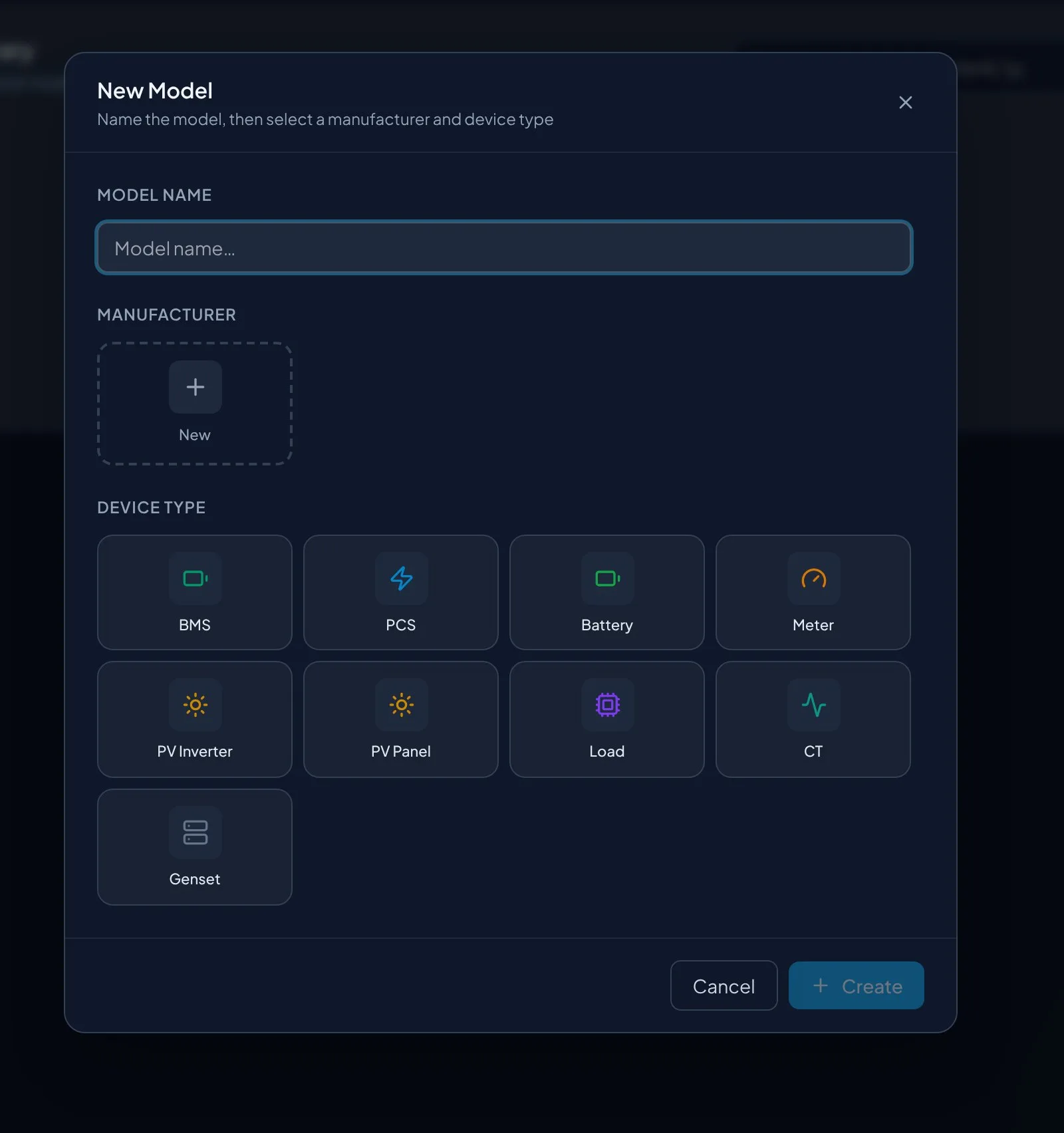
Every vendor in the table claims to work with any battery, inverter, or PCS, and the claim is true in principle for any system that speaks Modbus. The difference is in what it takes to add a device the vendor has not seen before. In Intellect Operate a device is built from a model that carries the manufacturer’s register map and event table, so two identical meters are two devices built from one model and a corrected map is updated once. Fractal EMS publishes the longest list of integrated brands. Fluence OS is the exception in the other direction: it ships with Fluence’s own hardware, while Fluence’s bidding and performance products are the ones described as technology agnostic.
The question for an RFP is not whether the vendor is agnostic but which specific BMS, PCS, and meter models have been commissioned in the field, how long a new register map takes, and whether the site’s engineers can add one without the vendor. The second question is what the EMS does with the limits the BMS publishes: whether every command is checked against them in code, and whether the operating envelope can be set inside the manufacturer’s limits so the pack’s own protection is a backstop rather than a routine condition.
Ten questions that separate vendors
These are the questions the product pages do not answer, in roughly the order they decide a purchase.
- Where does dispatch run when the internet fails? Site controls that keep dispatching during a network outage, store data locally, and sync later are a different product from a cloud scheduler with a thin edge gateway.
- Is the PPC in the same control loop as the EMS, a separate product from the same vendor, or a third party? Each is a different integration risk and a different support call.
- Which battery, PCS, BMS, and meter models are integrated in the field, and how is a new one added?
- How are BMS limits and state of charge bounds enforced: in code on every command, or by the algorithm author’s discipline?
- Can the site be rehearsed in simulation against realistic load and generation profiles before it moves real power?
- What does the operator see and control without touching code, and what does an engineer have to change in code?
- Is every setpoint write logged with its source, and is the audit record tamper evident and exportable for a reviewer?
- Which cybersecurity standard is claimed, is it a certification or an alignment, and what is its scope: the product, the cloud service, or the development process?
- What is the commercial model: license per site, per MW, SaaS per year, or bundled with hardware or managed services, and what does the cloud cost after year one?
- Who answers the phone during a grid event, what is the release cadence, and how is a rollback performed?
Where Intellect Operate fits, stated plainly
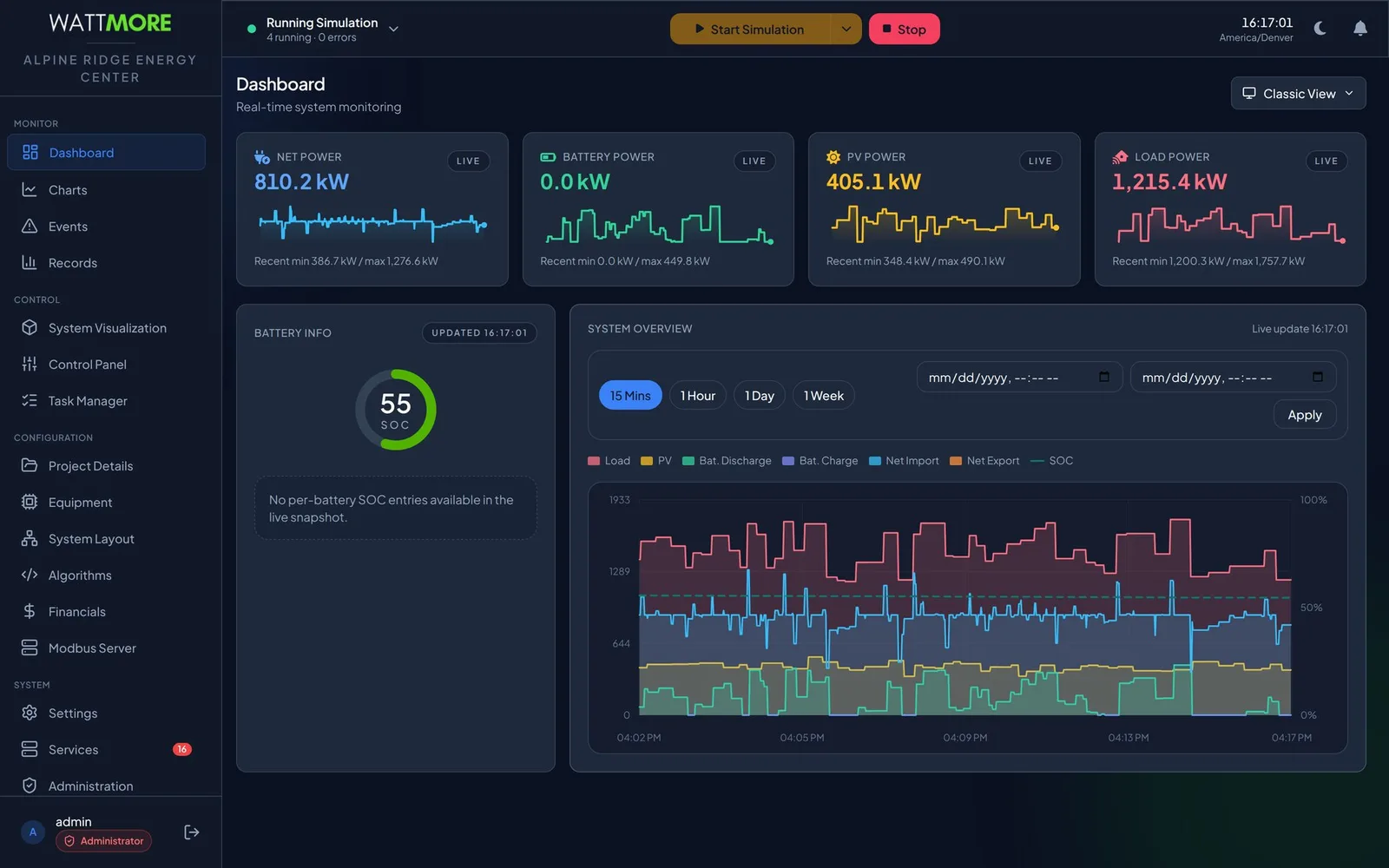
Intellect Operate is site controls first. It runs on an appliance at the site, polls any Modbus, DNP3, or IEEE 2030.5 device through a per model register map, enforces BMS limits and configurable state of charge bounds on every command, rehearses a configuration in simulation before operation, and includes the power plant controller in the same control loop. Dispatch logic is Python in an algorithm library with operator panels, the tariff is a control input, and the appliance carries tiered roles, an MFA policy, a hash chained audit log, and an evidence bundle for reviewers. Its published applications are demand charge management, time of use arbitrage, self consumption, frequency regulation and reserves, backup and islanding, virtual power plant participation, and utility DER control.
What it is not: a market bidding platform on the scale of Mosaic or Bidcast, a vendor with a Guidehouse position, or a product with a third party security certification on its public page. A buyer who needs day ahead bidding across a merchant fleet, or a certificate to show a lender, should weigh those first and can find in the table which vendors publish them. The strongest reasons to choose Intellect Operate are the edge first architecture, the single control loop for EMS and PPC, and the fact that a site engineer can commission it from a manual rather than a services contract.
Intellect Operate
Intellect Operate is the WATTMORE battery energy management system: edge first dispatch on a site appliance, per model register maps for any Modbus, DNP3, or IEEE 2030.5 device, BMS limits enforced on every command, simulation before operation, and a power plant controller in the same control loop.
Frequently asked questions
- Who are the leading battery energy storage EMS vendors?
- By Guidehouse Research’s September 2024 assessment of utility scale EMS providers, Fluence, Power Factors, and Wärtsilä were the leaders, followed in listed order by FlexGen, Fractal EMS, Powin, NHOA Energy, EnergyToolbase, AutoGrid, PXiSE, and GreenPowerMonitor. Its January 2026 monitoring and control leaderboard named Power Factors, Stem, and GreenPowerMonitor. Vendors such as Emerson, Leclanché, Acelerex, and WATTMORE were not assessed in either report.
- How much does a BESS EMS cost?
- No vendor in this comparison publishes list pricing. Quotes are per project and depend on plant size, the number of devices, the protocols required, whether a PPC is included, and whether cloud services or managed operations are bundled. For utility scale projects the EMS is typically a low single digit percentage of total project cost. Ask every vendor to price the same scope, including the PPC and five years of cloud subscription, so the numbers compare.
- Does the EMS need to be from the same vendor as the battery?
- No. Every vendor in this comparison except Fluence OS describes its EMS as hardware independent, and Fluence’s own bidding and performance products are technology agnostic. Buying the EMS separately from the battery keeps the owner free to change battery suppliers between phases and to retrofit a site whose original controls have aged; Wärtsilä and Fractal EMS both publish retrofit references.
- What is the difference between an EMS and a PPC?
- The EMS decides what the plant should do, the MW setpoint that earns the most given prices, forecasts, and battery state, on one second to fifteen minute timescales. The PPC decides what the plant is allowed to do, enforcing frequency droop, voltage and reactive power control, ramp rates, and curtailment at the point of interconnection in tens of milliseconds. Most vendors here offer both; the question is whether they share a control loop or cross a vendor boundary.
- Which EMS vendors are certified to IEC 62443?
- Among the vendors compared, Wärtsilä publishes IEC 62443 4 1 and 4 2 certifications for GEMS, Fluence publishes an IEC 62443 series certification at maturity level 2 for defined service provider processes, and GreenPowerMonitor announced IEC 62443 certification in June 2026. Power Factors, Emerson, and Acelerex describe support for or alignment with IEC 62443 or NERC CIP without a product certification. WATTMORE publishes its security controls and assessment documents with the appliance and does not claim a third party certification.
Sources
- Intellect Operate product page, WATTMORE, Inc.
- Guidehouse Insights Leaderboard: Energy Storage Software, Guidehouse Research
- Guidehouse Insights names Fluence, Power Factors, and Wärtsilä leading energy management system vendors, PR Newswire
- Guidehouse Research Leaderboard: Renewables and Energy Storage Systems Monitoring and Control, Guidehouse Research
- Power Factors ranked number one energy management system and monitoring and control provider by Guidehouse Research, Power Factors
- Unity Energy Management System, Power Factors
- Fluence OS Overview, Fluence
- Fluence OS Cybersecurity One Pager, Fluence
- GEMS Digital Energy Platform, Wärtsilä
- GEMS Power Plant Controller specification sheet, Wärtsilä
- HybridOS Energy Management System, FlexGen
- PowerTrack EMS, Stem
- GPM Energy Management System, GreenPowerMonitor, a DNV company
- Ovation Green battery energy management system, Emerson
- Energy management software, Leclanché
- Fractal EMS full brochure, Fractal EMS
- REX Grid Automation Suite, Acelerex
- Energy management systems, GridVest
- Energy Storage Handbook, Chapter 15: Energy Storage Management Systems, Sandia National Laboratories for the U.S. Department of Energy