How to Enter a Time of Use Tariff in a Storage EMS
A time of use tariff in a storage EMS is the site’s electricity rate sheet entered as data: seasons made of months, day groups made of weekdays, and periods made of hour windows, each carrying its own energy and demand rate. The EMS uses it as a control input, because every algorithm that decides when to charge or discharge reasons about these prices, and as the basis for the savings it reports.
In brief
- The tariff is an input to control, not a reporting convenience. Enter it from the utility’s published rate sheet and keep that sheet in the project documents.
- The structure is season, then day group, then rate period. A season is a set of months, a day group a set of weekdays, a period a named price band with one or more hour windows.
- General settings hold fallback rates and two switches: demand charges enabled, and nonbypassable charges enabled. Both change what dispatch can earn.
- Check before saving that the seasons cover all twelve months exactly once and that every day group’s color bar is continuous from midnight to midnight.
- The spread between off peak and on peak, against round trip efficiency, is the arithmetic a storage algorithm arbitrages. Entering the tariff accurately is what makes that arithmetic correct.
Why does the EMS need the tariff at all?
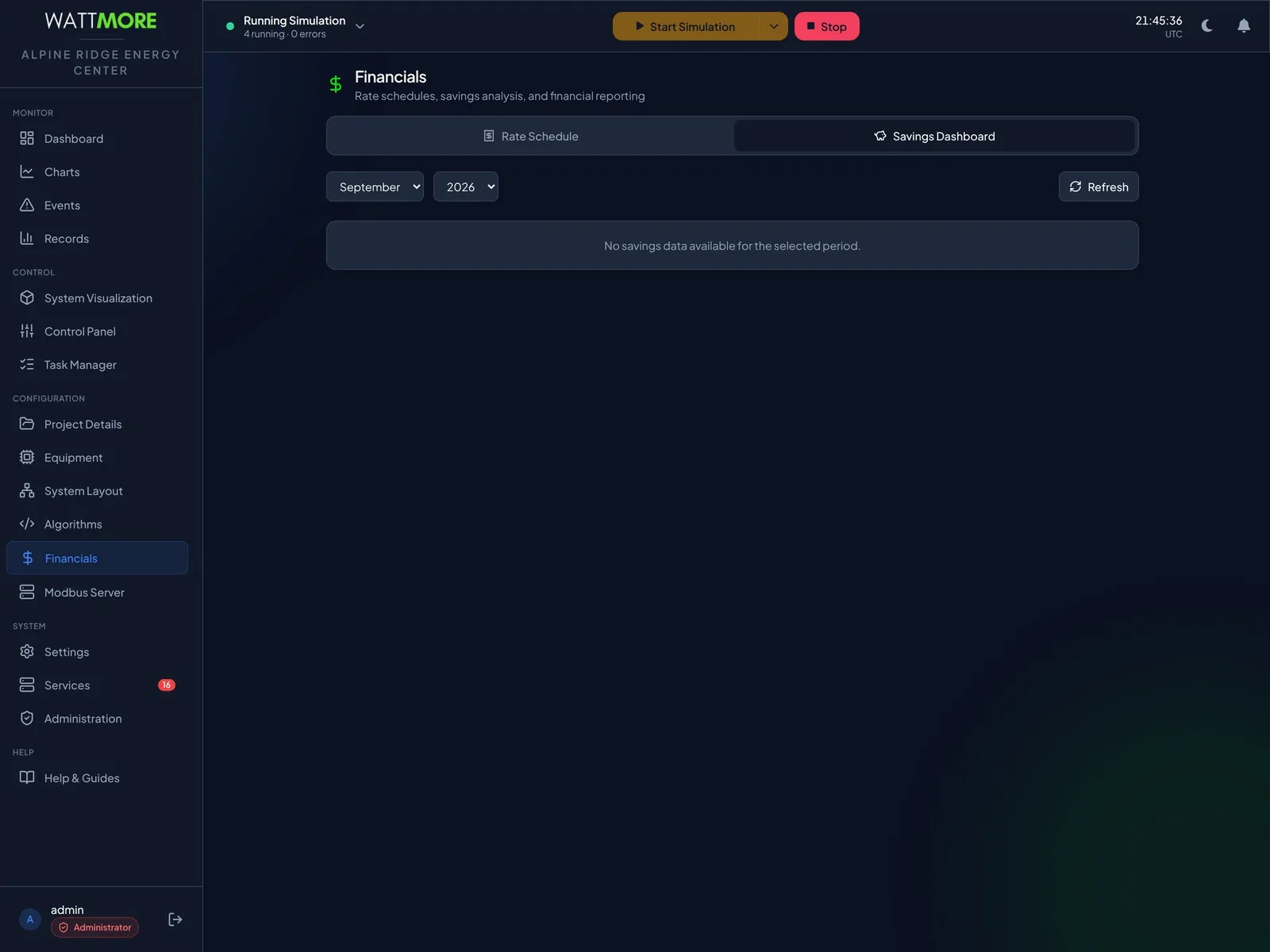
Any algorithm that decides when to charge or discharge, time of use arbitrage, demand charge reduction, self consumption with an export credit, reasons about prices. The same numbers value the energy the site imports, exports, and shifts, so the savings figures reported back to the customer are only as good as this page. The Financials page holds the tariff on a rate schedule tab and reports what it was worth on a savings dashboard tab.
Two switches in the general settings deserve care. Demand charges enabled switches on billing against the billing period peak; on a commercial tariff where the demand charge is a large share of the bill, leaving it off makes demand charge reduction look worthless in reporting. Nonbypassable charges enabled adds a per kWh charge on imported energy regardless of what the battery does. Utilities levy these to recover fixed costs, and they matter to dispatch because they narrow the spread between cheap and expensive hours; a battery cannot arbitrage a charge it cannot avoid.
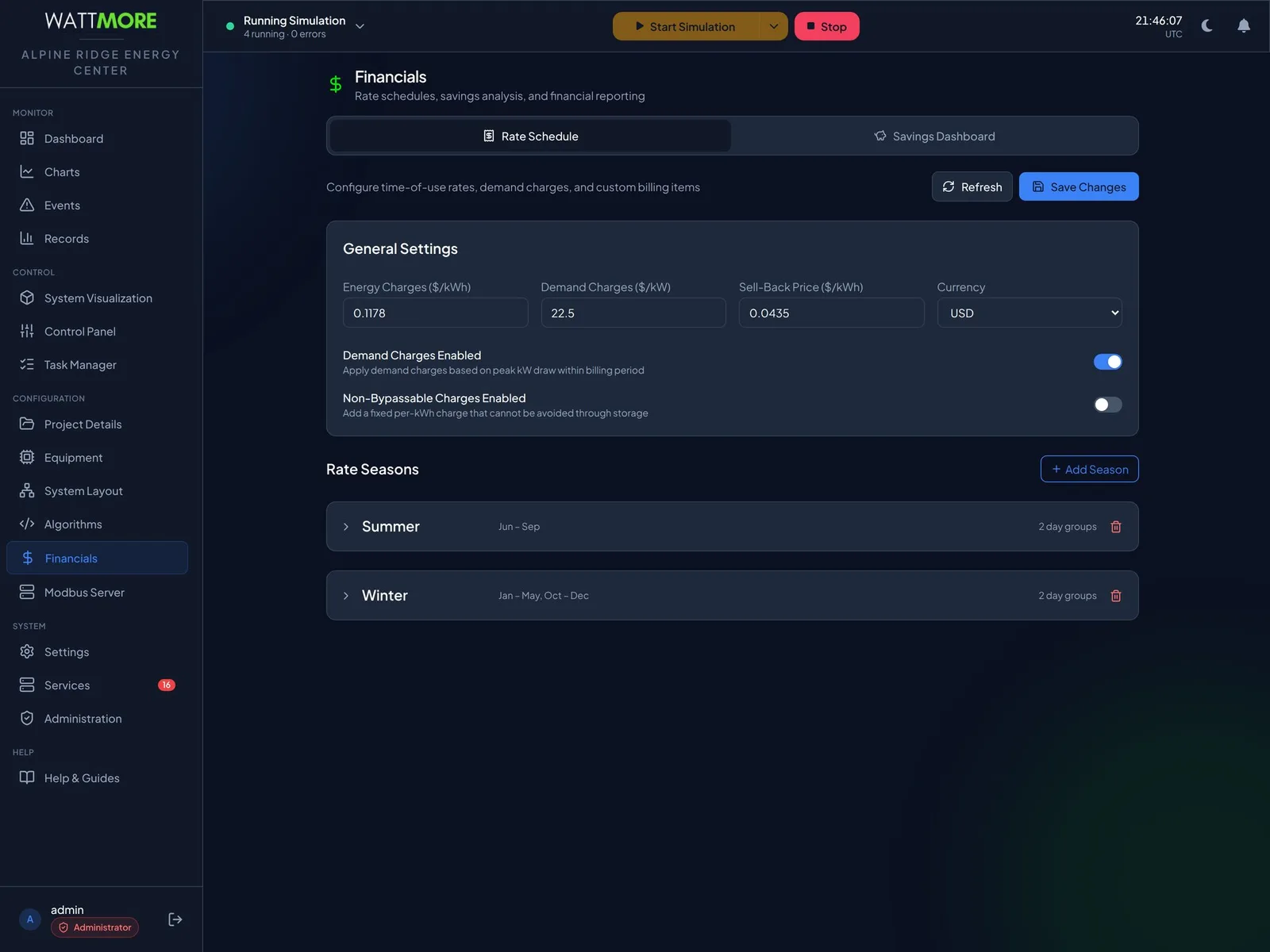
| Field | What it sets |
|---|---|
| Energy charges, dollars per kWh | The site wide volumetric rate for imported energy |
| Demand charges, dollars per kW | The site wide demand rate |
| Sell back price, dollars per kWh | The credit received for exported energy |
| Currency | The billing currency, USD by default |
| Demand charges enabled | Whether demand charges apply against the peak kW draw within the billing period |
| Nonbypassable charges enabled | Whether a fixed per kWh charge is added that storage cannot avoid |
How are seasons, day groups, and periods structured?
Most commercial tariffs price the same kilowatt hour differently in summer and winter. A season is a set of months that share one price structure, with a maximum demand charge that applies across the season. A season that wraps the turn of the year needs two month ranges on one season: winter at the demonstration site is January to May and October to December.
Within a season, a day group is a set of weekdays that share one daily price shape. Most tariffs need two, weekdays and weekends, but a tariff with a distinct Saturday schedule needs three. Within a day group, a rate period is a named price band such as on peak, mid peak, or off peak, with one or more hour windows and its own energy and demand rates. A period that occurs twice a day, off peak from midnight to the morning shoulder and again from evening to midnight, is one period with two windows and one pair of rates.
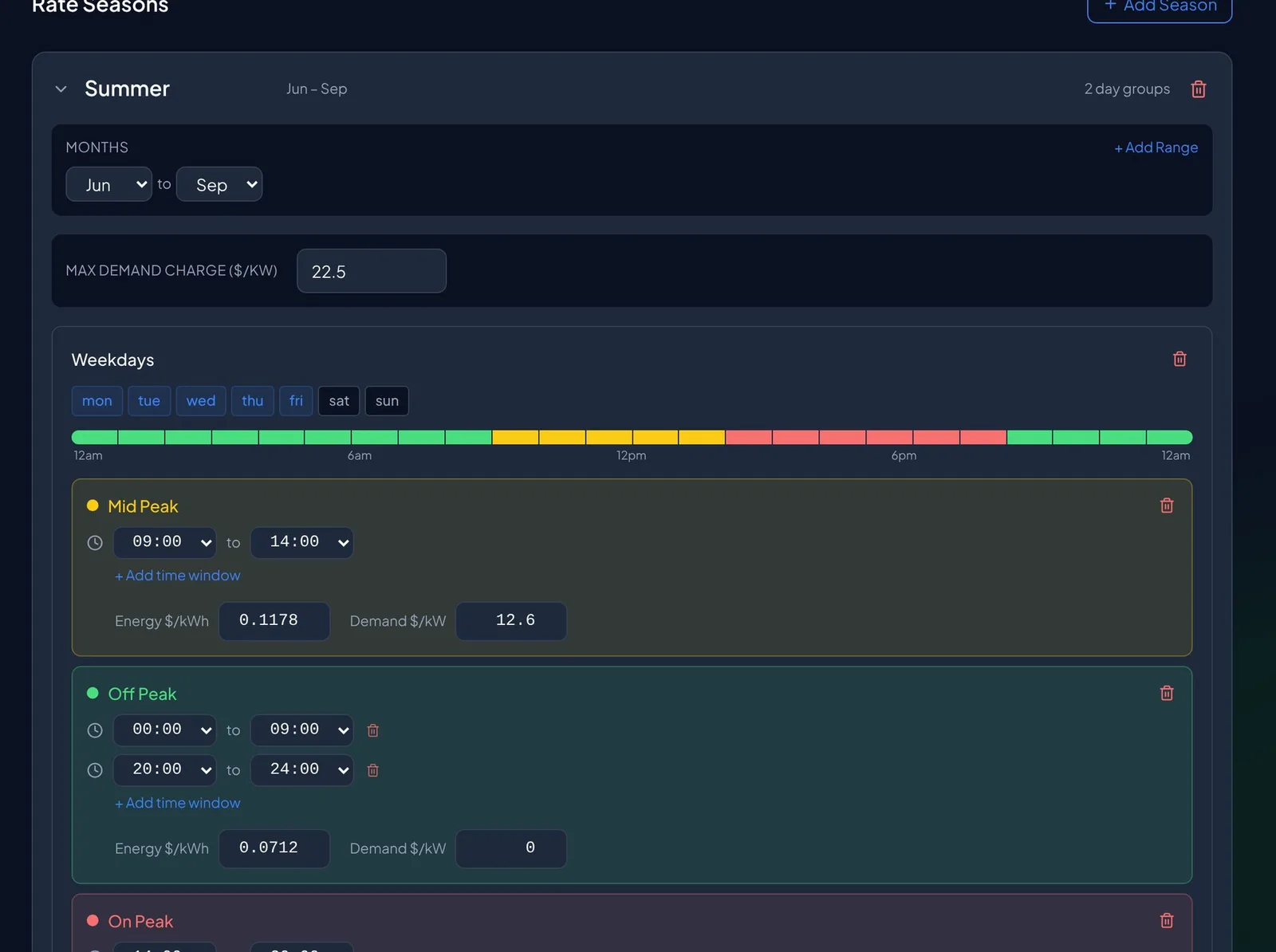
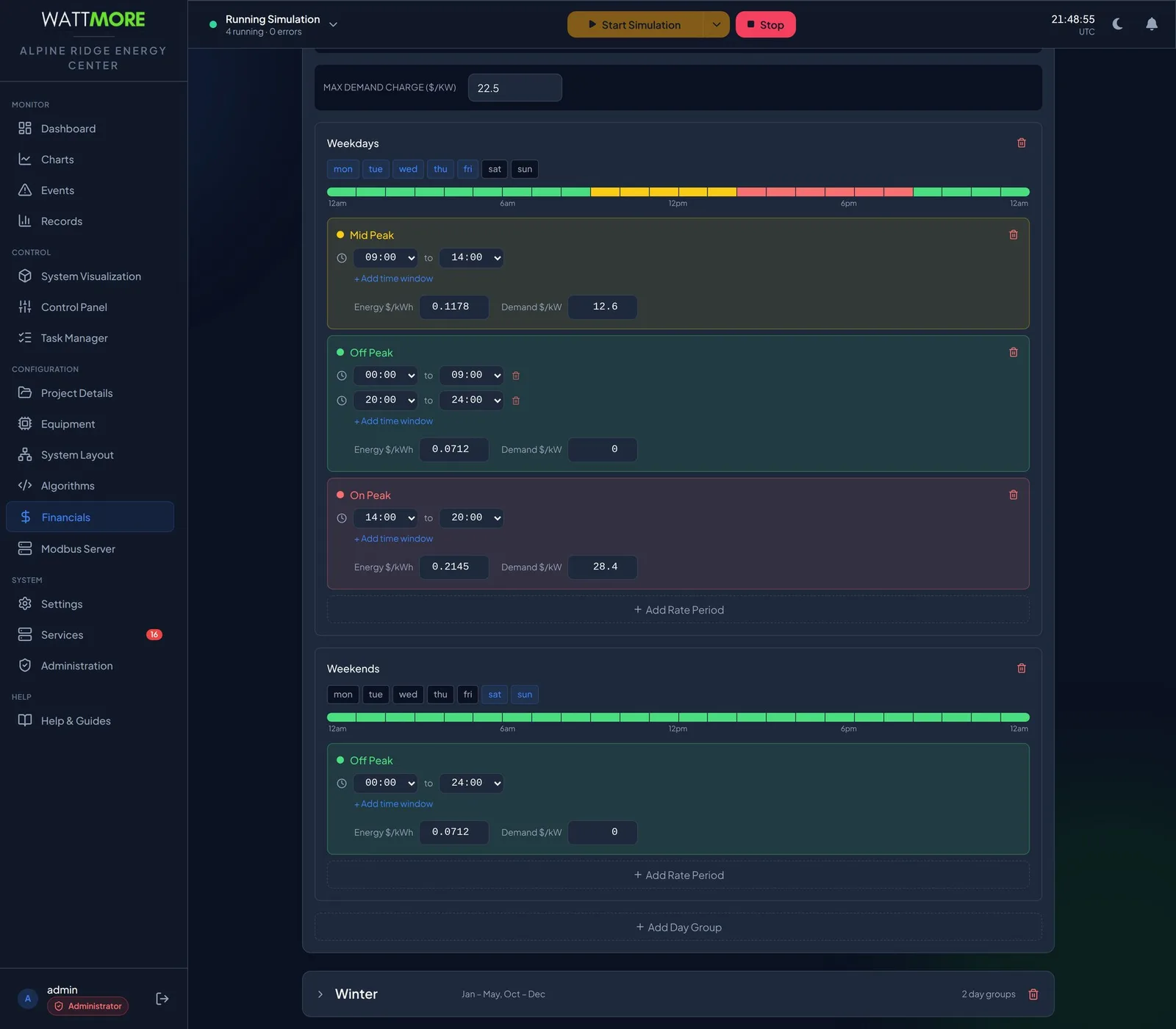
- Windows are entered on whole hours, start times from 00:00 to 23:00 and end times from 01:00 to 24:00. A tariff whose periods change on the half hour is approximated to the nearest hour, and the approximation is noted in the project documents so a later discrepancy against the bill is not mistaken for a fault.
- Everything remains a draft until Save Changes, and Discard abandons the whole draft. Changing the tariff changes how stored energy is valued in reporting from that point on, so a mid year rate change is dated in the project documents to explain the step in reported savings.
Worked example: a two season commercial tariff
This is the tariff configured at the Alpine Ridge Energy Center demonstration site, a summer and winter commercial rate with three weekday periods in summer and two in winter. The general settings are an energy charge of 0.1178 dollars per kWh, a demand charge of 22.5 dollars per kW, a sell back price of 0.0435 dollars per kWh, currency USD, demand charges on, and nonbypassable charges off.
The Summer season runs June to September with a maximum demand charge of 22.5 dollars per kW and two day groups. The Winter season runs January to May and October to December, entered as two ranges, with a maximum demand charge of 16.8 dollars per kW and two day groups.
| Day group | Period | Windows | Energy, dollars per kWh | Demand, dollars per kW |
|---|---|---|---|---|
| Weekdays | Off peak | 00:00 to 09:00 and 20:00 to 24:00 | 0.0712 | 0 |
| Weekdays | Mid peak | 09:00 to 14:00 | 0.1178 | 12.6 |
| Weekdays | On peak | 14:00 to 20:00 | 0.2145 | 28.4 |
| Weekends | Off peak | 00:00 to 24:00 | 0.0712 | 0 |
Winter, and the checks before saving
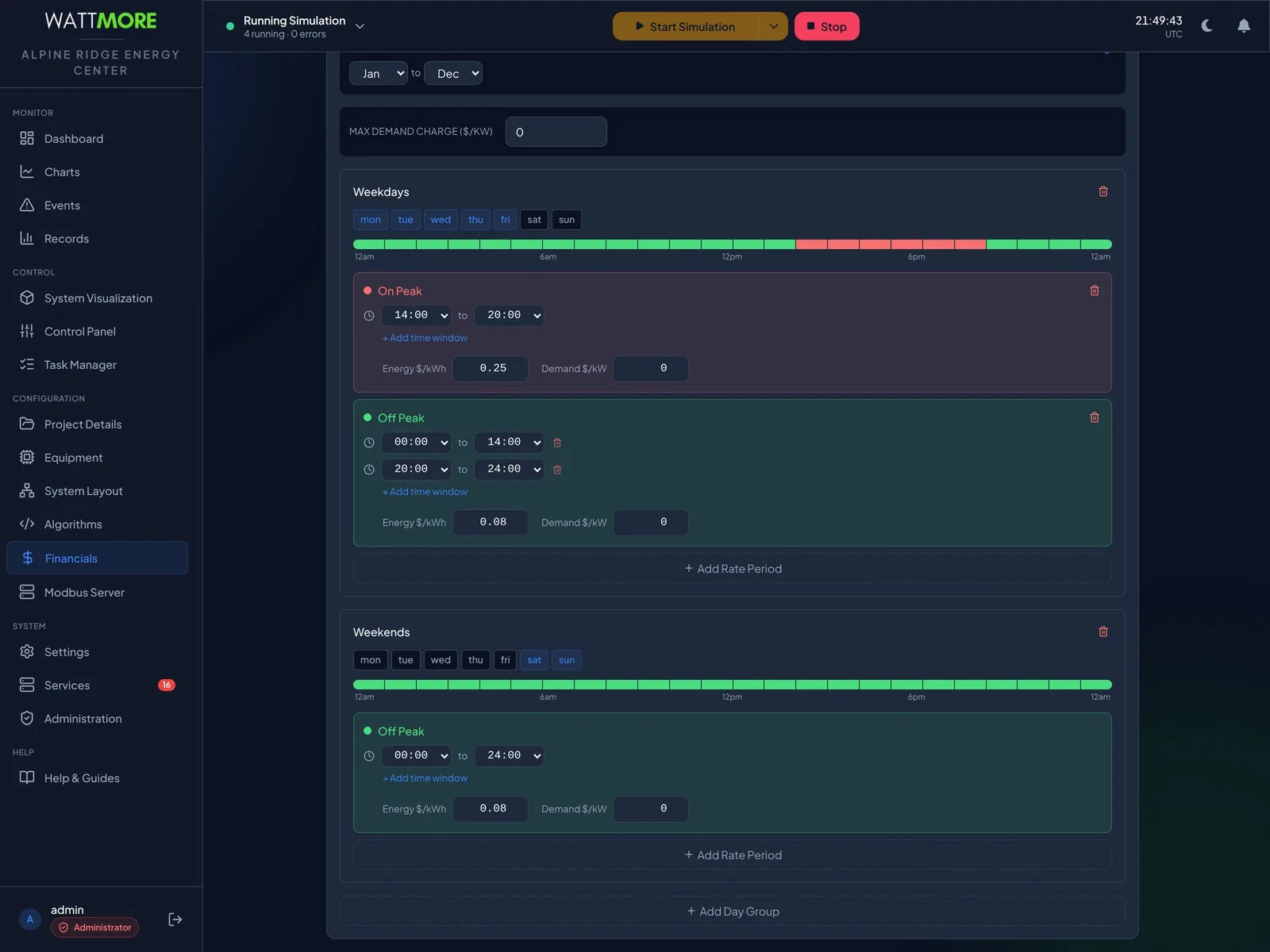
The winter shape is different because the winter peak sits in the early evening rather than the afternoon, which is why the two seasons are not copies of each other. Confirm the on peak window matches the site’s real demand peak; the tariff describes when the utility charges most, and the dispatch algorithm will move energy to meet that window.
Before saving, confirm that the twelve months are covered exactly once, June to September by Summer and the rest by Winter, and that each day group’s color bar is continuous from midnight to midnight. A month covered by no season has no time of use prices, and a month covered by two is ambiguous.
| Day group | Period | Windows | Energy, dollars per kWh | Demand, dollars per kW |
|---|---|---|---|---|
| Weekdays | Off peak | 00:00 to 17:00 and 21:00 to 24:00 | 0.0648 | 0 |
| Weekdays | On peak | 17:00 to 21:00 | 0.1563 | 19.2 |
| Weekends | Off peak | 00:00 to 24:00 | 0.0648 | 0 |
What does the tariff mean for the battery?
The spread between off peak and on peak is what a storage algorithm arbitrages. In summer at the demonstration site that spread is 0.0712 to 0.2145 dollars per kWh, roughly 0.14 dollars per kWh, against a round trip efficiency of about 92 percent from the PCS charging and discharging efficiencies of 0.96 each. Every kWh charged off peak and discharged on peak earns the spread less the efficiency loss, and every kWh of the on peak demand ceiling that the battery holds down avoids the 28.4 dollars per kW demand rate for the month.
The savings dashboard tab reports what the tariff was worth over any month the site has stored data for. A newly commissioned site has none until it has run for a while, and the tab says so rather than reporting zero.
Intellect Operate
Intellect Operate is the WATTMORE energy management system shown in these screenshots. The tariff is entered once on the Financials page, drives every dispatch algorithm on the site, and values the savings reported back to the customer.
Frequently asked questions
- What is a time of use tariff?
- A tariff structure in which the price of energy varies by time of day and by season. A typical commercial time of use tariff has an off peak rate overnight, a mid peak rate in the morning, and an on peak rate in the late afternoon and evening, with different shapes in summer and winter, and often a demand charge billed on the highest kW drawn during the on peak window.
- Why does a storage EMS need demand charges as a separate field?
- Because a demand charge is billed on the highest power drawn in a period rather than on energy consumed, and it is usually the charge a peak shaving algorithm exists to reduce. Entering the demand rate per period, and enabling demand charges at the site level, lets the EMS value each kW of avoided peak correctly and report demand savings separately from energy savings.
- What are nonbypassable charges?
- Per kWh charges that a utility applies to imported energy regardless of what the battery does, levied to recover fixed costs. They matter to dispatch because they narrow the spread between cheap and expensive hours. The EMS has a switch to include them so that arbitrage is valued on the spread the battery can actually capture.
- How do I handle a tariff whose periods change on the half hour?
- Windows are entered on whole hours, so a period that changes at 16:30 is approximated to 16:00 or 17:00. Note the approximation in the project documents so a later discrepancy against the utility bill is not mistaken for a fault.
- When does a tariff change take effect?
- On save. Algorithms use the new prices on their next cycle, and the savings reporting values stored energy at the new rates from that point on. Record the date of a utility rate change in the project documents so that a step in reported savings can be explained.
Sources
- INTELLECT EMS 4.0 Operator and Administrator Manual, Chapter 9: Financials, WATTMORE, Inc.
- Energy Storage for Electricity Generation, U.S. Energy Information Administration
- Energy Storage Handbook, Chapter 23: Applications and Grid Services, Sandia National Laboratories for the U.S. Department of Energy