Intellect OperateBattery Energy Management System and Power Plant Controller
WATTMORE's Battery Energy Management System
Intellect Operate is a battery energy management system (EMS) that decides when a battery charges, when it discharges, and how it takes part in grid services and energy markets. WATTMORE builds and deploys it for battery energy storage projects, with real time dispatch, revenue optimization, and the optional Intellect PPC add on for full grid compliance.

Intellect Operate at a glance
Intellect Operate is a battery energy management system (EMS) from WATTMORE that decides when a battery charges and discharges, follows utility and market signals, and holds the site inside its interconnection limits through a built in power plant controller. It runs on edge hardware at the site, is vendor agnostic across inverters, batteries, and meters, and reports to a cloud dashboard.
- The EMS and the power plant controller share one data bus and one control loop, so there is no second vendor to reconcile at commissioning.
- Dispatch applications: peak shaving and demand charge management, frequency regulation and spinning reserve, solar self consumption, arbitrage and time of use, backup power and islanding, virtual power plant participation, and utility dispatch with AGC response.
- SCADA integration over DNP3, Modbus RTU and TCP, and MQTT, so a utility can dispatch the battery from its own control room.
- Deployed from a 150 kW behind the meter battery in Ontario to the 12 MWh Lincoln Electric System battery in Nebraska.
- Measured in the field: a 24 percent lower billed peak at E.S. Fox, and 41.0 MWh delivered over seventeen months of unattended operation at 303 Battery in Seattle.
- Covered by five US patents on battery and energy management software.
Facts current as of .
Built to
- IEEE 2800Interconnection of inverter based resources with transmission systems
- IEEE 1547Interconnection of distributed energy resources
- SunSpec ModbusInverter, meter, and storage data model interoperability
- ModbusDevice polling over RTU and TCP
Batteries Are Dumb.
A $2M battery asset without a dynamic, predictive controller is just an expensive box that follows a schedule.
WATTMORE has the solution.
Battery discharges to reduce grid draw and lower the monthly peak.
Traditional Controllers
From large electrical equipment manufacturers
Intellect Operate
ML-POWEREDPurpose-built for revenue optimization
Real Economics: 400 kW / 800 kWh System
Click below to see the full solution
Learn how our three-tier architecture makes batteries smart
What You Get with Intellect Operate
A complete, deployed energy management system from dispatch to analytics.
Real-Time Dispatch
Control batteries, inverters, and DERs with millisecond-fast edge algorithms. Maximize value with intelligent charge/discharge strategies.
Grid Services & Market Participation
Frequency regulation, spinning reserve, peak shaving, and demand response. IEEE 1547 and UL 1741 compliant.
Revenue Optimization
Tariff-based optimization, coincident peak reduction, and market trading. Maximize ROI across all value streams.
Multi-Asset Coordination
Orchestrate solar, storage, generators, and loads as a unified system. Single control plane for complex hybrid sites.
Fleet-Wide Visibility
Single cloud dashboard with alarms, analytics, and portfolio KPIs. Monitor everything from one interface.
Warranty Compliance
Intelligent state-of-health management protects your investment and maintains manufacturer warranties.
Who Operate Serves
Developers
A bankable EMS product for project financing and interconnection agreements. Deployed and supported by WATTMORE.
Asset Managers
Actionable insights, automated reporting, and ROI tracking. Know exactly how your assets perform.
Utilities & Co-ops
Grid-stabilizing DER coordination. Flexible enough for microgrids, powerful enough for utility-scale.
Commercial & Industrial
Demand charge reduction, backup power, and resilience. Protect your operations and your bottom line.
How Intellect Operate Works
WATTMORE deploys Intellect Operate with an edge + cloud architecture for reliability and intelligence.
- 01
At the Edge
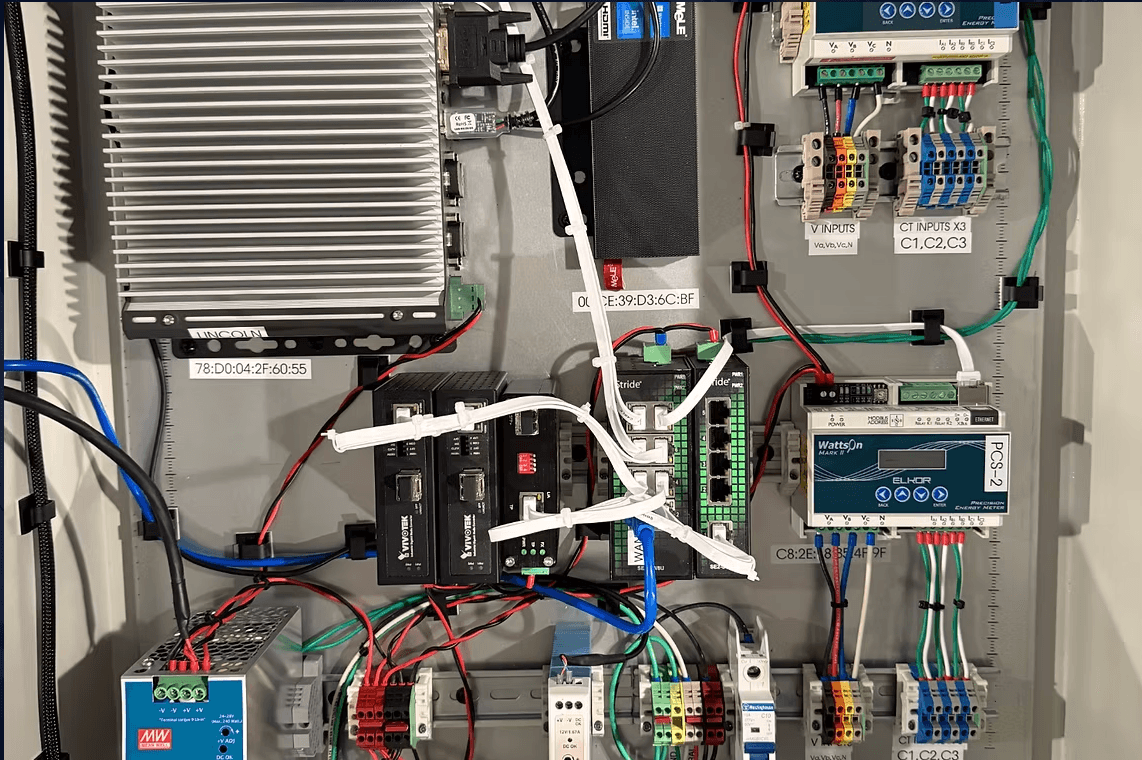
Ruggedized industrial hardware runs patented control algorithms locally, ensuring uptime during network interruptions.
- 02
In the Cloud
Fleet analytics, AI-driven insights, and centralized management for your entire portfolio.
- 03
With AI Insight
Solstice AI analyzes performance, forecasts conditions, detects anomalies, and recommends adjustments.
- 04
Device Agnostic
SMA, Dynapower, LG, Tesla; flexible register mapping supports any hardware via Modbus/MQTT.
System Architecture
Intellect Operate orchestrates your entire energy system from a single intelligent platform.
Energy Sources
Solar, Wind, Natural Gas
BESS Control
BMS, PCS, HVAC, Fire
Grid Services
Bill reduction, EV, off-grid
Cloud Analytics
Model training, monitoring
Full Capabilities
Everything you need for battery storage optimization.
Try Our EMS
Experience the Intellect Operate interface with this interactive demo.
Enterprise-Grade Architecture
Built on the same foundation as Intellect EnFORM, all monitoring features included.
Edge + Cloud Architecture
Ruggedized edge controllers ensure ultra-low latency, local autonomy, and store-and-forward resilience.
Vendor-Agnostic Integration
Native support for Modbus RTU/TCP, MQTT, HTTPS, DNP3, and REST APIs.
Real-Time + Historical Data
High-resolution logging from 1-second to 15-minute intervals.
Analytics & Insights
Weather-normalized KPIs, peer comparisons, anomaly detection, and predictive algorithms.
Security by Design
TLS 1.3 encryption and NERC-CIP/IEEE 1547 ready frameworks.
Compliance & Connectivity
DNP3 and ISO support for utility/market integration with SCADA networks and dispatch systems.
Need monitoring only? Start with Intellect EnFORM.
Learn about Intellect EnFORMFrequently Asked Questions
What is a Storage EMS or Battery Energy Management System?
A storage EMS (Energy Management System) is the brain of a battery energy storage system. It sits above the Battery Management System (BMS) and Power Conversion System (PCS) in the control hierarchy, orchestrating when and how much power flows in and out of the battery. The EMS reads real-time data from all system components, respects the safety limits published by the BMS, and sends active power commands to each PCS inverter to optimize for revenue, grid services, or demand charge reduction.
What is the difference between an EMS, BMS, and PCS?
These three systems form the control hierarchy of any battery energy storage system. The BMS (Battery Management System) is the guardian, it monitors cell voltages, temperatures, and state of charge, and publishes safe operating limits to protect the battery. The PCS (Power Conversion System) is the muscle, it converts DC power from the battery to AC power for the grid, and vice versa. The EMS (Energy Management System) is the brain, it reads the BMS limits, calculates optimal setpoints, and commands each PCS inverter. The BMS never directly controls the inverters; it only publishes what the battery can safely handle, and the EMS ensures those limits are never exceeded.
How does an EMS control the PCS inverters?
The EMS sends active power setpoint commands to each PCS inverter via Modbus TCP/IP, typically at 1-second intervals or faster. For example, if the EMS determines the system should discharge at 500 kW, it sends that setpoint to each inverter (distributed proportionally if multiple inverters are present). The PCS executes the command and reports actual power back to the EMS, completing the control loop. The EMS continuously adjusts these setpoints based on grid signals, tariff schedules, BMS limits, and optimization algorithms.
How does the EMS work with the BMS to ensure safe operation?
The BMS continuously publishes safe operating parameters, including maximum charge power, maximum discharge power, state of charge (SOC), state of health (SOH), and any active alarms. The EMS reads these limits in real-time (typically every second) and constrains all dispatch commands to stay within them. For example, if the BMS reports that maximum discharge power is 450 kW due to temperature limits, the EMS will never command the inverters above 450 kW, even if the optimization algorithm requests more. The BMS is the guardian; the EMS is the operator that respects the guardian's rules.
What happens when a utility or ISO sends a dispatch command?
When a utility, ISO, or aggregator sends a dispatch signal (via DNP3, ICCP, or API), the EMS receives the power request and validates it against current system constraints. The EMS checks BMS limits, inverter availability, SOC bounds, and any site-level constraints. It then calculates the achievable setpoint and distributes commands to each PCS inverter. The EMS reports actual delivered power back to the dispatch authority, completing the telemetry loop. This entire process happens in seconds, enabling participation in fast-response grid services like frequency regulation.
Does the BMS control the inverters?
No. The BMS does not send commands to the inverters; that is the EMS's job. The BMS is purely a monitoring and protection system for the battery cells. It publishes data (voltages, temperatures, SOC, alarms) and safe operating limits, but the EMS is responsible for reading that data and commanding the PCS inverters accordingly. In an emergency, the BMS can open contactors to protect the battery, but normal power dispatch always flows through the EMS.
What communication protocols does the EMS use?
Intellect Operate uses industry-standard protocols for all communications. For on-site equipment (BMS, PCS, meters, weather stations), we use Modbus RTU and Modbus TCP/IP. For utility and ISO dispatch, we support DNP3 and ICCP. For cloud connectivity and third-party integrations, we use MQTT, HTTPS, and REST APIs. All communications are encrypted with TLS 1.3 for security.
What should you look for in battery EMS software?
Leading battery EMS software combines vendor-agnostic hardware support, robust BMS integration, proven safety protocols, and AI-powered optimization. WATTMORE's Intellect Operate supports all major battery and inverter manufacturers, including Tesla, LG, Samsung, BYD, CATL, Dynapower, SMA, and EPC Power, via flexible protocol mapping. Our edge-cloud architecture ensures reliable operation even during network outages, while cloud analytics enable fleet-wide optimization.
Can an EMS reduce demand charges?
Yes, demand charge reduction is a core EMS capability. The EMS monitors site load in real-time and predicts when demand peaks will occur. Before the peak, the EMS commands the battery to discharge, shaving the peak and reducing the maximum demand recorded by the utility meter. Intellect Operate typically reduces demand charges by 30-50% depending on load profile and tariff structure, with some C&I customers seeing even greater savings.
What grid services can the EMS participate in?
Intellect Operate enables participation in frequency regulation, spinning reserve, demand response, capacity markets, energy arbitrage, and virtual power plant (VPP) aggregation. The EMS can stack multiple value streams simultaneously; for example, providing frequency regulation while also managing demand charges and solar self-consumption. All grid interconnection is IEEE 1547 and UL 1741 compliant.
How fast can the EMS respond to grid signals?
Intellect Operate achieves sub-second response times for grid signals. Our edge computing architecture runs control algorithms locally, eliminating cloud latency for time-critical operations. This enables participation in fast frequency response (FFR) markets and primary frequency regulation, which require response times under 2 seconds. The EMS continuously reads BMS data and adjusts PCS setpoints at 1-second intervals or faster.
What happens if the network connection is lost?
Intellect Operate uses edge computing with local algorithms that continue operating autonomously during network outages. The EMS stores all data locally and syncs to the cloud when connectivity is restored. Critical functions like demand charge management, solar self-consumption, and BMS safety monitoring continue uninterrupted. Site operators can also access the local HMI for on-site control and visibility.
How does the EMS protect battery warranty and longevity?
The EMS monitors battery state of health (SOH) and adjusts dispatch strategies to maximize asset life. It respects all BMS-published limits, avoids deep cycling when not economically justified, and can enforce custom SOC bounds to reduce degradation. Intellect Operate tracks cycle counts, throughput, and temperature excursions to ensure operations stay within manufacturer warranty requirements. Regular SOH reporting helps asset owners plan for capacity fade over time.
Can the EMS control solar and other DERs alongside storage?
Yes. Intellect Operate orchestrates solar inverters, generators, EV chargers, and controllable loads alongside battery storage. The EMS optimizes the entire site as a unified system; for example, curtailing solar when necessary for grid compliance, charging batteries from excess solar, or coordinating generator dispatch with battery storage for peak shaving. This multi-asset coordination maximizes overall site value.
Does Intellect Operate include a power plant controller?
Yes. Intellect Operate includes a fully integrated power plant controller (Intellect PPC) as part of the platform. The power plant controller handles all grid compliance functions including frequency-watt droop response, voltage and reactive power control, ramp rate limiting, and curtailment. Because the EMS and power plant controller share the same control loop, there is zero integration risk and no vendor boundary between optimization and compliance.
What is a battery energy management system for BESS?
A battery energy management system for BESS combines real-time dispatch optimization, integrated power plant controller, vendor-agnostic hardware support, and edge computing for reliability. WATTMORE's Intellect Operate is a complete battery energy management system that includes EMS, PPC, and SCADA in a single platform. It supports all major battery and inverter manufacturers and delivers sub-second response times for grid services.
Why does an energy management system need a power plant controller?
An energy management system without a power plant controller cannot operate on the grid. The EMS optimizes dispatch for revenue, but the power plant controller ensures every command meets grid compliance requirements before reaching the inverters. Utilities and ISOs require the power plant controller to enforce frequency droop, voltage regulation, and ramp rate limits per IEEE 2800. WATTMORE integrates both into Intellect Operate so the energy management system and power plant controller work as one.
What is the difference between an energy management system and SCADA?
SCADA (Supervisory Control and Data Acquisition) monitors and collects data from equipment but does not make optimization decisions. An energy management system actively controls battery dispatch in real time, deciding when to charge, discharge, and participate in grid services to maximize revenue. WATTMORE's Intellect Operate combines both; the energy management system handles optimization and control, while integrated SCADA provides monitoring, alarms, and data acquisition in a single platform.
How does an energy management system maximize revenue for battery storage?
An energy management system maximizes revenue by stacking multiple value streams simultaneously. Intellect Operate optimizes across demand charge reduction, time-of-use arbitrage, frequency regulation, spinning reserve, capacity markets, and solar self-consumption. The energy management system reads real-time price signals, load data, and weather forecasts to make optimal dispatch decisions every second. AI-powered algorithms continuously learn and improve performance over the life of the asset.
What is an energy management system for solar and storage?
An energy management system for solar and storage coordinates both solar generation and battery storage as a unified system. The energy management system decides when to store excess solar energy, when to discharge the battery for peak shaving or arbitrage, and when to curtail solar for grid compliance. WATTMORE's Intellect Operate is an energy management system purpose-built for hybrid solar-plus-storage projects, with integrated power plant controller for grid compliance.
How does an energy management system communicate with site equipment?
An energy management system communicates with batteries, inverters, meters, and other equipment using industry-standard protocols. Intellect Operate supports Modbus RTU and Modbus TCP/IP for on-site equipment, DNP3 and ICCP for utility dispatch, and MQTT and REST APIs for cloud integration. The energy management system reads data from all devices and sends optimized setpoint commands to inverters at 1-second intervals or faster, with all communications encrypted using TLS 1.3.
Further Reading
Guides on how a storage EMS works and field reports from sites Intellect Operate runs today.
- explainerWhat is a battery energy storage EMS?
- explainerEMS vs BMS vs SCADA vs PPC: who does what in a BESS
- explainerWhat is peak shaving with battery storage?
- guideWhat a battery energy management system does, and what it does not
- guideHow to choose a storage EMS for your project
- guideStorage EMS versus SCADA: where the line falls
- guideHow peak shaving with battery storage works
- case studyE.S. Fox: a 150 kW battery cutting industrial demand charges in Ontario
- case study303 Battery: seventeen months of unattended solar plus storage operation in Seattle
Ready to Optimize Your Storage?
See how Intellect Operate can maximize revenue from your battery assets.