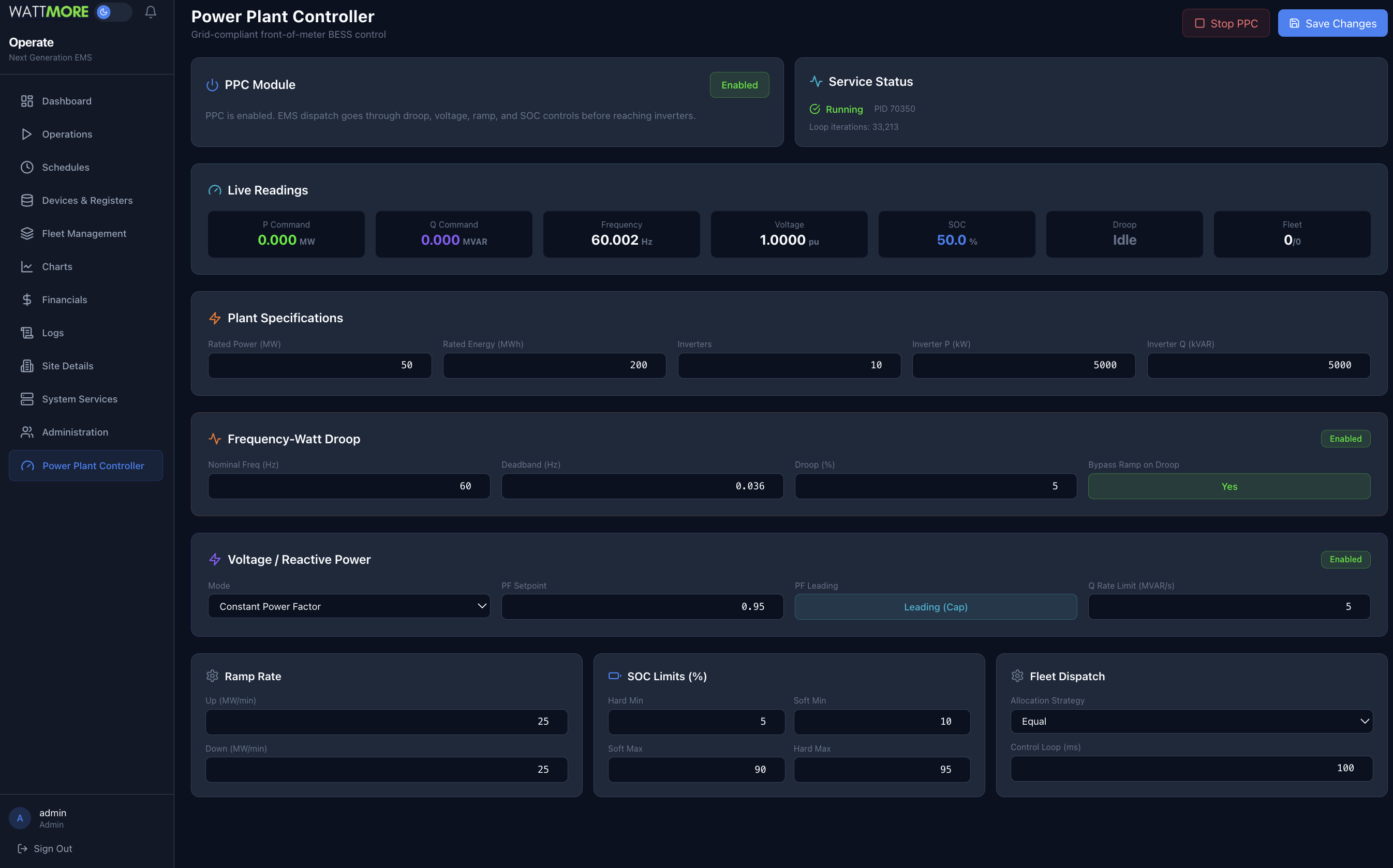
Every utility scale battery energy storage system must pass interconnection studies before it can connect to the grid. Those studies run on two industry standard simulation platforms: PSCAD and PSS/E. If your EMS and Power Plant Controller provider does not have validated models in both platforms, your project is carrying unnecessary risk, unnecessary cost, and unnecessary delay. WATTMORE has these models. Most competitors do not.
What Is PSCAD?
PSCAD (Power Systems Computer Aided Design) is the world's leading electromagnetic transient (EMT) simulation software, developed by Manitoba Hydro International. It simulates time domain instantaneous responses of electrical systems at microsecond resolution. PSCAD captures fast switching events, inverter control loop dynamics, fault ride through behavior, and sub synchronous interactions that no other simulation approach can accurately model.
PSCAD is the gold standard for EMT studies. It is the most required and most recommended EMT simulation tool across every major ISO and utility in North America. When a utility needs to verify how your battery plant will behave during a fault, a frequency excursion, or a voltage transient, they run that analysis in PSCAD.
What Is PSS/E?
PSS/E (Power System Simulator for Engineering) is Siemens' industry leading transmission planning and analysis software, used in over 140 countries. PSS/E performs steady state power flow analysis, dynamic transient stability simulation, short circuit and contingency analysis, and voltage stability studies. It operates in the phasor domain, capturing electromechanical dynamics over timescales of seconds to tens of seconds.
PSS/E is the standard platform for system wide power flow and stability screening during the interconnection process. Every ISO and most utilities run their transmission planning studies in PSS/E. Your project's behavior must be accurately represented in their PSS/E base case models.
Why Utilities Require Both Models
PSS/E and PSCAD are complementary. PSS/E captures the big picture of system wide stability and power flow at lower computational cost. PSCAD captures the detailed, fast acting dynamics that PSS/E's positive sequence approximation cannot see. Utilities need both to fully validate that your plant will operate safely and reliably under all grid conditions.
FERC Order 2023 now requires interconnection customers with nonsynchronous generating facilities to submit a validated user defined RMS positive sequence dynamic model, a parameterized generic library RMS model, and a validated EMT model if the transmission provider performs an EMT study. NERC reliability standards PRC-028-1 and PRC-029-1 are adding additional mandatory modeling and performance requirements for inverter based resources. IEEE 2800 establishes the baseline technical requirements that these models must demonstrate compliance with.
Every major ISO is formalizing these requirements. CAISO requires EMT models in PSCAD format for projects at the point of interconnection. ERCOT has formalized PSCAD model submittal guidelines. MISO requires four model types including PSS/E and PSCAD with requirements expected to be effective in 2026. PJM, SPP, and ISO-NE all have their own dynamic model development guidelines. The direction is clear: EMT model requirements are becoming universal, not optional.
What WATTMORE's Models Actually Contain
WATTMORE's PSCAD model of Intellect PPC is not a simplified approximation. It is an exact replica of the physical power plant controller. It has the same number of inputs, the same outputs, and runs the same control logic and equations as the actual device. The model demonstrates step changes to real and reactive power, step changes to positive and negative power factors, voltage regulation behavior, and frequency regulation response. It is plug and play compatible with any inverter or converter manufacturer's equipment model.
WATTMORE's PSS/E models include both generic standard library models and User Defined Models (UDMs) to represent Intellect PPC's behavior in steady state power flow and transient stability simulations. UDMs require custom coding and must be recompiled with each new software version. Both model types accurately capture Intellect PPC's control behavior across the full range of operating conditions defined by the interconnection agreement.
Both models go through rigorous validation processes defined independently by each ISO. The validation includes step response tests, fault response tests, and comparison against field measurements from the actual commissioned system. A model that fails validation can halt your interconnection process. WATTMORE's models have been built to survive this scrutiny.
Why Having These Models Matters for Your Project
Approximately 2,300 GW of generation and storage capacity across over 10,000 projects are actively seeking grid interconnection in the United States. The median time from initial request to commercial operation has doubled to over four years. Only 13% of capacity that submitted interconnection requests from 2000 to 2019 had reached commercial operations by the end of 2024.
In this environment, any delay caused by missing or rejected simulation models can be catastrophic to project economics. Developers who show up to interconnection studies with pre-validated PSCAD and PSS/E models from their Power Plant Controller vendor move through the process faster. Developers who discover mid-study that their Power Plant Controller vendor cannot provide these models face weeks or months of delay while scrambling to build them from scratch or hire third party consultants.
When you select WATTMORE's Intellect PPC, you get a vendor that has already built and validated these models. Your interconnection study package arrives complete. Your utility sees a Power Plant Controller vendor that has done the engineering work upfront. Your project timeline stays on track.
The Investment Behind These Models
Building validated PSCAD and PSS/E models is not trivial. It requires substantial investment across multiple dimensions.
The software itself is expensive. PSCAD licenses from Manitoba Hydro International and PSS/E licenses from Siemens represent significant annual costs. Both platforms require additional modules and add-ons for full capability. Companies serious about this work also invest in RTDS (Real Time Digital Simulator) hardware for hardware in the loop validation.
The engineering talent is specialized and scarce. Power systems engineers with PSCAD and PSS/E modeling expertise command salaries well above $150,000 per year. These engineers typically hold advanced degrees in power systems and require years of experience with electromagnetic transient phenomena, control theory, power electronics, and the specific requirements of each ISO and utility. The talent pool is small and the demand is high.
The development effort is substantial. A PSCAD Power Plant Controller model must replicate the exact control code and equations of the physical device. This is not a weekend project. It requires deep collaboration between controls engineers, power systems engineers, and simulation specialists. The model must then survive rigorous validation testing defined by each ISO, which often involves multiple rounds of iteration.
WATTMORE has made this investment. We have the software, the engineering team, the mathematical foundation, and the validated models. This is not a capability we plan to build someday. It exists today.
What This Says About WATTMORE
Any company can build a dashboard. Any company can write a dispatch algorithm. Building validated PSCAD and PSS/E models of your power plant controller demonstrates something fundamentally different about the depth of your engineering capability.
It means WATTMORE understands Intellect PPC at the deepest technical level, down to the exact control equations and switching dynamics. It means our product has been subjected to rigorous third party scrutiny by utilities and ISOs. It means we have invested in the specialized talent, the industry standard software, and the iterative validation process that most EMS and Power Plant Controller providers have not.
For project developers evaluating Power Plant Controller vendors, a vendor with validated simulation models represents reduced interconnection risk, which directly impacts project bankability and financing. Clean, utility accepted technical packages improve investor confidence during acquisition due diligence. Faster interconnection approvals translate directly to earlier revenue.
WATTMORE's Intellect PPC is not just a controller that runs on a server. It is a fully modeled, utility validated, grid compliant power plant controller backed by the same simulation tools that utilities themselves use to plan and operate the grid.
Explore Intellect PPC or contact WATTMORE to learn more about our PSCAD and PSS/E models and how they accelerate your interconnection process.