Every utility-scale battery energy storage system (BESS) that connects to the grid needs a power plant controller. This is not optional. Without a power plant controller, your project will not pass interconnection studies, will not receive permission to operate, and will not be allowed to inject or absorb power on the transmission or distribution system.
Yet many developers and asset owners still treat the power plant controller as an afterthought, something to figure out late in the project timeline. This is a costly mistake. The power plant controller is a core piece of infrastructure that determines whether your BESS project can actually operate on the grid, and how well it performs once it does.
What Is a Power Plant Controller?
A power plant controller, often abbreviated PPC, is a real-time control system that sits between the grid operator and the individual power conversion equipment at a generation or storage facility. The power plant controller receives setpoints and commands from the utility or ISO, and translates those into coordinated control actions across all inverters, transformers, and auxiliary equipment at the plant.
For a battery energy storage system, the power plant controller manages the aggregate behavior of the entire facility at the point of interconnection (POI). It ensures that the plant responds correctly to grid signals, maintains voltage and frequency within prescribed limits, and complies with the interconnection agreement and applicable grid codes.
Think of the power plant controller as the single point of accountability between your facility and the grid. The utility does not communicate with individual inverters. It communicates with the power plant controller, and the power plant controller coordinates everything downstream.
Why a Power Plant Controller Is Required for Interconnection
No utility or ISO in North America will grant interconnection approval to a BESS project without a compliant power plant controller. The interconnection process requires detailed documentation of how the facility will respond to grid events, curtailment signals, voltage references, and frequency deviations. All of these responses are implemented by the power plant controller.
During the interconnection study process, utilities run power flow and dynamic simulations to verify that your facility will not destabilize the grid. These simulations require validated models of your power plant controller, typically built in PSCAD for electromagnetic transient studies and PSS/E for positive-sequence dynamic studies. If you cannot provide these models, your interconnection application stalls.
The power plant controller is also the device that undergoes commissioning testing at the site. Utilities send test signals and verify that the plant responds within the tolerances specified in the interconnection agreement. A power plant controller that fails commissioning testing delays your commercial operation date, which directly impacts revenue and financing obligations.
How a Power Plant Controller Differs from an Energy Management System
This is one of the most common points of confusion in the BESS industry. A power plant controller and an energy management system (EMS) are not the same thing, even though some vendors blur the line between them.
The energy management system is responsible for economic optimization. It decides when to charge, when to discharge, how to stack revenue streams, and how to manage battery health over the project lifetime. The EMS operates on a timescale of minutes to hours, making decisions based on market prices, forecasts, and contractual obligations.
The power plant controller operates on a much faster timescale, typically milliseconds to seconds. It is responsible for real-time grid compliance: maintaining voltage at the POI, responding to frequency events, limiting ramp rates, and executing curtailment commands from the grid operator. The power plant controller does not care about revenue optimization. It cares about keeping the plant compliant with grid requirements at every instant.
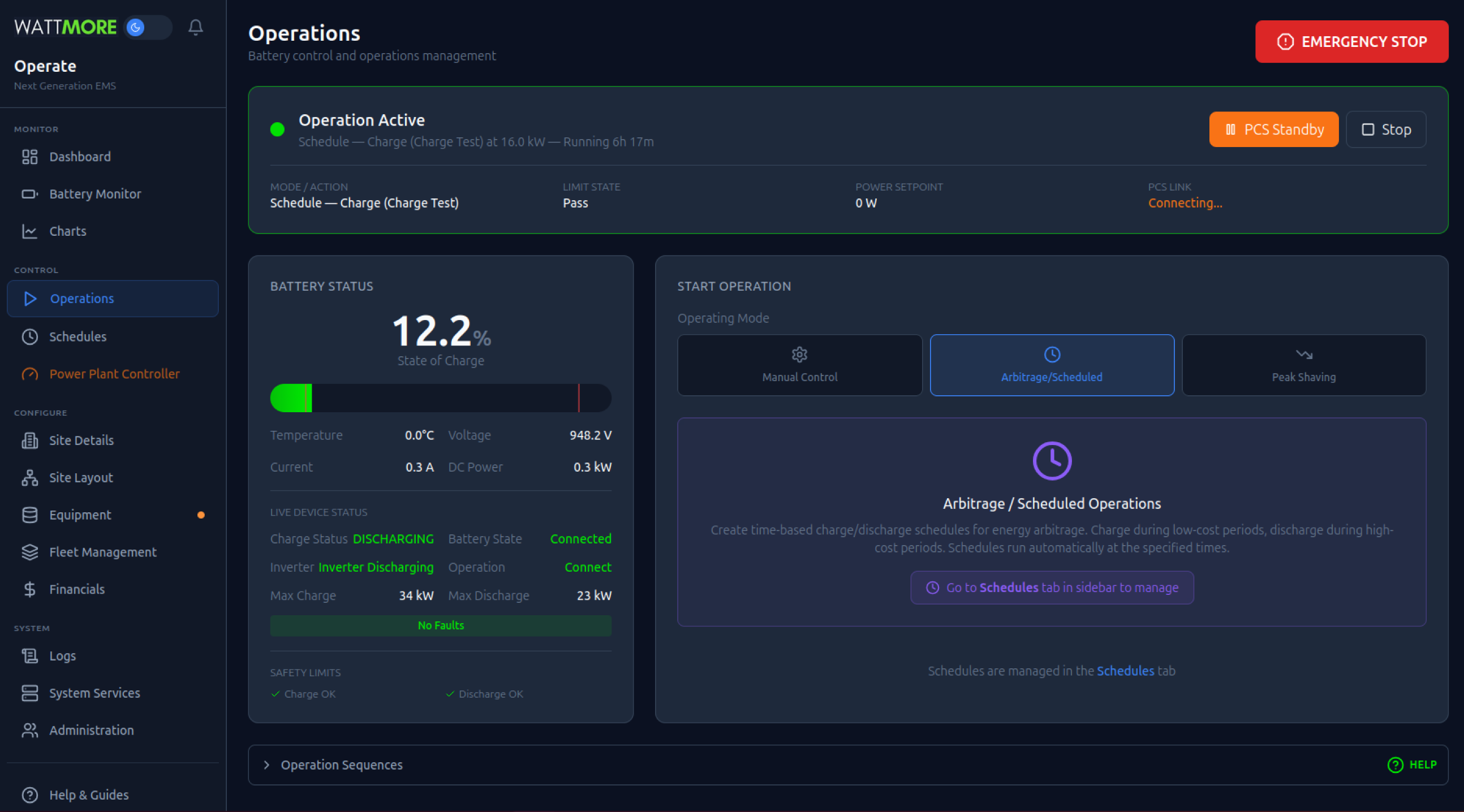
In a well-designed system, the EMS sends dispatch targets to the power plant controller, and the power plant controller executes those targets while ensuring grid compliance at all times. The power plant controller has authority to override EMS commands if doing so is necessary to maintain grid stability or comply with utility directives. Learn more about this relationship on our Intellect Operate platform page.
Key Functions of a Power Plant Controller
Active Power Control and Ramp Rate Limiting
The power plant controller manages the total active power output of the facility. It distributes power setpoints across individual inverters and enforces ramp rate limits to prevent sudden changes in power output that could destabilize the grid. Most interconnection agreements specify maximum ramp rates in megawatts per minute, and the power plant controller ensures these limits are never exceeded, regardless of what the EMS requests.
Frequency Droop Response
When grid frequency deviates from nominal (60 Hz in North America), the power plant controller adjusts the facility's active power output according to a configurable droop curve. This is a fundamental grid support function that helps maintain system frequency stability. The droop settings, including deadband, droop percentage, and response time, are specified in the interconnection agreement and implemented in the power plant controller.
Voltage and Reactive Power Regulation
The power plant controller regulates voltage at the point of interconnection by controlling reactive power output across all inverters. It supports multiple control modes including voltage regulation, power factor control, and reactive power setpoint mode. The utility specifies which mode to use and the power plant controller maintains the required voltage or reactive power output continuously.
Curtailment and AGC Response
Grid operators issue curtailment commands and automatic generation control (AGC) signals that the power plant controller must execute promptly and accurately. The power plant controller receives these signals via communication protocols such as DNP3 or ICCP and translates them into coordinated inverter commands within the required response time.
Fault Ride-Through Coordination
During grid faults, the power plant controller coordinates the response of all inverters to maintain connection to the grid and provide reactive current injection as required by grid codes. This fault ride-through capability is critical for maintaining grid stability during disturbances and is a mandatory requirement under IEEE 2800 and most interconnection agreements.
IEEE 2800 and Modern Power Plant Controller Requirements
IEEE 2800, the Standard for Interconnection and Interoperability of Inverter-Based Resources, has significantly raised the bar for power plant controller functionality. Published in 2022 and increasingly adopted by utilities and ISOs across North America, IEEE 2800 establishes detailed performance requirements for inverter-based resources including BESS.
Key IEEE 2800 requirements that directly impact power plant controller design include:
- Voltage ride-through - The power plant controller must coordinate inverter responses during voltage excursions to maintain continuous operation within specified voltage and time envelopes.
- Frequency ride-through - Similar requirements for frequency excursions, with the power plant controller managing active power adjustments during off-nominal frequency conditions.
- Rate of change of frequency (RoCoF) ride-through - The power plant controller must maintain operation during rapid frequency changes that can occur during large generation or load loss events.
- Reactive current injection during faults - The power plant controller must coordinate fast reactive current injection from all inverters during voltage dips, with specific requirements for response time and magnitude.
- Power quality - The power plant controller must ensure total harmonic distortion at the POI remains within specified limits under all operating conditions.
Meeting these requirements demands a power plant controller with fast, deterministic control loops, validated simulation models, and extensive commissioning test procedures. This is not something you can bolt on at the end of a project.
Why WATTMORE Integrates the Power Plant Controller into Intellect Operate
Most BESS projects today use a power plant controller from one vendor and an energy management system from another. This creates an integration boundary that introduces latency, communication failures, and finger-pointing when something goes wrong.
WATTMORE takes a different approach. Our Intellect PPC power plant controller is fully integrated with Intellect Operate, our energy management system. Both run on the same platform, share the same data layer, and are maintained by the same engineering team. This eliminates the integration risk that plagues multi-vendor architectures.
The benefits of this integrated approach are significant:
- Zero integration risk - No protocol translation or middleware between the EMS and power plant controller. They share native data structures and communicate internally with sub-millisecond latency.
- Single point of accountability - When a grid compliance issue arises, there is no ambiguity about which vendor is responsible. WATTMORE owns both the optimization and the compliance layer.
- Coordinated optimization - Because the EMS understands the power plant controller constraints natively, it can optimize dispatch without requesting setpoints that the power plant controller will override. This reduces curtailment losses and improves revenue capture.
- Faster commissioning - Integrated systems require fewer commissioning test iterations because the EMS and power plant controller are pre-validated together before deployment.
- Validated simulation models - WATTMORE provides PSCAD and PSS/E models of the Intellect PPC that have been validated against utility requirements, accelerating your interconnection study process.
Choosing the Right Power Plant Controller for Your BESS Project
When evaluating power plant controller vendors, ask these questions:
- Does the power plant controller have validated PSCAD and PSS/E models accepted by major utilities and ISOs?
- Does the vendor have experience commissioning power plant controllers at utility-scale BESS facilities?
- Does the power plant controller meet IEEE 2800 requirements?
- How does the power plant controller integrate with your energy management system?
- What is the vendor's track record for interconnection approval timelines?
The power plant controller is not a commodity component. It is a critical system that determines whether your project can connect to the grid and operate reliably for its entire economic life. Choose a vendor that treats it with the engineering rigor it deserves.
Learn more about Intellect PPC or contact WATTMORE to discuss your project's power plant controller requirements.